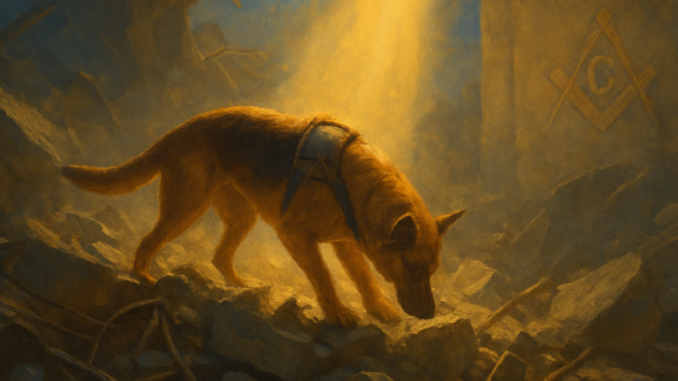
A search dog picks its way through the rubble of an exploded building in Amsterdam. The footage circulated across the Netherlands this past week, drawing millions of eyes. But for those willing to look beyond the headlines, the images reveal something far more profound than breaking news: a creature moving without hesitation toward what has been lost. In that unconditional devotion lies a lesson Freemasons have been trying to understand for centuries — what does it truly mean to show up for another person?
Searching Without Knowing What You Will Find
The search dog knows no doubt. It follows its nose, trusts its training, and surrenders completely to the task at hand. Whether the search will lead to a living person, a body, or nothing but emptiness — the animal does not know. And yet it searches. This posture of unconditional action without any guarantee of results strikes at one of the core paradoxes of human connection. We humans hesitate because we cannot see the outcome. The dog reminds us that true devotion needs no certainty.
In Freemasonry, we speak of the search for light — a symbolic journey toward insight and truth. But just like the search dog, the seeking person rarely knows in advance what he will encounter. It is the willingness to keep searching, even when the path is uncertain, that defines the true seeker. Brotherhood does not begin with finding — it begins with the choice to search together.
Loyalty as the Foundation of Connection
What makes the bond between a search dog and its handler so remarkable? It is a mutual loyalty that rests on no conditions. The dog does not ask for a reward before it begins. The handler does not question the commitment of his companion. This trust is not naive — it has been forged through shared experience, through moments of failure and success, through endless practice carried out in silence.
Brotherhood is not a contract. It is a promise you renew every day through your actions.
This idea resonates powerfully with the Masonic understanding of brotherhood. You do not choose a brother or sister based on what they can offer you. The bond arises through shared values, through the willingness to stand beside someone even when circumstances are difficult. Just as the search dog and its handler form a team in the face of the unknown, so do brethren form a chain that does not break when life leaves rubble in its wake.
The Art of Being Truly Present
What stands out most in the Amsterdam footage is the absolute concentration of the search dog. There is no distraction, no half-heartedness. The animal is entirely present in the moment, every sense directed toward a single purpose: finding whoever needs to be found. In our age of fractured attention and digital noise, this kind of presence has become rare.
Freemasons practice what we might call focused attention. During lodge meetings, the outside world is literally shut out. Phones disappear, daily concerns are set aside for a time. This ritual of presence is not an escape from reality — it is an exercise in deeper connection. Because whoever is truly present for another person, whoever listens and observes with full attention, builds brotherhood at the most fundamental level.
Rubble as a Metaphor for Life
Every person knows moments when life seems to lie in ruins. A loss, a setback, an unexpected turn that sweeps away every certainty. It is in these moments that the true nature of connection reveals itself. Are there people who come to you, even when the landscape has become unrecognizable? Are there hands that help you search, even without knowing what they will find?
The search dog does not judge how the rubble came to be. It does not ask whether the help is deserved. It simply comes because it was called. This may be the very essence of brotherhood: the willingness to come when you are called, without judgment, without conditions. It is an ideal that is not easy to achieve. People are more complicated than dogs — burdened with ego, with fear, with self-interest. But the ideal remains valuable precisely because it challenges us to rise above ourselves.
From Instinct to Conscious Choice
There is an essential difference between the loyalty of a search dog and the brotherhood between human beings. The dog acts largely from instinct and training. A person must choose — every single time. This choice makes human connection both more fragile and more valuable. Whoever chooses to be there for another, whoever consciously steps into the rubble of someone else’s life, gives something that no instinct can provide.
Freemasonry offers a framework within which this conscious choice can be practiced. Not through rules or dogma, but through regular meeting, through rituals that focus the mind, through conversations that reach beyond the superficial. It is a workshop for the soul, where brotherhood is not given but must be built, again and again.
The Silent Lesson of the Animal
Perhaps the deepest lesson the search dog teaches us is the lesson of silence. The animal does not bark for attention, does not boast about its discoveries, does not demand recognition. It works in service, invisible until the work is done. In a world that screams for visibility, this quiet devotion is a radical act. Brotherhood that does not need to be seen — but that is simply there when it matters most.
The images of the search dog in Amsterdam will fade from the news quickly, overshadowed by the next crisis, the next scandal. But whoever pauses to reflect on what we actually witnessed will discover an ancient truth. Real connection does not reveal itself in grand words or public gestures, but in the quiet willingness to search through another person’s rubble. It is a lesson that can be learned anew every day — by humans and animals, by brothers and sisters, by anyone with the courage to be present when life demands it.
Copyright text & image: devrijmetselaar.nl
Texts are based on the ideas and content of the author of devrijmetselaar.nl, reviewed, corrected, and supplemented with the assistance of OpenAI. Images are created based on the ideas of the author of devrijmetselaar.nl using OpenAI/DALL-E.
Frequently Asked Questions
What does Freemasonry mean by 'the search for light'?
In Freemasonry, 'the search for light' is a symbolic journey toward insight, truth, and self-improvement. Like the search dog in the article, Masons undertake this quest without guaranteed outcomes, understanding that true brotherhood is found in the willingness to search together rather than in certainty of results. It represents the commitment to continuous learning and spiritual growth throughout one's life.
How does Freemasonry define brotherhood?
Masonic brotherhood is not a contract or transaction, but a lifelong promise renewed daily through actions and mutual loyalty. It is built on shared values and the unwavering commitment to stand beside fellow members through both triumphs and difficulties. True brotherhood requires no conditions and is forged through shared experience, trust, and dedication—much like the bond between a search dog and its handler.
What is the significance of presence and focus in Freemasonry?
Freemasons practice focused attention as a core part of their experience, particularly during lodge meetings where the outside world is intentionally set aside. This ritual of presence allows members to concentrate fully on their shared values and connections without distraction. In our modern age of digital noise, this deliberate practice of being truly present strengthens the bonds of brotherhood and deepens the Masonic experience.
Why does Freemasonry emphasize unconditional commitment?
Freemasonry recognizes that meaningful human connection requires the willingness to show up for others without needing to see guaranteed results first. Like the search dog that moves through rubble without knowing what it will find, Masons understand that true devotion does not depend on certainty or reward. This unconditional commitment to brotherhood creates stronger bonds and reflects the organization's core values of service and mutual support.



Be the first to comment