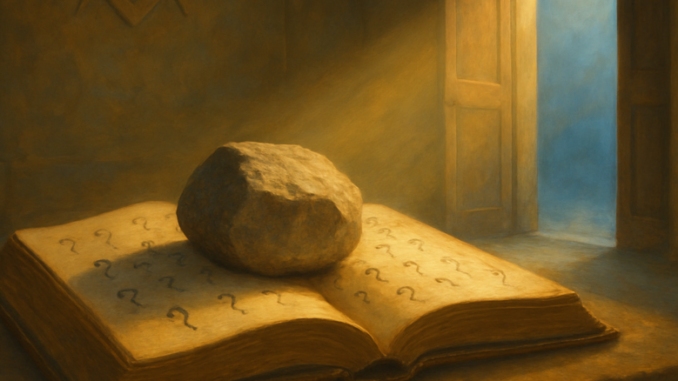
Agnosticism is often mistaken for indifference or an inability to make up one’s mind, but nothing could be further from the truth. It is a deliberate philosophical stance — one that acknowledges certain questions may never be definitively answered. For the Freemason, who is constantly rearranging the building blocks of his inner life, this attitude offers remarkably fertile ground. The answer is not what matters most; what matters is the courage to keep asking the question.
The Origins of Agnosticism
The term “agnostic” was coined in the nineteenth century by British scientist Thomas Henry Huxley, who sought to express the idea that certain metaphysical truths lie beyond the reach of human knowledge. The Greek prefix “a” means “without,” and “gnosis” means “knowledge” — literally, without knowledge. But this bare translation fails to capture the richness of the concept. Agnosticism is not intellectual laziness; it is a sincere recognition of the limits of human understanding.
Throughout the centuries, countless thinkers have wrestled with the question of what we can truly know about the transcendent, about the origins of existence, about what lies behind the veil of observable reality. The agnostic position refuses to answer these questions with certainties that cannot be substantiated. In doing so, it places itself squarely between the certainty of belief and the equal certainty of disbelief.
Agnosticism and the Philosophy of Seeking
Philosophy, in its purest form, is not the accumulation of answers but the refinement of questions. The agnostic thinker shares with the philosopher a fundamental curiosity about the unknown, without the urge to prematurely fill that unknown with assumptions. This stance requires courage, because in a world that craves certainty, suspending judgment is often far more difficult than simply picking a side.
Freemasonry has a long tradition of philosophical inquiry in which asking questions takes precedence over finding definitive answers. In the lodge, Masons work with symbols that are inherently multivalent. The square and compasses, the rough and perfect ashlar — these invite interpretation, not dogma. This symbolic language aligns seamlessly with an agnostic disposition that values openness over closed-mindedness.
The Agnostic Freemason: Doubt as a Virtue
Within Freemasonry, people from widely diverse philosophical and spiritual backgrounds come together. What unites them is not a shared creed but a shared willingness to reflect and to examine themselves. The agnostic attitude fits beautifully here because it excludes no one and invites everyone. Those who acknowledge that absolute knowledge of the transcendent is unattainable can listen to the perspectives of others with a genuinely open mind.
True wisdom begins with the recognition of one’s own ignorance.
This idea, articulated as far back as classical antiquity, resonates deeply with both the agnostic and the Masonic tradition. The Freemason sees himself as a rough stone in perpetual need of refinement. That work is not accomplished by adopting ready-made truths but by living through doubt, examining assumptions, and sharpening one’s own thinking. In the lodge, this process is communal — Brothers challenge each other not with answers but with ever-better questions.
Wonder as a Starting Point
Where certainty often leads to stagnation, wonder is the engine of movement. The agnostic mindset keeps wonder alive. It refuses to solve the mystery by reducing it to a formula or a dogma. Instead, it continues to gaze with astonishment at the complexity of existence, the beauty of the cosmos, and the depths of human consciousness.
For the Freemason, this wonder is not a casual aesthetic pleasure but an ethical imperative. Those who remain in a state of wonder also remain humble. And humility is a precondition for genuine brotherhood — for the ability to live alongside people who hold different convictions. The agnostic attitude thus nurtures not only personal growth but also social tolerance, a principle at the very heart of the Craft.
Not Knowing as the Gateway to Knowledge
Paradoxically, acknowledging ignorance can open the door to deeper insight. Those who believe they already know everything stop learning. Those who have the courage to say “I don’t know” create space for new perspectives. In the philosophical tradition, this is sometimes called “learned ignorance” — a consciously chosen position of openness that keeps thought in motion.
Consider what this means in practice:
- Agnosticism invites intellectual humility.
- Doubt can become a wellspring of personal growth.
- Suspending judgment fosters tolerance and understanding.
- Wonder keeps the mind alive and receptive to new truths.
The Freemason who embraces this attitude discovers that building the inner temple is not a project with a completion date. It is a lifelong journey in which every acquired certainty can be re-examined, every stone weighed and placed anew. The agnostic disposition is not an obstacle on the path — it is the path itself.
Agnosticism is not a destination but a point of departure. It is the recognition that the deepest questions of existence cannot be captured in final answers — and that their true value lies in the seeking itself. For the Freemason, who is well versed in the art of symbolic thinking and fraternal fellowship, this attitude offers an endlessly fertile ground. In doubt lies not weakness but the seed of wisdom. And in the question that remains unanswered, there sometimes glimmers the purest light.
Copyright text & image: devrijmetselaar.nl
Texts are based on the ideas and content of the author of devrijmetselaar.nl, reviewed, corrected, and supplemented with the assistance of OpenAI. Images are created based on the ideas of the author of devrijmetselaar.nl using OpenAI/DALL-E.
Frequently Asked Questions
Is Freemasonry a religion, and can agnostics be Masons?
Freemasonry is not a religion but a philosophical organization that welcomes men of all faiths and philosophical perspectives, including agnostics. The Masonic tradition values the courage to ask meaningful questions about existence and meaning, which aligns naturally with an agnostic approach to seeking truth. What unites Masons is not a shared creed but a shared commitment to self-reflection and mutual respect.
What does agnosticism actually mean, and why is it misunderstood?
Agnosticism, derived from the Greek words 'a' (without) and 'gnosis' (knowledge), is a deliberate philosophical stance acknowledging that certain metaphysical truths may lie beyond human understanding—not intellectual laziness or indecision. It is positioned between the certainty of belief and the certainty of disbelief, requiring genuine courage to suspend judgment in a world that craves definitive answers. This thoughtful approach actually demonstrates deep engagement with life's biggest questions rather than avoidance of them.
How does Freemasonry use symbols, and why do they appeal to agnostic thinkers?
Freemasonry employs multivalent symbols like the square and compasses and the rough and perfect ashlar that invite personal interpretation rather than dogmatic doctrine. These symbols align perfectly with an agnostic disposition because they encourage open-minded exploration and individual meaning-making rather than demanding acceptance of fixed truths. This symbolic approach allows Masons of different worldviews to find common ground in their shared pursuit of self-improvement and wisdom.
Is doubt considered negative in Freemasonry?
In Freemasonry, doubt and questioning are valued as virtues rather than weaknesses, reflecting the organization's deep philosophical tradition. True wisdom begins with recognizing the limits of one's own knowledge, a principle echoing back to classical antiquity and central to Masonic teaching. The willingness to examine oneself honestly and remain open to new understanding is what unites Masons across diverse backgrounds and belief systems.


Be the first to comment