In a world increasingly driven by superficiality and snap judgments, many of us long for something deeper. For integrity. For authenticity. For a way to grow — not just in knowledge, but in character. This is where Freemasonry enters the picture: an ancient system that doesn’t just offer philosophical insights, but actively invites you to put them into practice. And nowhere is that invitation more powerful than in the realm of ethics.
What Does Ethics Mean in Freemasonry?
Ethics in Freemasonry is not a rigid set of rules or dogmas. It functions as a living compass — an inner guide that is continually sharpened through self-reflection, ritual, and fraternal interaction. You don’t learn a standard answer to what is “good.” Instead, you learn to ask yourself the right questions: What are my true intentions? What is my responsibility? How can I contribute to the greater good — in my community, my work, my relationships?
Freemasonry invites you to see ethics not as abstract theory, but as something you experience, apply, and develop in your daily life.
Ethics Begins with Yourself
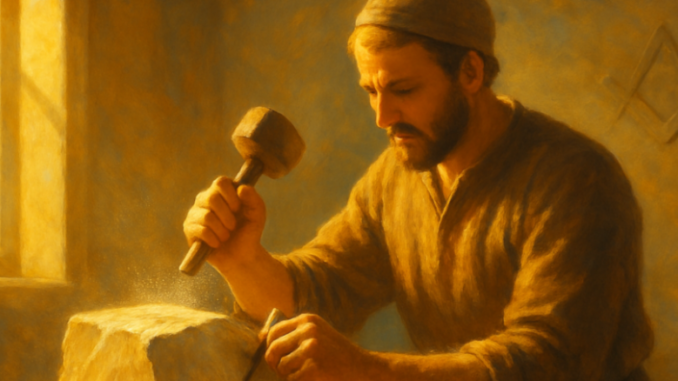
Freemasons work with a powerful symbol: the rough ashlar. This unworked stone represents your unrefined self — full of potential, but also full of rough edges, imperfections, and blind spots. Ethics within Freemasonry means having the courage to work on that stone. Not to become perfect, but to become authentic. To bring your actions into alignment with who you truly are — or who you aspire to be.
This kind of personal ethics requires discipline. Not the kind that punishes or constrains, but the kind that invites you to take yourself more seriously than you ever have before. Understood this way, ethics is not a burden — it’s a form of freedom: the freedom to consciously choose what feels right and true.
Symbolism and Ritual as Ethical Training Grounds
One of the most distinctive aspects of Freemasonry is that ethics isn’t merely discussed — it’s actively practiced. Rituals serve as a powerful instrument for this purpose. They invite you to pause, step away from the noise of everyday life, and reflect on a deeper level about who you are and how you act. The symbols found in the lodge — the compass, the square, the gavel, and the chisel — are each invitations to examine your moral choices with care and intention.
Ethical Living Is a Verb
Freemasonry is not about preaching — it’s about practice. You learn to give shape to your ideals through concrete actions. Consider the following principles:
Honesty: Do you say what you truly think, even when it’s difficult?
Responsibility: Do you take ownership of your words and actions?
Respect: Do you treat others the way you wish to be treated — even when you disagree?
Inside the lodge, you practice these principles in a safe and supportive environment. But the real test takes place outside the lodge — in your workplace, your family life, your friendships, and your everyday choices. Freemasonry doesn’t offer an ethics of fine words. It offers an ethics of action.
Brotherhood as a Moral Mirror
A unique dimension of Freemasonry is the concept of brotherhood. In a lodge, you are never alone. You share your journey with others who, like you, seek to grow. You learn from one another, hold up mirrors for each other, and challenge one another to be better. This interaction is not casual friendship — it’s a moral bond. On your own, it’s easy to get lost in your blind spots. Together, you can grow through honesty and mutual support.
Ethics Without Dogma
Freemasonry prescribes nothing. There is no holy text, no central authority, no required belief system. There is only the invitation to reflect and to grow. This is precisely what makes the Masonic path accessible to people of all convictions — humanists and Christians, agnostics and Buddhists alike. Because while ethics is universal, it must always be shaped personally.
Freemasonry as a Way of Life
Freemasonry helps you shift from being a passive observer of the world to an active participant in it. That transformation begins with yourself: your thoughts, your attitudes, your choices. But it doesn’t end there. Because someone who lives ethically inevitably influences the people around them. You become a source of inspiration — not by preaching, but simply by doing.
The result? A world in which people take more responsibility. Listen more. Judge less. Where ethics doesn’t live in words alone, but in deeds.
What Does This Mean for You?
Perhaps you’ve felt for some time that there’s more inside you waiting to emerge. That you’re no longer satisfied with superficiality, quick judgments, or automatic patterns of behavior. That you want to grow — truly grow. Freemasonry offers a path that supports you in that journey. Not a crash course in ethics, but a lifelong voyage of discovery. Not a wagging finger, but an open invitation.
And perhaps that’s exactly what you’ve been looking for: a place where you can practice becoming better. A community that supports you, challenges you, and inspires you. A path that gives you direction without limiting your freedom.
Are you ready to build your best self? Reach out to a lodge near you, ask your questions, and take the first step. Because ethics is not what you know — it’s what you do. And today could be the beginning of something extraordinary.
Copyright text & image: devrijmetselaar.nl
Texts are based on the ideas and content of the author of devrijmetselaar.nl, reviewed, corrected, and supplemented with the assistance of OpenAI. Images are created based on the ideas of the author of devrijmetselaar.nl using OpenAI/DALL-E.
Frequently Asked Questions
Is Freemasonry just a set of rules I have to follow?
No, Freemasonry doesn't impose rigid rules or dogmas. Instead, it functions as a living compass that guides you to ask yourself meaningful questions about your intentions, responsibilities, and how you can contribute to the greater good. Ethics in Freemasonry is about developing authentic character through self-reflection and practice, not blind obedience.
How does Freemasonry help me develop better ethics?
Freemasonry uses symbols and rituals as training grounds for ethical development. These practices invite you to pause and reflect deeply on who you are and how you act, while the symbolic tools—like the compass and square—help you examine your moral choices with care and intention. The real learning happens when you apply these principles outside the lodge in your daily life, relationships, and work.
What does the 'rough ashlar' symbol mean for my personal ethics?
The rough ashlar represents your unrefined self—full of potential but also imperfections and blind spots. Freemasonry invites you to courageously work on shaping yourself into who you truly are or aspire to be, bringing your actions into alignment with your authentic values. This isn't about becoming perfect; it's about becoming genuinely authentic through disciplined self-development.
Will Freemasonry make me a better person in my everyday life?
Absolutely. Freemasonry emphasizes that ethics must be actively practiced, not just discussed. You learn principles like honesty, responsibility, and respect in a supportive lodge environment, but the real transformation happens as you apply these ideals through concrete actions in your workplace, family, friendships, and daily choices.
Be the first to comment