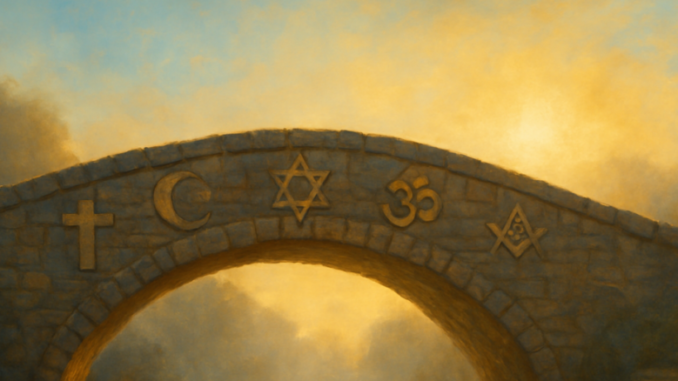
In a world where religion often draws dividing lines, Freemasonry offers something rare: a space where differences are not obstacles but invitations to dialogue. Freemasonry is not a religion. Nor is it a counter-movement. It is a centuries-old brotherhood where people — believers and non-believers alike — come together to work on themselves, their values, and their contribution to the world.
This naturally raises questions. If Freemasonry isn’t a religion, why does spiritual symbolism play such a central role? And how can a community that prescribes no particular belief still be so profoundly meaningful and morally grounded?
Let’s take a closer look at the unique relationship between Freemasonry and religion — and what it means for your personal development and ethical growth.
No Dogma, But Genuine Depth
Freemasonry makes no demands on your faith. Whether you are Christian, Muslim, Jewish, Hindu, humanist, or agnostic — as long as you believe in something greater than yourself, you are welcome. That “higher power” doesn’t need a name. What matters is that you recognize that humanity is not the center of everything, but part of a larger whole.
There is no theological debate, no creed to recite, no prescribed path. Instead, Freemasonry offers a space of silence, reflection, and symbolism where each individual can explore their own faith — or doubt — on their own terms. It is precisely this openness that makes the experience so remarkable: you learn not only about yourself but also about others. About how people think, believe, and search. And you come to see differences as enrichment rather than threat.
Ethics as Common Ground
Although Freemasons come from every religious — and non-religious — background, they share one clear core value: the pursuit of moral integrity. Not an imposed morality, but a personal ethic that you shape yourself. This is where the true bridge between Freemasonry and religion reveals itself: a deep desire to act rightly, to live consciously, and to take responsibility for one’s actions.
Freemasonry provides centuries-old symbols, rituals, and allegories that invite reflection. You learn to see yourself as you truly are — and as you could become. You develop not only a clearer awareness but also the courage to act on it. Ethics ceases to be an abstract concept and becomes a daily practice.
A Brotherhood Without Exclusion
Within the walls of a lodge, titles, ranks, and religious affiliations fall away. Everyone is equal. You sit beside one another as human beings, not as representatives of a particular ideology. This is not just refreshing — it is transformative. It breaks down the boxes, the judgments, the us-versus-them mentality that so often divides our world.
This creates space. Space to be yourself and to truly meet the other. Space to learn, to grow, and to connect on a deeper level. Freemasonry doesn’t build walls — it builds bridges. Bridges between head and heart. Between tradition and renewal. Between religion and personal freedom.
Personal Development as a Spiritual Journey
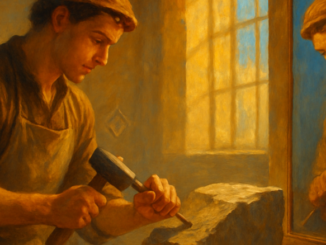
Freemasonry sees every person as a work in progress. You are the rough stone — the ashlar — that you yourself shape, with the help of symbolism, ritual, and brotherhood, into something more refined, stronger, and purer. Religion can serve as a source of inspiration in this process, but the focus remains firmly on your personal transformation.
That transformation begins with questions. Questions you ask and answer for yourself: Who am I? What drives me? What can I contribute? Freemasonry doesn’t hand you answers — it teaches you how to ask the right questions. And that may be the most spiritual experience you can have.
What Does This Look Like in Practice?
In practice, being a Freemason means regularly gathering with others to reflect through silence, symbolism, and ritual. You listen, you speak, you contemplate. You examine your values, your beliefs, and your choices — not to arrive at a fixed conclusion, but to become ever more aware of who you are and who you aspire to be.
For some, this is a complement to their faith. For others, it is a personal path toward meaning without a religious framework. But for everyone, it is a journey of growth, ethics, and inner peace.
Freemasonry and Religion: Harmony in Diversity
Perhaps the greatest strength of Freemasonry lies in its ability to bring together people who might otherwise never meet. Where religions sometimes clash, Freemasonry connects. Not by erasing differences, but by seeing the person behind them.
Especially in an era of polarization and misunderstanding, Freemasonry demonstrates that an ethical, conscious, and spiritual life is entirely possible — without exclusion, without coercion, without dogma.
What Does This Mean for You?
Maybe you are a person of faith. Maybe you are not. Maybe you are looking for deeper meaning, or for a place where you can join others in building a better world. Whatever motivates you, Freemasonry offers space. Space to know yourself more fully, to deepen your ethical awareness, and to grow into the best version of yourself — alongside others who are on a similar journey.
Freemasonry is not a destination. It is a beginning. The beginning of a journey that changes not only you but also the world around you. Are you ready to step across the bridge?
Copyright text & image: devrijmetselaar.nl
Texts are based on the ideas and content of the author of devrijmetselaar.nl, reviewed, corrected, and supplemented with the assistance of OpenAI. Images are created based on the ideas of the author of devrijmetselaar.nl using OpenAI/DALL-E.
Frequently Asked Questions
Is Freemasonry a religion?
No, Freemasonry is not a religion. It is a brotherhood that welcomes people of all faiths — Christians, Muslims, Jews, Hindus, humanists, and agnostics — as long as they believe in something greater than themselves. Freemasonry prescribes no dogma, creed, or theological beliefs, but instead provides a space for personal spiritual exploration and reflection that complements, rather than replaces, individual faith traditions.
Can people of different religions be Freemasons together?
Absolutely. One of Freemasonry's greatest strengths is that it unites people from diverse religious and non-religious backgrounds in a shared pursuit of moral integrity and personal growth. Within the lodge, religious affiliations fall away, and members connect as equals on a deeper human level, learning from one another's perspectives and seeing their differences as enrichment rather than division.
Why does Freemasonry use religious symbolism if it's not a religion?
Freemasonry uses spiritual symbolism, rituals, and allegories as powerful tools for personal reflection and ethical development, not as religious doctrine. These centuries-old symbols invite each member to explore their own understanding of meaning, purpose, and morality on their own terms, making the experience deeply meaningful while remaining accessible to people of all beliefs.
What moral values does Freemasonry teach?
Freemasonry emphasizes the pursuit of moral integrity and personal ethics — not as imposed rules, but as values you develop and shape for yourself. Members are encouraged to act rightly, live consciously, and take responsibility for their actions, transforming ethics from an abstract concept into a daily practice through reflection and self-improvement.
Do I need to be religious to join Freemasonry?
No, you don't need to follow any particular religion to become a Freemason. What matters is that you believe in something greater than yourself — whether that's a traditional God, a higher power, nature, or humanity's potential. This openness makes Freemasonry a truly inclusive brotherhood where believers and non-believers can grow together.
Be the first to comment