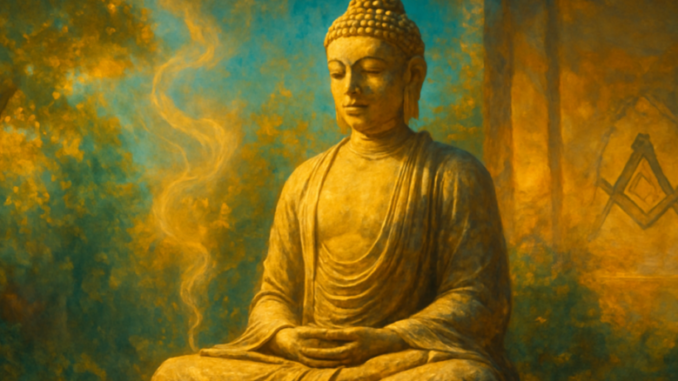
Buddhism, with its emphasis on meditation and enlightenment, has steadily grown in popularity across the Western world. At the same time, Freemasonry continues to offer a unique framework for spiritual growth and self-discovery. While these two traditions differ significantly in origin, they share a remarkable devotion to introspection, ethical living, and personal development. For those drawn to both paths, the intersections between Buddhism and Freemasonry reveal a rich landscape of shared wisdom.
Buddhism: The Way of Meditation and Wisdom
Buddhism is more than a religion — it is a philosophy and way of life that encourages individuals to understand and transcend suffering. At its core lie foundational teachings such as the Eightfold Path, the Four Noble Truths, and the disciplined practice of meditation. These principles guide practitioners toward clarity, compassion, and ultimately, enlightenment.
Buddhist temples and meditation centers around the world serve as sanctuaries for reflection and spiritual growth. The serene images of the Buddha, the fragrance of incense, and the resonant tones of singing bowls create environments that foster harmony and inner balance. For many seekers, Buddhism offers a practical, experience-based approach to understanding the mind and finding peace.
Freemasonry: A Universal Spiritual Journey
Freemasonry offers a symbolic path toward enlightenment without being bound to any specific religion. Through carefully crafted rituals and rich symbolism, Freemasons are encouraged to gain deeper insight into themselves and their place in the world. This quest for self-knowledge aligns closely with the Buddhist emphasis on self-discovery and expanded awareness.
Much like Buddhism, Freemasonry invites its members to seek their own spiritual truth and to contribute meaningfully to the betterment of society. The Craft does not prescribe a single doctrine but rather provides tools — allegorical and symbolic — that each Brother can use to build his own understanding. For those who feel drawn to both traditions, the combination can be profoundly enriching.
Striking Parallels Between Buddhism and Freemasonry
When we examine these two traditions side by side, several compelling parallels emerge:
Introspection and Meditation: Both traditions place great value on self-reflection and meditative practice as essential tools for personal growth. In Freemasonry, the concept of the “inner chamber” mirrors the Buddhist practice of turning inward to examine the mind. Both paths recognize that true transformation begins within.
Ritual and Symbolism: Symbols and rituals play a central role in both Buddhist ceremonies and Masonic degree work. In each tradition, these elements serve as vehicles for expressing deeper spiritual truths that transcend ordinary language. The Buddhist mandala and the Masonic tracing board, for instance, both function as symbolic maps of spiritual reality.
Ethics and Compassion: Buddhism teaches principles such as compassion, non-harm, and right action — values that are also held in high regard within Freemasonry. The Masonic emphasis on brotherly love, relief, and truth resonates deeply with the Buddhist commitment to alleviating suffering and living with integrity.
Harmony in Diversity
Although Buddhism and Freemasonry spring from very different cultural and historical roots, they complement each other remarkably well. Buddhist practitioners may find in Freemasonry an additional platform for spiritual deepening — one that offers structured ritual and a supportive fraternal community. Conversely, Freemasons may discover in Buddhist meditation techniques and philosophical teachings a powerful source of inspiration that enhances their Masonic journey.
This harmony in diversity is itself a reflection of a core Masonic principle: that truth can be found in many traditions, and that wisdom is enriched when we remain open to different perspectives. The Buddhist concept of “skillful means” — adapting one’s approach to suit the needs of the moment — echoes the Masonic understanding that symbols can hold different meanings for different seekers.
Working Together for a Better World
Both Buddhist communities and Masonic lodges provide spaces where individuals can reflect, grow, and work toward positive change. Buddhist sanghas (communities) and Masonic lodges alike emphasize the importance of fellowship, mutual support, and service to others. By learning from one another, these traditions can contribute to a world that is both spiritually and socially richer.
In an era when many people are searching for meaning and balance, the intersection of Buddhism and Freemasonry demonstrates how spirituality can connect and inspire people across cultural boundaries. Both traditions remind us that the journey inward is inseparable from our responsibility to the world around us.
Buddhism and Freemasonry share a fundamental mission: helping individuals find inner peace while contributing to a better society. For Buddhist practitioners, Freemasonry can offer fresh perspectives on ritual, symbolism, and fraternal fellowship. For Freemasons, Buddhism can serve as an inspiring wellspring of meditative practice and ethical philosophy. In a time when so many of us seek deeper meaning and greater balance, these two traditions show us how ancient wisdom can illuminate the modern path — and how spirituality, in all its forms, has the power to unite and uplift.
Copyright text & image: devrijmetselaar.nl
Texts are based on the ideas and content of the author of devrijmetselaar.nl, reviewed, corrected, and supplemented with the assistance of OpenAI. Images are created based on the ideas of the author of devrijmetselaar.nl using OpenAI/DALL-E.
Frequently Asked Questions
Can someone practice both Buddhism and Freemasonry at the same time?
Yes, absolutely. Both traditions welcome seekers from diverse backgrounds and do not require exclusive religious commitment. Many find that practicing both Buddhism and Freemasonry enriches their spiritual journey, as each tradition complements the other through shared emphasis on introspection, ethical living, and personal growth.
Does Freemasonry conflict with Buddhist beliefs?
No, Freemasonry and Buddhism are fundamentally compatible. Freemasonry is non-dogmatic and does not prescribe a specific religious doctrine, making it accessible to people of all faiths, including Buddhists. Both traditions encourage self-discovery and spiritual development without requiring members to abandon their existing beliefs.
What are the main similarities between Buddhism and Freemasonry?
Both traditions emphasize introspection, meditation, and self-reflection as pathways to personal transformation. They also share a deep commitment to ritual and symbolism as spiritual tools, and both stress ethical living and compassion as essential to human development. Additionally, each path invites practitioners to seek their own spiritual truth rather than imposing rigid doctrine.
How does Freemasonry support spiritual growth like Buddhism does?
Freemasonry provides carefully crafted rituals and rich symbolic teachings that guide members toward greater self-knowledge and enlightenment. Through the degree work and allegorical lessons, Freemasons are encouraged to examine themselves deeply and find their place in the world, mirroring the introspective journey that Buddhism facilitates through meditation and philosophical study.




Be the first to comment