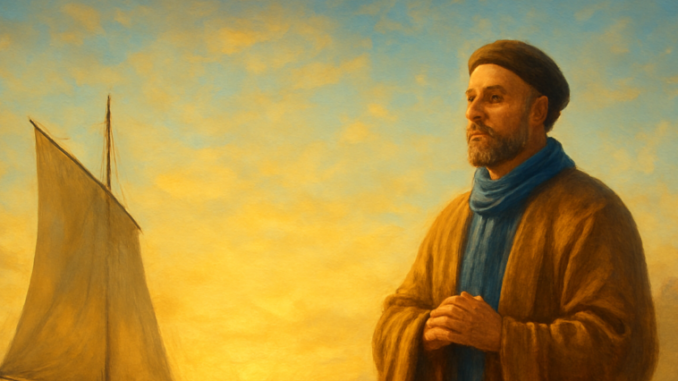
A tear falls. A single droplet of moisture sliding down a cheek. In everyday life, we might look past it quickly, or avert our gaze out of respect for someone else’s sorrow. But what if we truly considered this tear? What if we paused, as sixteenth-century philosopher Michel de Montaigne did in his essay “Of Sadness,” to reflect on what this small gesture reveals about our humanity and our connection to others?
The Tear as a Language Beyond Words
In his essay, Montaigne describes how the most intense emotions are sometimes too vast for words. The deepest grief, he observes, exceeds our ability to express it. When sorrow overwhelms us, the body takes over: we weep, we fall silent, we tremble. The tear then becomes more than a physical reaction — it becomes a symbol of everything that language cannot contain.
Freemasonry holds a deep understanding of this language beyond words. Rituals, symbols, and gestures carry meanings that the intellect alone cannot fully grasp. Just as the tear speaks where the voice fails, so too do the working tools of the Freemason speak of truths that resist neat definitions. The square does not merely measure angles; it also measures the uprightness of our conduct. The compasses do not merely describe circles; they describe the boundaries we set in our behavior toward others.
Vulnerability as the Foundation of Connection
What Montaigne observes so keenly is that grief makes us vulnerable. And within that vulnerability lies a deeper truth. When we set aside our masks and allow our sorrow to show, we create space for genuine encounter. The tear breaks through the armor we wear in daily life.
“Excessive grief stifles the powers of our soul, just as excessive joy does.”
These words from Montaigne touch upon a central idea within Freemasonry: the pursuit of balance. Both extreme sorrow and extreme joy can blind us to those around us. The fraternal bond between Freemasons rests on the ability to find equilibrium — to receive both the joy and the grief of a Brother without being overwhelmed by either.
The Salt of the Tear: Purification and Transformation
A tear contains salt. This simple chemical fact carries a rich symbolic weight. Salt preserves, purifies, and gives flavor. In alchemical traditions — traces of which can be found throughout Masonic symbolism — salt represents the body and the earth, that which is solid and tangible.
When we weep, we release something of ourselves. We quite literally let something go. This release can be understood as a form of inner purification. Montaigne describes how certain forms of grief only fully break through after time has passed, when the soul finally finds the space to mourn. This process of delayed reckoning is not a weakness but a wisdom of the body.
Freemasonry recognizes this process in the working of the rough ashlar. Grief, when truly experienced rather than suppressed, contributes to the shaping of a more mature and wiser person. Every tear that has fallen has washed away something that no longer served its purpose.
Shared Grief in the Fraternal Circle
One of the most valuable aspects of Brotherhood is the capacity to share sorrow. Montaigne lived in an era of religious wars, plague, and profound personal loss. He lost his closest friend at a young age — a loss that would mark him for the rest of his life. Yet he did not retreat into isolation. He wrote, he shared, he sought connection by entrusting his thoughts to the page.
His approach reflects virtues that resonate deeply with the Masonic journey: Self-reflection — Montaigne examined his own grief without judgment. Virtue — he saw in the endurance of sorrow a form of human greatness. Brotherhood — his essays were written to be read, to forge connections across time and space. Inner growth — grief became for him a teacher, not an enemy.
In the Lodge, Brethren gather in a space where the outside world is held at a distance. Here, grief can be shared without the pressure of daily functioning. Here, a tear is not wiped away in shame but acknowledged as a sign of deep humanity.
The Silent Language of Presence
Perhaps the greatest lesson Montaigne offers us about grief is not a philosophical theory but an invitation to presence. Sometimes no words are needed. Sometimes it is enough simply to be there — to stand beside someone in silence, to place a hand on a shoulder.
Freemasonry contains many rituals of silence. Moments in which no words are spoken, yet in which presence itself is deeply meaningful. In that silence, a tear may fall without needing explanation. In that silence, grief is not a problem to be solved but a human experience to be shared.
The tear — so small and seemingly insignificant — carries a world of meaning. Following in Montaigne’s footsteps, we may learn not to flee from grief but to regard it as a gateway to deeper connection. Within Masonic symbolism, where every action and every object points toward something greater, the tear finds its rightful place as a sign of vulnerability, purification, and fraternal closeness. Perhaps the ability to weep together is every bit as valuable as the ability to build together.
Copyright text & image: devrijmetselaar.nl
Texts are based on the ideas and content of the author of devrijmetselaar.nl, reviewed, corrected, and supplemented with the assistance of OpenAI. Images are created based on the ideas of the author of devrijmetselaar.nl using OpenAI/DALL-E.
Frequently Asked Questions
What does Freemasonry teach about expressing emotions like grief?
Freemasonry teaches that vulnerability and honest emotion, including grief, are essential to genuine human connection and brotherhood. Rather than suppressing sorrow, the fraternity recognizes that experiencing and processing grief helps shape us into more compassionate and mature individuals. This understanding aligns with the Masonic pursuit of balance, where we learn to support our Brothers through both their joy and their sorrow.
How do Masonic symbols communicate meaning beyond words?
Masonic symbols like the Square and Compasses carry deep truths that words alone cannot fully express, much like a tear communicates what language cannot contain. These working tools speak to the soul and intellect simultaneously, with the Square representing uprightness of conduct and the Compasses representing the boundaries we set in our relationships with others. Through ritual and symbolic work, Masons experience profound truths that transcend purely intellectual understanding.
What does Freemasonry mean by 'the rough ashlar' in relation to personal growth?
The rough ashlar symbolizes the unpolished, raw state of a person when they enter Freemasonry, and their journey toward becoming a finished stone through experience and self-improvement. Grief and hardship, when truly faced rather than avoided, contribute to this refinement process, shaping us into wiser and more empathetic individuals. Freemasonry honors this natural process of transformation, recognizing that our sorrows and challenges are essential to our spiritual development.
How does Freemasonry promote emotional balance among its members?
Freemasonry teaches that both excessive joy and excessive grief can blind us to those around us, and that true wisdom lies in finding equilibrium between these extremes. The fraternal bond between Masons is built on the ability to support each other through all emotional states without being overwhelmed by them. Through brotherhood and ritual, Freemasons learn to maintain balance while remaining deeply connected to one another's human experience.

Be the first to comment