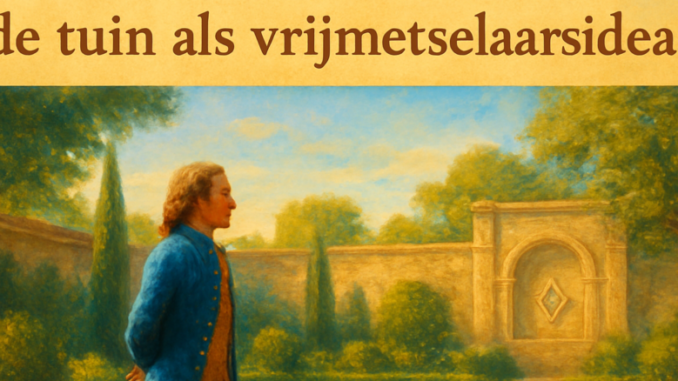
What did Voltaire really mean by that famous closing line? “Il faut cultiver notre jardin” — we must cultivate our garden. Is it a call to withdraw from the world, a retreat into comfortable isolation? Or does it point to something deeper, something that touches the very heart of what Freemasons strive for: connection through shared labor? Let’s sit with this question as if gathered around a table with a good glass of wine and an open mind.
Why Does Candide End in a Garden?
Candide has crossed the entire world. He has witnessed wars, survived earthquakes, listened to philosophers, and won and lost fortunes. And where does he ultimately end up? On a small farm on the outskirts of Constantinople, tilling the earth alongside his companions. Voltaire — who was deeply connected to Enlightenment thinkers and moved in circles where Freemasons were well represented — chose this ending deliberately. No triumph, no palace, no philosophical certainty. Just a garden.
This raises an essential question: is the garden a retreat, or is it actually a starting point? For Voltaire, the answer seems carefully nuanced. The garden is not an escape from the world but a redefinition of what meaningful action looks like. Not endless debate over abstract systems, but concrete, collaborative work on something tangible.
What Does Labor Have to Do with Brotherhood?
Here we touch on a central idea that both Voltaire and Freemasonry share. In the lodge, members speak of “labor” — not as an economic activity, but as a moral and spiritual endeavor. Freemasons see themselves as builders working on an inner temple, but also on the broader community. This labor is never solitary; it always takes place in fellowship with others.
Consider the group that tends the garden at the end of Candide. It consists of people from entirely different backgrounds: the optimistic Pangloss, the pessimistic Martin, the pragmatic Cacambo, the former baroness. They never find unity in their philosophical convictions — those remain as divergent as ever — but they find it in shared work. Voltaire suggests that connection does not arise from agreement in thought, but from cooperation in action.
True brotherhood is not born from shared opinions, but from shared labor toward a common ideal.
Is the Garden a Symbol of Inner Growth?
Absolutely — and this is where things become particularly interesting for anyone familiar with Masonic thought. The garden as a metaphor for the human soul has ancient roots. In many traditions, a garden represents ordered nature — a place where chaos is transformed into harmony through conscious effort. Think of the paradisiacal garden in religious scripture, but also of the philosophical gardens of Epicurus, where wisdom was sought through friendship and simplicity.
For Freemasons, the rough ashlar being shaped into a perfect cube offers a parallel image. Both the garden and the stone demand patience, craftsmanship, and perseverance. Candide does not achieve perfection by the story’s end, but he finds direction. He stops searching for ultimate answers and starts acting. This is what Freemasonry calls “working on oneself” — not reaching a final destination, but engaging in the ongoing process of refinement.
But What About All the World’s Suffering?
A fair question. After all, Candide has witnessed so much suffering. Doesn’t the garden become a denial of all that injustice? Voltaire seems to be making a subtle point here. The garden is not a rejection of the world, but a redefinition of one’s sphere of influence. Candide does not save the world, but he makes his own corner of it livable — together with others.
This resonates deeply with the Masonic idea that improvement begins with the individual and radiates outward into the community. One does not reform the world through grand gestures, but by consistently living according to values such as integrity, service, and mutual respect. The lodge, in this sense, is also a garden: a bounded space where brethren practice virtue, so they can carry that disposition out into the wider world.
How Does Voltaire Relate to Freemasonry?
Voltaire was initiated into the Parisian lodge Les Neuf Sœurs in 1778, shortly before his death. This was no casual choice; the lodge attracted Enlightenment thinkers, artists, and scientists. Voltaire shared with Freemasonry a belief in religious tolerance, the power of reason, and the value of fraternal bonds over dogmatic division.
In Candide, written two decades before his initiation, we can already see these values shimmering beneath the surface. The critique of blind optimism, of religious persecution, of war — these are themes that resonate strongly within Freemasonry. And the book’s conclusion — that shared, modest work holds more value than abstract systems — aligns closely with the Masonic emphasis on practical virtue.
What Can We Learn from Candide’s Garden?
The garden of Candide is not a destination but a method. It represents the recognition that meaning is not found in absolute truths, but in purposeful action within a community. For Freemasons, this is instantly recognizable: the lodge offers no dogmas, but a space where people of different backgrounds come together to work toward shared ideals.
Several key principles emerge from this reading:
• Labor as a unifying principle, not as individual achievement.
• Humility about what we can truly know and influence.
• The value of community over ideological uniformity.
• Inner growth as an ongoing process, never a finished product.
Voltaire’s wisdom and Masonic thought meet in this garden — not as systems that confirm each other, but as traditions that both understand a fundamental truth: human beings flourish when they work together, with patience, with respect, and with their hands in the earth.
The garden of Candide is not an escape from the world but an invitation to seek connection through shared labor. Voltaire offers us a wisdom that Freemasons have cherished for centuries: that true brotherhood emerges when people stop debating and start building — side by side, stone by stone, seed by seed. In cultivating the garden, we cultivate ourselves, each other, and the bonds that make a community whole.
Copyright text & image: devrijmetselaar.nl
Texts are based on the ideas and content of the author of devrijmetselaar.nl, reviewed, corrected, and supplemented with the assistance of OpenAI. Images are created based on the ideas of the author of devrijmetselaar.nl using OpenAI/DALL-E.
Frequently Asked Questions
What does Voltaire mean by 'cultivating our garden' at the end of Candide?
Voltaire's famous closing line is not a call to withdraw from the world, but rather a redefinition of meaningful action. The garden represents concrete, collaborative work on something tangible rather than endless abstract philosophical debate. It suggests that true purpose comes from practical engagement and shared labor with others, not from isolation or philosophical certainty.
How does the garden in Candide connect to Masonic ideals of brotherhood?
Both Voltaire and Freemasonry emphasize 'labor' as a moral and spiritual endeavor rather than merely economic activity. In the novel, Candide's diverse group of companions—with conflicting philosophies—finds unity not through agreement in thought, but through cooperative work toward a common goal. This reflects the Masonic principle that true brotherhood is born from shared labor and action, not from shared opinions.
Why does Voltaire choose a garden as the setting for Candide's final resolution?
After Candide's global journey involving wars, earthquakes, and constant upheaval, Voltaire deliberately places him in a simple garden, suggesting that meaningful life is found in humble, collaborative work rather than in triumph, palaces, or philosophical victories. The garden serves as both a practical workspace and a symbol of inner growth, representing the transformation that occurs through shared effort and connection with others.


Be the first to comment