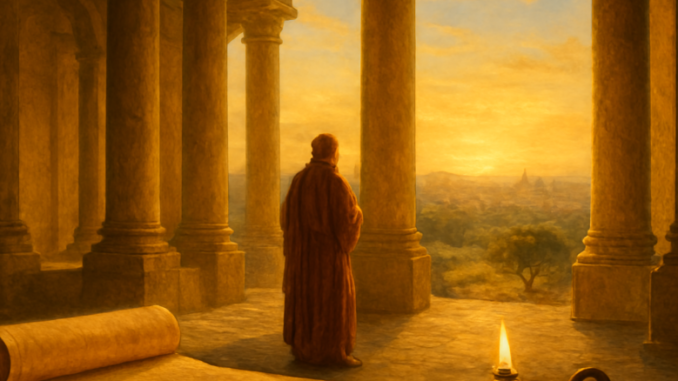
Candles flicker softly in the dim light of the lodge as a brother reads aloud from an ancient text — a prophet warning of a day of reckoning, yet promising that from the ashes something new will rise. The brethren listen in silence, recognizing in these age-old words something strikingly contemporary: the necessity of inner purification before any true building can begin. The Book of Zephaniah, written in the kingdom of Judah during the seventh century BCE, speaks with an urgency that still resonates today.
The Prophet and His Time
Zephaniah was active during the reign of King Josiah, a period when Judah was struggling with religious decay and societal corruption. The prophet spoke to a people who had neglected their foundations — a nation that maintained the outer temple walls while allowing the inner temple to crumble. His message was twofold: first, a confrontation with what had become rotten; then, a promise of restoration for those willing to be reshaped.
This small book, only three chapters long, opens with a gripping description of what Zephaniah calls the “Day of the Lord.” This is no simplistic fire-and-brimstone sermon but a call to fundamental reflection. The prophet does not only address foreign nations — he turns his gaze inward, toward his own community, toward the leaders, priests, and merchants who have forsaken their responsibilities.
Darkness as a Precondition for Light
One of the most powerful images in Zephaniah is the description of darkness that precedes renewal. The prophet paints a day “of darkness and gloom, of clouds and thick darkness.” To a casual reader, this sounds like pure threat. But those who look deeper recognize a universal pattern: before the light can break through, the darkness must first be acknowledged.
“Seek the Lord, all you humble of the land, who do his just commands; seek righteousness, seek humility.” This seeking — this active striving toward justice and modesty — forms the heart of Zephaniah’s message. It is not passive waiting but a deliberate choice to face one’s own shortcomings. In Freemasonry, we know this principle well: it is the work on the rough ashlar, the unrefined stone that can only become a useful building block through patient chiseling.
The Refining Fire
Zephaniah repeatedly employs the image of fire that purifies. “In the fire of my jealousy, all the earth shall be consumed,” he writes — yet this fire is not meant to destroy. It is the fire of the smith who purifies metal from dross, the flame that burns away impurities so that pure gold remains. Across countless traditions, including Freemasonry, fire symbolizes the transformative force required for genuine change.
The prophet does not announce an ending but a new beginning. After the purification comes the promise of a “remnant” — a core of people who, refined and cleansed, can continue to build. This mirrors the way a master builder must first clear and prepare the ground before a solid foundation can be laid. Without this preparation, any construction would stand on shifting sand.
The Quiet Core: Humility and Community
What sets Zephaniah apart from some other prophetic books is its emphasis on humility. The Hebrew word used here, anawim, refers to people who are not haughty — those who recognize their own limitations and remain open to growth. The prophet does not exalt the powerful or the eloquent but rather those who work on themselves in silence.
Several themes emerge from this prophetic vision that resonate powerfully with Masonic values: humility as the foundation of wisdom; community as a safeguard against pride; silence as a space for reflection; and justice as an active way of life. The lodge is, by its very nature, a space where brethren work in quiet humility on their inner development, supported by a community that serves as both mirror and guide. Zephaniah’s vision of a purified community reflects this ideal — people united not by pride but by shared purpose.
From Ancient Prophecy to Modern Practice
What can we, as readers in the twenty-first century, learn from a prophet who addressed his contemporaries twenty-six centuries ago? Zephaniah’s message transcends its historical context because it touches on universal human experiences: the tendency toward complacency, the fear of genuine self-knowledge, and the deep longing for meaningful community and inner peace.
The prophet invites us to explore our own dark corners — not out of masochism, but from the understanding that only acknowledged shadow can be transformed. In the ritual practice of Freemasonry, this journey is symbolized by the passage from darkness to light, from ignorance to knowledge, from rough ashlar to perfect cube. Zephaniah offers an Old Testament echo of this timeless pattern.
The Promise of Joy
The Book of Zephaniah does not end on a somber note. Its final verses burst into a song of joy and liberation. The prophet describes how purification culminates in celebration, how the community that has passed through the fire ultimately experiences the presence of the sacred “in her midst.” This movement from confrontation to celebration, from darkness to light, forms the dramatic arc of the entire book.
For the Freemason, Zephaniah offers a powerful reminder: the work on the inner temple is not a grim task but a path toward deeper joy. The hammer and chisel are not instruments of punishment but tools of liberation. And the brotherhood is not a refuge for the weak but a workshop for the courageous — those willing to let themselves be shaped and refined.
In the candlelit silence of the lodge, Zephaniah’s voice still echoes: an invitation to honest self-knowledge, a promise that purification leads to rebuilding, and the assurance that those who humbly submit to the refining fire will discover not destruction but transformation — not an ending but a joyful new beginning. The ancient prophet and the modern Mason walk the same path, guided by the same enduring truth: that only through the courage to confront what lies within can we hope to build something lasting without.
Copyright text & image: devrijmetselaar.nl
Texts are based on the ideas and content of the author of devrijmetselaar.nl, reviewed, corrected, and supplemented with the assistance of OpenAI. Images are created based on the ideas of the author of devrijmetselaar.nl using OpenAI/DALL-E.
Frequently Asked Questions
What is the connection between the Book of Zephaniah and Freemasonry?
Both Zephaniah and Freemasonry emphasize the necessity of inner purification and self-reflection before meaningful progress can be achieved. The prophet's message about refining oneself through acknowledging shortcomings mirrors the Masonic principle of working on the rough ashlar—the unfinished stone that must be carefully shaped to become a useful building block. This shared symbolism demonstrates how ancient wisdom and Masonic teachings complement each other in promoting personal and spiritual development.
What does Zephaniah mean by the 'Day of the Lord'?
Rather than a simplistic threat of destruction, Zephaniah's 'Day of the Lord' represents a call to fundamental reflection and necessary purification—a confrontation with corruption followed by the promise of restoration. The darkness he describes is not an ending but a precondition for light and renewal, symbolizing the transformative process that allows individuals and communities to rebuild on solid foundations. This concept resonates deeply with Masonic teachings about personal reformation and growth.
How does Freemasonry interpret the symbolism of fire in Zephaniah's writings?
In both Zephaniah and Freemasonry, fire represents a purifying and transformative force rather than destruction—much like the smith's fire that refines metal and burns away impurities to reveal pure gold. This shared symbolism emphasizes that genuine change requires the deliberate burning away of flaws and shortcomings to allow one's true essence to emerge. The fire, therefore, symbolizes the challenging but necessary inner work that leads to authentic spiritual and personal development.
What is the 'remnant' that Zephaniah describes, and why is it important?
The remnant refers to a core group of people who have undergone purification and refinement, prepared to build anew on solid foundations. In Masonic terms, this represents those committed to the principles of self-improvement and moral development who become the building blocks of a better community. Zephaniah's message teaches that true progress comes not from starting with a large group, but from having dedicated individuals who have genuinely purified themselves and are ready to contribute meaningfully to collective progress.
Why would Freemasons study ancient prophetic texts like Zephaniah?
Freemasons study prophetic texts because they contain timeless wisdom about personal transformation, moral accountability, and the building of better societies—principles central to Masonic teachings. These ancient writings provide a mirror for reflection, helping brothers recognize the importance of continuous self-improvement and the purification of character before contributing to their communities. By engaging with such texts, Masons connect their craft to a broader tradition of seeking truth, justice, and enlightenment across cultures and centuries.

Be the first to comment