
A swimmer pushes forward despite nausea and exhaustion, carried by the cheers of thousands lining the shore. What drives someone to keep going when every fiber of their body begs them to stop? And what does this tell us about the power of community? These are questions that reach far beyond the sports pages — questions that touch the very heart of what Freemasons understand as brotherhood.
Why Do We Persevere When the Body Refuses?
When Dutch open-water swimmer Maarten van der Weijden announced he would continue his legendary charity swim despite severe physical discomfort, the world took notice. But beyond the headlines lies a deeper question: what compels a person to press on when quitting seems like the only rational choice? Is it sheer willpower alone, or is something else at work?
When we look at great endeavors throughout history, a pattern emerges. Rarely does anyone accomplish something truly monumental in complete isolation. Aristotle wrote that human beings are inherently social creatures, ill-suited for a life without others. He didn’t simply mean that we enjoy company — he meant that our highest aspirations only gain meaning in relation to community.
What Does This Have to Do With Masonic Brotherhood?
This is where we touch upon one of Freemasonry’s core principles: brotherhood. The word is sometimes used casually, but within the Masonic tradition it carries a far deeper meaning. Brotherhood is not merely friendship or professional collegiality. It is a bond in which people support one another on their personal journey — without conditions, without ulterior motives.
True brotherhood is the hand that holds yours, not to lead you, but to remind you that you are not alone.
When thousands of people stand along the waterside to encourage a swimmer, we see a reflection of this principle. They are not swimming themselves, yet their presence carries the swimmer forward. Their voices become his strength when his own strength falters. This is brotherhood in action: not taking over the burden, but lightening it through presence.
Can We Truly Achieve Anything Alone?
Western culture often glorifies the lone hero — the self-made individual who triumphs against all odds. But how accurate is this picture? Johann Wolfgang von Goethe, himself a Freemason, wrote extensively about the interplay between the individual and the community. For him, personal development was inseparable from service to others.
A charity swim illustrates this beautifully. The physical achievement is individual, but the motivation is collective. The swimmer swims for others, supported by others, in the name of something greater than himself. The boundaries between self and community blur, and it is precisely in that blurring that something powerful emerges.
How Do Freemasons Practice Brotherhood?
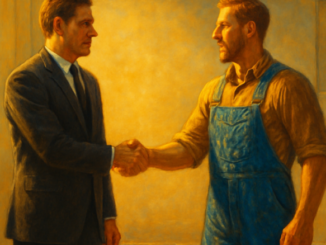
In Freemasonry, brotherhood takes concrete form. It begins in the lodge, where men from vastly different backgrounds come together as equals. Here, there are no social ranks that matter, no distinctions of status that count. The banker sits beside the carpenter, the professor beside the shopkeeper. All are brothers, united by shared values.
In practice, Masonic brotherhood manifests in several powerful ways: mutual support during difficult times without it needing to be asked for; honest reflection on each other’s behavior and growth; celebrating successes as shared joy; and bearing grief as a common burden.
These are not abstract ideals. In reality, it means that a brother who falls ill receives visitors. That someone who is struggling finds a listening ear. That joy, when shared, multiplies. Seneca, the Stoic philosopher, put it aptly: whoever helps a friend helps himself. Not out of selfishness, but because human connection is a two-way current.
What Can We All Learn From This?
You don’t need to be a Freemason to experience the power of brotherhood. It begins with a simple acknowledgment: we are not made for solitude. Our dreams grow richer when they are shared. Our burdens grow lighter when others walk beside us. Our failures become more instructive when someone catches us without judgment.
A swimmer in cold water, battling nausea, perseveres because he knows there are people who believe in him. That knowledge is not a luxury — it is fuel. Plato wrote in his dialogues about the role of community in shaping the soul. Without others, a person remains unfinished — a sketch rather than a painting.
Is Brotherhood an Act or a Feeling?
This may be the most important question of all. Brotherhood is not a sentiment that simply happens to you. It is a choice, made anew each day. It is the choice to be present, to listen when you would rather speak, to give when you expect nothing in return. It is the choice to stand on the shore, even if the swimmer will never know your name.
Freemasonry offers a structure in which this choice is practiced and deepened. But the essence is universally available. Wherever people come together with sincere intention, brotherhood can flourish. It requires only the courage to be vulnerable — to acknowledge that we need each other.
A swimmer who perseveres despite adversity shows us more than physical strength. He reveals the power of community — of people united by a shared purpose. This is what Freemasons have strived toward for centuries: a brotherhood that brings out the best in people. Not by preaching, but by being present. Not by forcing, but by carrying. And in that act of carrying, we find — paradoxically — our own strength.
Copyright text & image: devrijmetselaar.nl
Texts are based on the ideas and content of the author of devrijmetselaar.nl, reviewed, corrected, and supplemented with the assistance of OpenAI. Images are created based on the ideas of the author of devrijmetselaar.nl using OpenAI/DALL-E.
Frequently Asked Questions
What is the connection between a swimmer's perseverance and Masonic brotherhood?
The article draws a parallel between a swimmer pushing through physical exhaustion with support from crowds and the Masonic principle of brotherhood. Just as thousands lining the shore provide strength through their presence without taking over the burden, Masonic brotherhood is a bond where members support one another on their personal journey without conditions or ulterior motives. The presence of community lightens individual burdens and makes great endeavors possible.
Why does the article argue that humans cannot accomplish great things alone?
The article references Aristotle's philosophy that human beings are inherently social creatures unsuited for life without others. It explains that our highest aspirations only gain meaning in relation to community. The example of the charity swimmer demonstrates that while physical achievement may seem individual, it is truly enabled by the collective support and encouragement of others. Even the self-made hero narrative is challenged as incomplete when examined closely.
How does Freemasonry define brotherhood differently from casual friendship?
According to the article, brotherhood within the Masonic tradition carries a far deeper meaning than simple friendship or professional collegiality. True Masonic brotherhood is described as a bond in which people support one another on their personal journey without conditions or ulterior motives. It is characterized as 'the hand that holds yours, not to lead you, but to remind you that you are not alone,' emphasizing unconditional support and presence rather than directed guidance.


Be the first to comment