A young footballer watches his dream transfer collapse at the last moment due to a disagreement between medical experts. He calls the situation “rotten.” This moment of public disappointment raises a timeless question that philosophers and Freemasons have pondered for centuries: how does adversity shape our character, and what determines whether we emerge stronger — or more embittered?
The Stoic Legacy in Times of Adversity
In the Roman Empire, Marcus Aurelius — emperor and philosopher — wrote extensively about the art of enduring setbacks. In his personal meditations, he argued that it is not events themselves that affect us, but our interpretation of them. This insight, shared with his predecessors Epictetus and Seneca, forms a cornerstone of Stoic philosophy. When a young athlete watches a career opportunity evaporate due to circumstances beyond his control, he is confronted with precisely this ancient wisdom.
The Stoics drew a sharp distinction between what lies within our control and what does not. The judgment of physicians, the decisions of club officials, the whims of fate — these are external factors. What does lie within our power is how we respond. Marcus Aurelius would argue that the true test of character is not found in achieving success, but in how a person handles disappointment.
The Rough Stone and the Workshop of the Soul
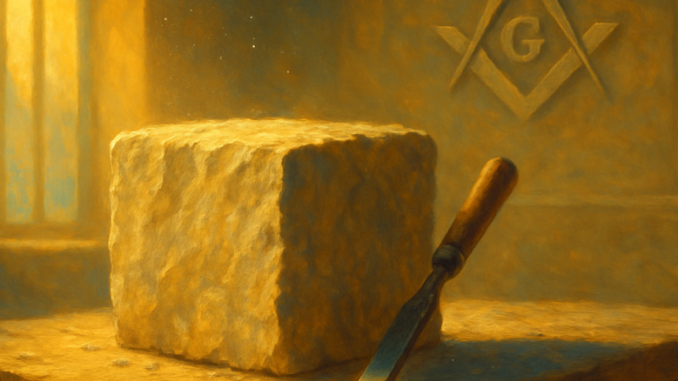
In Freemasonry, the concept of the “rough ashlar” plays a central role. Every candidate is presented as an unworked stone that must be shaped through self-improvement into a perfect cube — fit to take its place in a greater structure. This metaphor is far from arbitrary imagery: it reflects a deep conviction in the possibility of personal transformation through conscious effort.
Within this framework, setbacks serve as the chisel strikes that give the rough stone its form. Without resistance, without the cutting away of rough edges and protrusions, no refinement can take place. The eighteenth-century Freemason Johann Wolfgang von Goethe expressed this insight when he wrote about the necessity of struggle for genuine growth. His life’s work bears witness to the belief that suffering and adversity are the raw materials of character formation.
Character is not formed by success, but by the way a person rises after a fall.
Disagreement as a Mirror
One striking aspect of the failed transfer is the disagreement between medical experts. Two qualified professionals examine the same evidence and arrive at different conclusions. In Freemasonry, this phenomenon is both recognized and valued. The lodge is a space where differing perspectives are allowed to coexist. The ritual teaches brethren to listen to dissenting opinions without immediately becoming defensive.
Voltaire, though not a Freemason in the strictest sense, maintained close ties with the movement and shared its ideal of reasoned discourse. In his novel Candide, he showed how dogmatic certainty leads to catastrophe, while a willingness to embrace nuance and reflection opens the path to wisdom. A disagreement between doctors is not a failure of science — it is a reminder of the limits of human knowledge.
Inner Attitude as an Anchor
What separates those who grow stronger through adversity from those who are broken by it? Freemasonry offers a nuanced answer rooted in age-old traditions. It is not about denying pain or dismissing disappointment. The young footballer has every right to call his situation “rotten.” Honesty about one’s feelings is not a weakness.
The decisive moment comes afterward. In Masonic ritual practice, the candidate is repeatedly confronted with darkness before being permitted to see the light. This symbolic journey reflects a psychological truth: integrating difficult experiences requires that we first face them fully. Only then can the real work on the rough stone begin.
The process involves several essential steps: acknowledging the disappointment without wallowing in self-pity; distinguishing between what you can influence and what you cannot; searching for the lesson within the setback; and rediscovering direction through reflection. These are not abstract ideals — they are practical tools for navigating life’s inevitable difficulties.
From Disappointment to Depth
History is filled with examples of individuals whose greatest contributions emerged from periods of hardship. Isaac Newton developed his revolutionary ideas during a forced retreat to the countryside when plague swept through London. Wolfgang Amadeus Mozart, a member of a Viennese Masonic lodge, composed some of his most profound works during times of financial hardship and personal loss.
This pattern is no coincidence. Adversity compels introspection and forces us to ask fundamental questions about what truly matters. Freemasonry institutionalizes this kind of reflection by regularly inviting its members to engage in self-examination. In the stillness of the temple, removed from the noise of daily life, space opens up for the kind of deep reflection that superficial success would never demand.
The Greater Structure
Ultimately, Freemasonry teaches that character is not shaped for ourselves alone. The polished stone is meant to fit into a greater whole — the symbolic temple of humanity. Someone who has learned to navigate adversity can become a source of support for others facing similar trials. In this way, personal suffering is transformed into collective wisdom.
A failed transfer is, in the grand scheme of things, a small drama. But the way a young person processes this experience can be defining for the rest of his life. The question is not whether he will ever secure a major transfer. The question is what kind of person he becomes through the process of facing this setback.
The ancient wisdom of the Stoics and the Freemasons remains as relevant as ever. Adversity is not an interruption of life — it is life itself. Every setback carries within it the seed of growth, provided we are willing to pick up the chisel and continue working on the rough stone. The temple we are building, both within ourselves and together, is shaped not by the blows we avoid, but by the ones we learn to endure.
Copyright text & image: devrijmetselaar.nl
Texts are based on the ideas and content of the author of devrijmetselaar.nl, reviewed, corrected, and supplemented with the assistance of OpenAI. Images are created based on the ideas of the author of devrijmetselaar.nl using OpenAI/DALL-E.
Frequently Asked Questions
What is the significance of the 'rough ashlar' concept in Freemasonry?
The 'rough ashlar' represents an unworked stone that must be shaped through self-improvement into a perfect cube, symbolizing personal transformation. In Freemasonry, this metaphor reflects the belief that setbacks and challenges act like chisel strikes that refine character. Without resistance and difficulty, no genuine personal refinement can take place, making adversity essential to character formation.
How do Stoic philosophers explain our response to adversity?
Stoic philosophers like Marcus Aurelius, Epictetus, and Seneca taught that it is not events themselves that affect us, but our interpretation of them. They distinguished between what lies within our control (our response and attitude) and what does not (external circumstances like medical judgments or fate). True character is demonstrated not by success, but by how a person handles disappointment and responds to setbacks.
Why does disagreement between experts, like in the footballer's medical evaluation, matter for character building?
Disagreement between qualified professionals highlights the reality that certainty is often impossible in complex situations. This mirrors life's ambiguities and teaches us that character is not formed by success or clear-cut outcomes, but by how we navigate uncertainty and respond to circumstances beyond our control with resilience and wisdom.

Be the first to comment