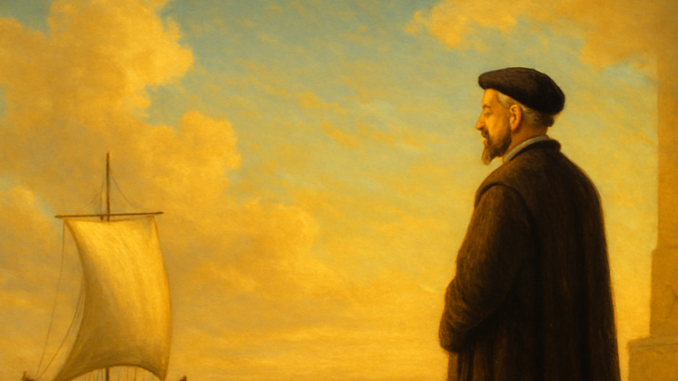
There comes a moment when words fail. A moment when the soul is so overwhelmed by sorrow that it freezes, falls silent, or erupts in a flood no one anticipated. Michel de Montaigne wrote about precisely this in his second essay — a brief but deeply penetrating exploration of the limits of human emotion. Beneath its seemingly simple subject lies a rich philosophical inheritance stretching from the Greek Stoics to Renaissance humanism. And for those accustomed to thinking in symbols, it opens a world of meaning that reaches far beyond the surface of everyday experience.
The Silent Voice of the Stoics
Montaigne‘s reflections on grief are unthinkable without Stoic philosophy. This school of thought, born in third-century Athens, taught that emotions are the result of the judgments we make about reality. Sorrow does not arise from what happens to us, but from how we interpret it. Seneca, the Roman philosopher whom Montaigne so frequently quotes, wrote extensively about the art of dealing with loss and adversity. He insisted that the wise person does not suppress emotions but learns to understand them.
In his essay on sadness, however, Montaigne takes a more nuanced position. He observes that extreme emotions sometimes paralyze the body — that the deepest grief expresses itself in silence or speechlessness. This is not simple Stoic detachment, but an acknowledgment that human nature is more complex than any philosophical system can fully capture. The Stoics provide a framework, but Montaigne carefully breaks through it.
Plutarch and the Power of the Example
Another crucial source for Montaigne was Plutarch, the Greek biographer and moralist whose works were eagerly read across sixteenth-century Europe. Plutarch did not write in abstract terms. Instead, he used vivid stories and examples drawn from the lives of historical figures. Montaigne adopted this method wholeheartedly. His essay on grief is filled with anecdotes: rulers struck dumb at the sight of their defeated armies, mothers who only find tears upon hearing an unexpected word.
The example speaks where the argument falls silent. In the concrete story, the soul finds recognition that no logic can provide.
Plutarch taught Montaigne that philosophy cannot be separated from lived experience. The anecdote is not decoration — it is a method for uncovering truth. This insight also permeates the symbolic practice of Freemasonry, where ritual actions and narratives serve as carriers of meaning that the intellect alone cannot grasp.
Renaissance Humanism: The Human Being as the Measure
Montaigne lived at the heart of the Renaissance, a period in which the rediscovery of classical texts went hand in hand with a renewed trust in human experience. Renaissance humanism placed the individual at the center of philosophical inquiry. The question was no longer solely what God or nature demanded of us, but also: what does it mean to be human? What can we truly know about ourselves?
It was in this intellectual climate that Montaigne wrote his Essays as an exercise in self-examination. His famous motto, Que sais-je? (What do I know?), reflects the deep influence of skepticism — another tradition that shaped his thinking profoundly. Pyrrhonian skepticism, named after the Greek philosopher Pyrrho, taught that certainty is unattainable and that the wise person suspends judgment. Montaigne applied this directly to the emotions: who dares claim to know exactly what grief is, or how it should properly manifest itself?
The Tear as Symbol: Hidden Layers of Meaning
For those trained to read symbolically, Montaigne‘s essay reveals a deeper layer. The tear, the sigh, the silence — these are not random phenomena but signs that reveal something about the relationship between inner and outer, between the invisible interior life and the visible world. Freemasonry has a long tradition of symbolic thinking in which outward forms point toward inner truths.
Consider the rough ashlar that must be worked and refined — a symbol of self-improvement. The light that dispels darkness — a sign of insight and growth. The silence that precedes the spoken word — a space for contemplation. Each of these symbols operates on the boundary between what can be expressed and what must be experienced.
Montaigne‘s observation that extreme grief sometimes leads to silence resonates powerfully with this symbolic awareness. That silence is not empty — it is full. It marks a threshold where words have done all they can and something else is needed. In the ritual practice of the lodge, silence is deliberately employed as a moment of inner turning — a transition from outward action to inward reflection.
A World in Turmoil: The Historical Context
Montaigne wrote during a time of religious wars, plague, and political chaos. France was torn apart by conflicts between Catholics and Protestants. He himself lost his closest friend at a young age — a loss that left deep marks on his work. This historical background is essential for understanding his interest in grief. It was no academic exercise, but an attempt to come to terms with a reality in which loss was ever-present.
Yet Montaigne refused to succumb to cynicism or despair. His essays breathe a certain serenity — a willingness to accept the human condition with all its limitations. This balance between realism and acceptance is an attitude also cherished in Freemasonry: the acknowledgment that life is imperfect, combined with the commitment to keep building — both oneself and the world — nonetheless.
Timeless Questions, Present-Day Relevance
The questions Montaigne raised remain strikingly relevant. How do we deal with grief in a culture that often demands quick solutions? What does it mean to make room for emotions without being overwhelmed by them? The philosophical traditions he drew upon — from Stoicism to skepticism — offer no ready-made answers, but they provide a wealth of perspectives that can help us navigate our own emotional landscapes with greater wisdom and humility.
In Freemasonry, the emphasis on self-knowledge, on working through difficulty rather than around it, and on finding meaning in symbols and silence, echoes Montaigne’s deepest convictions. His essay on grief is a reminder that philosophy at its best does not distance us from our emotions but helps us meet them with greater understanding.
Montaigne’s brief meditation on sadness is far more than a Renaissance curiosity. It is an invitation to confront the full spectrum of human emotion — not with rigid doctrine, but with openness, humility, and a willingness to sit in silence when words fall short. For Freemasons and seekers alike, his essay offers a mirror in which we can recognize our own struggles with loss, meaning, and the endless work of shaping the self. The rough stone does not become smooth by avoiding the chisel; it is through honest encounter with our deepest sorrows that real refinement begins.
Copyright text & image: devrijmetselaar.nl
Texts are based on the ideas and content of the author of devrijmetselaar.nl, reviewed, corrected, and supplemented with the assistance of OpenAI. Images are created based on the ideas of the author of devrijmetselaar.nl using OpenAI/DALL-E.
Frequently Asked Questions
What is the connection between Montaigne's philosophy and Freemasonry?
Montaigne's use of symbolic examples and lived experience as paths to truth aligns deeply with Masonic practice, where ritual actions and narratives carry meaning beyond intellectual understanding. Both traditions recognize that human experience cannot be fully captured by logic alone, and both use symbolic methods to explore profound truths about the human condition. This shared approach makes Montaigne's work particularly resonant for Masons seeking to understand the philosophical foundations of their practice.
How does Montaigne differ from the Stoics in understanding grief?
While Stoic philosophy teaches that emotions arise from our judgments about reality, Montaigne acknowledges that extreme grief sometimes transcends rational control, expressing itself in profound silence or speechlessness. He respects the Stoic framework but recognizes that human nature is more complex than any single philosophical system can fully explain. This nuanced view honors both reason and the mysterious depths of human emotion.
Why did Montaigne use examples and anecdotes in his essays?
Following the method of Plutarch, Montaigne believed that concrete stories drawn from lived experience reveal truths that abstract arguments cannot reach. The example allows the soul to find recognition and meaning in ways that logic alone cannot provide. This same principle underlies Masonic ritual, where symbolic narratives and actions serve as powerful carriers of wisdom.
What is Renaissance humanism and how does it relate to Freemasonry?
Renaissance humanism placed the individual human being at the center of philosophical inquiry, asking not just what God demands but what it truly means to be human. This humanistic focus on individual experience and potential resonates with Freemasonry's emphasis on personal growth, self-knowledge, and the development of the individual Mason within a supportive community. Both traditions celebrate human dignity and the capacity for self-improvement.
Can Montaigne's essay on grief help Masons understand their ritual work?
Yes—Montaigne's exploration of how grief exceeds words and requires symbolic expression mirrors the Masonic use of ritual to communicate truths beyond ordinary language. His recognition that human experience contains depths inaccessible to reason alone validates the Masonic conviction that symbols, ceremonies, and lived practice are essential pathways to wisdom and self-understanding.



Be the first to comment