Somewhere around 740 BCE, in the kingdom of Judah, a voice rose — not from a man who had chosen the role of prophet, but from one who had been called to it. In a vision filled with smoke and seraphim, he glimpsed something his contemporaries could not yet grasp: a future in which light would drive out darkness and a broken people would rise again as builders of a new age. The images woven through the Book of Isaiah continue to resonate millennia later, and their echoes are remarkably vivid in the symbolic language of Freemasonry.
A Calling in the Temple
The sixth chapter of Isaiah contains one of the most striking calling visions in all of biblical literature. The prophet finds himself in the temple when he sees a throne surrounded by six-winged beings. One of the seraphim touches a burning coal to his lips, purifying him of unrighteousness. This moment of transformation — from the impure to the pure — lies at the heart of everything Isaiah will go on to proclaim.
For Freemasons, this theme feels deeply familiar. The candidate who enters the lodge undergoes a symbolic purification of his own. He leaves the profane world behind and prepares himself for a journey toward the light. The parallel is not accidental — both traditions understand that transformation begins with an act of surrender and cleansing.
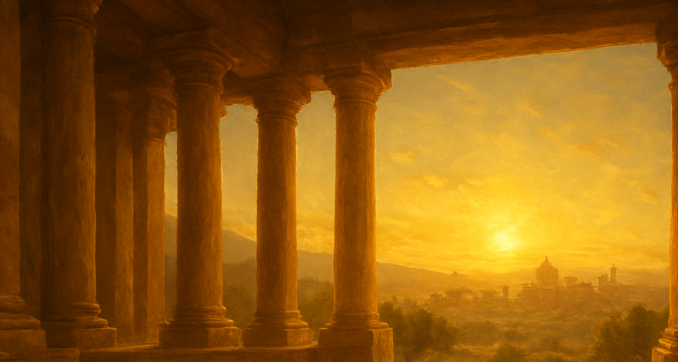
The temple in Isaiah’s vision was no ordinary building. It was the place where heaven and earth touched, where the divine reached into the human world. In the Masonic tradition, the lodge carries the same symbolic weight. It is a representation of the cosmos, with a canopy of stars overhead and a mosaic pavement that unites opposites beneath the brethren’s feet. In both Isaiah’s prophecy and Masonic symbolism, the temple serves as a workshop for inner transformation.
Light in the Darkness
Perhaps the most famous passage in the entire Book of Isaiah is the promise to a people walking in darkness: they shall see a great light. Written during a time of political upheaval and existential dread, these words offered comfort and hope. The light Isaiah promised was never merely physical. It represented insight, liberation, and moral clarity.
The people who walked in darkness have seen a great light; those who dwelt in a land of deep darkness, on them has light shone.
For Freemasons, light is the central symbol of the entire initiation process. The blindfold that is removed, the candles burning in the lodge, the East where the Worshipful Master sits — everything points toward the journey from darkness to illumination. Isaiah’s prophecy speaks the same language, even though it was written more than two thousand years earlier. Both traditions recognize that light is never to be taken for granted. It must be sought, received, and cherished.
The Builder Among Ruins
A less well-known but extraordinarily rich theme in Isaiah is that of rebuilding. After the exile, the prophet foretold, the people would return and restore their ruined cities. In chapter 58 we read: You shall raise up the foundations of many generations; you shall be called the repairer of the breach, the restorer of streets to dwell in. This image of the builder who raises something new from rubble runs like a golden thread through Masonic symbolism.
The operative masons of the Middle Ages worked with their hands on cathedrals and castles. Their speculative heirs — today’s Freemasons — build an inner temple. Yet both share the understanding that building means starting with the foundations, raising the structure stone by stone, and honoring what came before. Isaiah’s vision of restoration and rebuilding resonates powerfully with this Masonic ideal. The rough ashlar is shaped into a perfect cube that fits within the greater edifice.
Justice and Moral Growth
Isaiah’s message went far beyond ritual or vision. He called his contemporaries to social justice. The prophet had sharp words for empty religiosity that was not accompanied by genuine care for the vulnerable members of society. In chapter 1 comes the unmistakable charge: Learn to do good; seek justice, correct oppression; bring justice to the fatherless, plead the widow’s cause.
Several key principles emerge from Isaiah’s moral teaching that align closely with Masonic values: justice as the foundation of genuine faith, care for widows and orphans as a true test of morality, and a sharp critique of outward show without inner transformation. These are not abstract ideals — they are calls to action.
This emphasis on ethics over ritual finds a strong echo in the Masonic tradition. The lodge is not a place for empty forms, but for genuine self-improvement that translates into action in the wider world. A Freemason is expected not only to become a better person within the temple, but to demonstrate that growth in daily life. Isaiah would have understood this perfectly.
What We Can Learn Today
Isaiah’s texts were written in a world of conflict, uncertainty, and social tension. The people of Judah lived under pressure from empires and struggled with questions of identity and meaning. In that context, a prophet’s voice emerged — one that did not retreat into illusion, but pointed toward hope through transformation.
Today, we live once again in a time when old certainties are crumbling. It is precisely in such moments that ancient texts like Isaiah and traditions like Freemasonry can serve as a compass. Not because they offer ready-made answers, but because they invite reflection. They remind us that light must be actively sought, that building begins with the foundations, and that moral growth is a lifelong endeavor.
The prophet of the eighth century BCE and the modern brother in the lodge share the same journey: from darkness to light, from rough stone to polished cube, from ruin to rebuilding.
The Book of Isaiah is far more than a religious document from a distant past. It is a wellspring of symbolism that speaks across the centuries to anyone who seeks depth and self-improvement. The images of light piercing darkness, of temples and builders, of justice and transformation — these form a universal language. For Freemasons, Isaiah offers a mirror: in his visions, they recognize their own search for the light that never ceases to shine for those who dare to seek it.
Copyright text & image: devrijmetselaar.nl
Texts are based on the ideas and content of the author of devrijmetselaar.nl, reviewed, corrected, and supplemented with the assistance of OpenAI. Images are created based on the ideas of the author of devrijmetselaar.nl using OpenAI/DALL-E.
Frequently Asked Questions
What is the connection between the Book of Isaiah and Freemasonry?
Both Isaiah's prophecies and Freemasonry use remarkably similar symbolic language, particularly around themes of light, transformation, and building. The prophet's visions of purification, illumination, and renewal written around 740 BCE echo strongly in Masonic rituals and teachings, suggesting a deep spiritual alignment across centuries. This connection demonstrates how Freemasonry draws from profound spiritual and philosophical traditions to convey timeless truths about human development.
How does Isaiah's temple vision relate to the Masonic lodge?
In Isaiah's calling vision, the temple serves as a sacred space where heaven and earth meet and the prophet experiences divine transformation through purification. Similarly, the Masonic lodge functions as a symbolic cosmos and workshop for inner transformation, where candidates undergo their own purification and preparation for enlightenment. Both traditions understand the temple or lodge as more than physical structures—they are sacred spaces designed to facilitate spiritual growth and connection to higher truths.
What does the symbolism of light mean in both Isaiah and Freemasonry?
In Isaiah's prophecies, light represents hope, moral clarity, insight, and liberation for people dwelling in darkness and despair. Freemasonry similarly places light at the center of its initiation process, with the removal of the blindfold and the illumination of the lodge symbolizing the journey from ignorance to understanding. Both traditions recognize that light must be actively sought, received, and cherished as a representation of spiritual awakening and enlightenment.
Why do Masonic candidates undergo purification similar to Isaiah's seraphim experience?
Both traditions understand that meaningful transformation requires first releasing oneself from the impurities of the profane world through an act of surrender and cleansing. The seraphim's burning coal purifying Isaiah's lips in the temple parallels the candidate's symbolic purification as he enters the lodge, establishing that inner transformation is the foundation for all spiritual progress. This shared understanding emphasizes that enlightenment and growth cannot occur without first preparing oneself through deliberate acts of purification and dedication.
How does the theme of rebuilding appear in both Isaiah and Freemasonry?
Isaiah prophesied that after exile and destruction, the people would return and restore their ruined cities, becoming builders of a new age of hope and renewal. Freemasonry similarly emphasizes the role of its members as builders—not just of physical structures, but of character, community, and spiritual truth within themselves. Both traditions celebrate humanity's capacity to rise from ruin and create something enduring and meaningful through dedication, skill, and brotherhood.

Be the first to comment