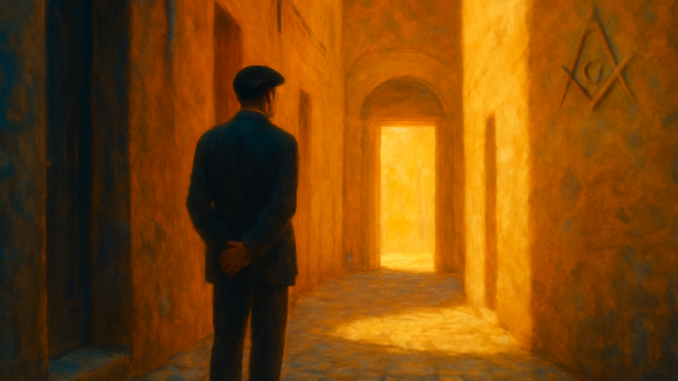
In a dimly lit room somewhere in southern Italy, a middle-aged man sits across from his lawyer. His hands tremble slightly as he signs the documents that will formally sever his ties to the organization he was born into. For the first time in his life, he gets to choose which brotherhood he belongs to. This scene — now increasingly possible thanks to new Italian legislation — touches on a question that Freemasons have grappled with for centuries: what makes a true brotherhood?
A Law That Liberates
The Italian government has recently passed legislation offering members of mafia families a formal pathway out of organized crime. The law provides protection, guidance, and a route toward building a new life. It represents an acknowledgment of something long considered unspeakable: that people born into criminal networks are not necessarily bound to that legacy forever. The blood oath, the code of silence, the family loyalty that was considered unbreakable for generations — it turns out these chains can be cut after all.
To outsiders, this might sound obvious. But anyone familiar with the structure of these organizations knows how deep the bonds run. Members are not recruited — they are born into a system where loyalty to the family supersedes everything else. The question this raises is a fundamental one: when is brotherhood a blessing, and when does it become a prison?
Brotherhood as a Free Choice
Freemasonry upholds a principle that stands in direct opposition to forced loyalty: every brother joins of his own free will. No one is born a Freemason. No one inherits membership from his father. The bond that unites brethren arises because they find one another through shared values — not through shared blood or coerced allegiance. This distinction is far from trivial. It goes to the very heart of what makes human connection meaningful.
True brotherhood emerges where people voluntarily extend a hand to one another — not where hands are held together by chains.
The Italian law implicitly recognizes this distinction. By offering a way out, the legislature is essentially saying: we understand that you can be part of something you never chose. And we are giving you the chance to finally make that choice yourself. That opportunity for personal choice is precisely what separates a brotherhood that uplifts from one that suffocates.
The Courage to Let Go
Leaving a tightly knit community takes enormous courage. This is true for someone walking away from a criminal organization, but it also applies in far less extreme situations. People often remain tied to groups, families, or networks that no longer serve them, simply because the step into the unknown feels too threatening. The fear of what lies ahead, the dread of being called a traitor, the uncertainty of who you are without that group identity — these are powerful forces that keep people in place.
Freemasons are familiar with rituals that symbolically explore this very theme. The candidate entering the lodge for the first time literally and figuratively leaves something behind. He steps into a new space, not knowing exactly what awaits him. It is a deliberate reenactment of what people throughout history have done when they chose growth over comfort: leaving the familiar world behind in search of a better one.
Loyalty That Leaves Room to Breathe
There is a persistent misconception about brotherhood: that true loyalty means you never leave, never voice criticism, and never choose your own path. In reality, healthy brotherhood is defined by exactly the opposite. Brothers support one another, but they also grant each other freedom. They encourage growth — even when that growth means someone chooses a different direction.
Forced loyalty creates fear and stagnation. Voluntary connection creates trust and development. True brotherhood can withstand criticism and change. False brotherhood punishes any deviation from the norm.
The new Italian law draws a clear line between these two forms of bonding. It tells people trapped in destructive loyalty: there is another way. And implicitly, it also says something about what genuine community should look like — not a cage, but a house with open doors.
From Darkness Into Light
In Masonic symbolism, the transition from darkness to light plays a central role. It is a metaphor for awakening — for the step from ignorance to understanding. But it can also be read more literally: as the movement from a life lived in the shadows to an existence in the open. For someone who grows up in circumstances where crime is the norm, that transition is not abstract philosophy — it is a concrete necessity.
The law provides a path, but each person must walk it alone. That demands courage, trust in an uncertain future, and the willingness to release everything that was familiar — no matter how damaged it may have been. It is the same inner movement that every person must make who truly wants to grow: the readiness to leave the known behind in pursuit of something better.
What This Teaches Us About Connection
The Italian initiative is not only relevant to those directly affected by organized crime. It holds up a mirror to all of us. What bonds are we clinging to that no longer serve us? Which loyalties do we maintain out of habit rather than conviction? And do we have the courage to give others the space to choose — even when their choice might cause us pain?
Brotherhood in its purest form is not a chain but a choice. Made again and again, affirmed again and again. Not because you must, but because you want to. That is the brotherhood that truly connects.
The man in that Italian room signs his papers and steps outside into the sunlight. He does not know exactly what lies ahead, but he knows this much: for the first time, the path he walks is his own choice. In that freedom lies the essence of true brotherhood. Not in the bonds you inherit, but in the hand you voluntarily extend to another.
Copyright text & image: devrijmetselaar.nl
Texts are based on the ideas and content of the author of devrijmetselaar.nl, reviewed, corrected, and supplemented with the assistance of OpenAI. Images are created based on the ideas of the author of devrijmetselaar.nl using OpenAI/DALL-E.
Frequently Asked Questions
What is the main difference between Freemasonry and organizations like the mafia?
Freemasonry is based on voluntary membership where individuals freely choose to join based on shared values, whereas criminal organizations often bind members through birth and coerced loyalty. In Freemasonry, brotherhood arises from personal choice and mutual respect, not inherited obligation or blood oaths. This fundamental distinction means Freemasons can leave whenever they wish, and their bonds are strengthened by genuine commitment rather than fear.
Can someone be born a Freemason?
No, Freemasonry explicitly rejects inherited membership. Every Mason must voluntarily choose to join the fraternity as an adult, regardless of whether their father or relatives were Masons. This ensures that all members are bound by authentic personal commitment to the fraternity's principles and values.
What makes Freemasonry a true brotherhood?
True brotherhood in Freemasonry stems from free choice and shared values rather than coercion or obligation. Members voluntarily extend their hands to one another in friendship and mutual support, creating bonds that uplift and strengthen rather than constrain. This voluntary association is what makes Masonic brotherhood meaningful and empowering.
Is it difficult to leave Freemasonry if someone chooses to do so?
Unlike organizations built on coercion and control, Freemasonry respects the autonomy of its members. Men are free to join or leave the fraternity based on their own choices and circumstances. The emphasis on personal freedom means that a Mason's commitment is always voluntary and never forced.

Be the first to comment