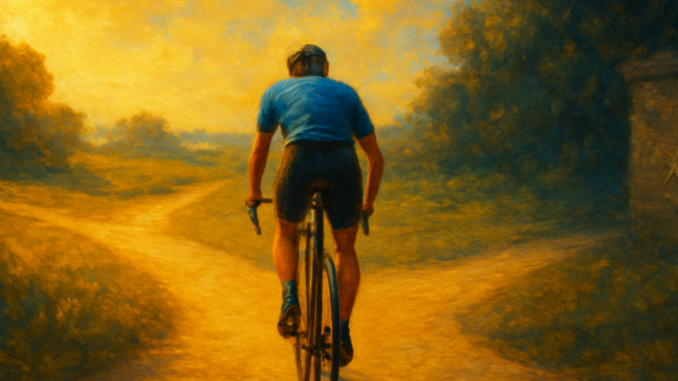
In a fraction of a second, a cyclist makes a decision. He follows his rival, convinced that rider is about to win. But reality unfolds differently. The gamble turns out to be wrong. This moment of human fallibility at the highest level of sport raises a deeper question: how do our snap judgments relate to genuine inner knowing? And what can two very different perspectives on intuition and spirituality teach us about the difference?
The Outsider’s Perspective: Intuition as Tactics
For most spectators watching a cycling sprint, the final dash to the finish line is a matter of raw physical power and clever tactics. The rider sitting in second position reads his opponents’ movements — shoulder shifts, breathing patterns, the subtle redistribution of weight. From this vantage point, intuition is nothing more than lightning-fast pattern recognition, honed by years of experience and training.
When a rider later admits he thought someone else was going to win and made his move accordingly, we interpret it as a miscalculation. A tactical error in a high-speed chess game. The outside world judges: he should have paid closer attention, picked up on different signals. The conversation revolves around technique — what went wrong in his analysis of the moment.
The Inner Seeker’s Perspective: Intuition as Spiritual Practice
An entirely different perspective opens up when we examine the same moment through the eyes of someone pursuing spiritual growth. In Freemasonry, as in many contemplative traditions, a clear distinction is drawn between superficial impulses and deeper inner knowing. The first is reactive, rooted in fear or desire. The second arises from a stillness that lies beneath the noise of everyday consciousness.
From this perspective, the wrong bet is not a failure of calculation but an invitation to self-examination. The question shifts from “What went wrong in my tactics?” to “From what inner state did I make this decision? Was it truly intuition, or was I projecting my own expectations onto reality?”
Genuine inner knowing requires the ability to distinguish between the voice of the ego and the whisper of the soul.
Where Both Worlds Converge
What is striking is that both perspectives share a common core. The tactically minded sports analyst and the spiritual seeker alike recognize the importance of presence in the moment. The athlete must be fully concentrated, stripped of distraction, to pick up the right signals. The meditating seeker strives for that same clarity of mind, free from the noise of thoughts and emotions.
In Freemasonry, this state is sometimes described as working the rough ashlar — chipping away what is impure, what clouds the clarity of perception. Whether you are sprinting for the finish line or sitting in silence, the challenge remains the same: to prepare yourself so thoroughly that in the crucial moment, you can act from your deepest truth.
The athlete trains the body and sharpens reflexes. The seeker trains inner stillness and discernment. Both strive for purity of action in the moment.
The Lesson of the Wrong Bet
So what does this moment truly teach us? The cyclist who openly acknowledges he made the wrong call demonstrates a form of honesty that is both rare and valuable — in sport and in spiritual life alike. He projected his expectation onto another person and acted on it. In that very acknowledgment lies the seed of growth.
For anyone pursuing spiritual development, this is deeply familiar. How often do we think we know what someone else will do, say, or feel, only to discover that our assumption revealed more about ourselves than about them? The difference between presuming and truly perceiving is subtle but crucial.
Projection and Pure Perception
In the symbolic language of Freemasonry, one might say: the level shows us whether we are in balance. When we act from inner restlessness, our perception is colored. The athlete under pressure sees what he fears or hopes to see. The person who is not inwardly centered projects his own state onto the world around him.
The path to genuine inner knowing does not bypass these projections — it runs directly through them. By acknowledging again and again where we were mistaken, we chip away at the rough ashlar. Not to achieve perfection, but to perceive just a little more clearly each time.
Two Paths, One Destination
The elite athlete and the Freemason may seem worlds apart. One chases victory in a peloton; the other pursues inner refinement in the stillness of reflection. Yet both are striving for the same thing: that moment when action and insight become one, when a decision is not consciously taken but flows through you.
That state cannot be forced. It arises through preparation, through practice, through honestly confronting the times we got it wrong. In that sense, every misjudgment is not a defeat but a lesson on the path toward deeper inner knowing.
A sprint lasts mere seconds, but the wisdom hidden within it reaches far beyond the finish line. Whether we race through life or observe it in stillness, the question remains: are we acting from superficial impulse or from genuine inner knowing? The wrong bet is not an endpoint — it is an invitation. Those who dare to honestly admit they thought they knew but were mistaken take the first step on a path that connects both worlds. There, in the recognition of our own fallibility, spiritual growth begins.
Copyright text & image: devrijmetselaar.nl
Texts are based on the ideas and content of the author of devrijmetselaar.nl, reviewed, corrected, and supplemented with the assistance of OpenAI. Images are created based on the ideas of the author of devrijmetselaar.nl using OpenAI/DALL-E.
Frequently Asked Questions
What does Freemasonry teach about intuition and inner knowing?
Freemasonry distinguishes between superficial impulses driven by ego and fear, versus genuine inner knowing that arises from spiritual stillness and clarity. This deeper intuition requires self-examination and presence, helping members distinguish between reactive impulses and the true voice of the soul. Through practices like meditation and self-reflection, Freemasons develop the ability to access this authentic inner wisdom.
How does Freemasonry help develop clarity of perception?
Freemasonry uses the metaphor of 'working the rough ashlar' — removing impurities and distractions that cloud clear perception. Through contemplative practice and spiritual development, members train themselves to achieve a state of presence and focus similar to what elite athletes pursue. This disciplined inner work prepares Masons to act from their deepest truth in crucial moments.
What is the connection between Masonic practice and everyday decision-making?
Masonic teachings emphasize that clarity and presence in the moment are essential to making good decisions, whether in spiritual practice or in life's challenges. By training the mind to distinguish between ego-driven impulses and genuine inner knowing, Masons develop better judgment and self-awareness. This inner work translates into more authentic and aligned choices in all aspects of life.
Can Freemasonry help me understand why I make poor decisions?
Yes, Freemasonry encourages deep self-examination to understand the inner state from which decisions arise. By learning to distinguish between fear-based reactions and authentic intuition, members gain insight into their patterns and motivations. This spiritual practice supports personal growth and helps members make decisions rooted in clarity rather than unconscious impulses.



Be the first to comment