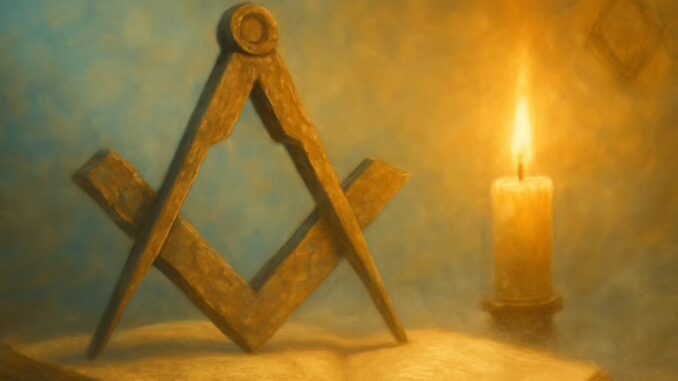
Agnosticism is often understood as a position of not-knowing — a philosophical stance that acknowledges certain questions about existence may be unanswerable. Freemasonry, on the other hand, is sometimes perceived as a fraternity defined by its rituals and symbols. But what happens when we place these two worlds side by side? Both share a fundamental recognition: that the human mind cannot fathom everything, and that within that very recognition lies a particular kind of wisdom. In this article, we explore how the agnostic outlook and Masonic philosophy mirror and enrich each other.
The Agnostic Perspective: Living With Uncertainty
The agnostic does not claim to know whether a higher power exists. This is not a weakness or a lack of conviction — it is a deliberate intellectual position. The term was coined in the nineteenth century by the British biologist Thomas Henry Huxley, who wanted to express that certain metaphysical questions lie beyond the reach of human knowledge. The agnostic stance demands humility: the ability to say “I don’t know” without abandoning the search for meaning.
In modern society, agnosticism is frequently confused with indifference or atheism. Nothing could be further from the truth. Where the atheist asserts that no god exists, the agnostic keeps the question open. This leads to a life in which wonder and doubt exist side by side. The agnostic does not seek definitive answers but ever-deeper questions. It is an outlook that leaves room for mystery without falling into dogma.
The Freemason and the Unknowable
Freemasonry has a long tradition of openness toward different belief systems. In the lodge, people meet who are sometimes deeply devout, sometimes doubtful, and sometimes openly agnostic. What unites them is not a shared image of God, but a shared acknowledgment of something greater than the individual. Freemasonry speaks of the Great Architect of the Universe — a concept that is intentionally left undefined. It is not a definition of God but a symbol for the unknowable itself.
The Freemason works on himself the way a stonemason shapes a rough stone. This work is not carried out with absolute certainties but with tools like the compass and the square — symbols of proportion, balance, and self-discipline. The lodge does not provide answers to life’s great questions. It provides a space where those questions may be asked, without anyone being forced toward a specific conclusion.
Agnosticism and Brotherhood: What They Share
When we place the agnostic outlook alongside Masonic philosophy, the similarities are striking. Both recognize the limits of human knowledge. Both value the journey over the destination. And both find meaning in community: the agnostic seeks like-minded individuals with whom to philosophize, while the Freemason finds brothers with whom to work toward personal and societal improvement.
The wise person recognizes that the mystery of existence need not be solved — it is meant to be lived.
Both perspectives offer a counterweight to the absolutism that sometimes characterizes our society. In an age of polarization and certainty, both agnosticism and Freemasonry offer a path of nuance. They invite us to listen, to tolerate ambiguity, and to respect those who think differently.
Lessons From Both Paths
The agnostic outlook and the Masonic path are not opposing roads — they can strengthen each other. The agnostic who enters the lodge finds a community that does not condemn his doubts but embraces them. The Freemason who studies agnostic philosophy discovers an intellectual foundation for the symbolic language of his brotherhood.
Both value humility as a virtue. Both seek connection despite differences. Both acknowledge mystery without denying it. And both offer space for personal growth.
In today’s society, where certainties are scarce and opinions often clash harshly, these two approaches offer a breath of fresh air. They demonstrate that it is possible to think deeply about the great questions without descending into fanaticism or cynicism. The agnostic Freemason — or the Freemason with agnostic leanings — embodies an openness that is sorely needed in our time.
Agnosticism as a Force in Society
Agnosticism is not merely a personal philosophy; it can also serve as a societal force. In a world where groups often define themselves by what they believe, the agnostic stance offers an alternative: define yourself by your willingness to listen, to doubt, and to grow. This aligns seamlessly with the Masonic idea that a person is never finished but perpetually in the process of becoming.
The lodge functions as a microcosm of society, where people from different backgrounds come together. The agnostic finds no mandatory answers here, but encounters mandatory questions. And perhaps that is exactly what our society needs: less certainty, more curiosity. Less judgment, more conversation.
Agnosticism and Freemasonry walk along different paths, but they share the same horizon: the recognition that human existence is permeated with mystery. The agnostic seeks truth in the acknowledgment of not-knowing. The Freemason builds upon himself in the awareness that the temple will never be complete. Together, they extend an invitation to approach life with wonder, humility, and an open heart. In a world that clamors for answers, they offer the courage to live with questions.
Copyright text & image: devrijmetselaar.nl
Texts are based on the ideas and content of the author of devrijmetselaar.nl, reviewed, corrected, and supplemented with the assistance of OpenAI. Images are created based on the ideas of the author of devrijmetselaar.nl using OpenAI/DALL-E.
Frequently Asked Questions
Can an agnostic become a Freemason?
Yes, absolutely. Freemasonry welcomes men of all belief systems, including agnostics. The fraternity does not require members to subscribe to any specific religious doctrine, only to believe in something greater than themselves. The concept of the Great Architect of the Universe is intentionally undefined, allowing agnostics and people of diverse faiths to find common ground in the lodge.
Does Freemasonry require belief in God?
Freemasonry requires belief in a higher power or something greater than oneself, but it does not prescribe what that should be. The term 'Great Architect of the Universe' is deliberately vague to accommodate various spiritual perspectives, making it possible for agnostics, atheists, and believers of all faiths to participate without compromising their convictions.
How does Freemasonry handle questions about religion and spirituality?
Rather than providing definitive answers, Freemasonry creates a safe space for men to explore life's profound questions together. The lodge encourages personal reflection and self-improvement without imposing dogma or specific theological conclusions, making it an ideal environment for those who value inquiry and intellectual honesty alongside spiritual fellowship.
What do Freemasonry and agnosticism have in common?
Both embrace the recognition that human knowledge has limits and that mystery is an inherent part of existence. Both value the journey of self-discovery over claiming to have all the answers, and both find deep meaning in community and philosophical dialogue. This shared humility creates a natural compatibility between the agnostic worldview and Masonic principles.
Will I be pressured to adopt any religious beliefs in Freemasonry?
No. Freemasonry explicitly respects the religious and philosophical autonomy of its members. The fraternity brings together men of different backgrounds and beliefs in brotherhood, united by shared values of integrity, self-improvement, and service—not by requiring agreement on matters of faith.

Be the first to comment