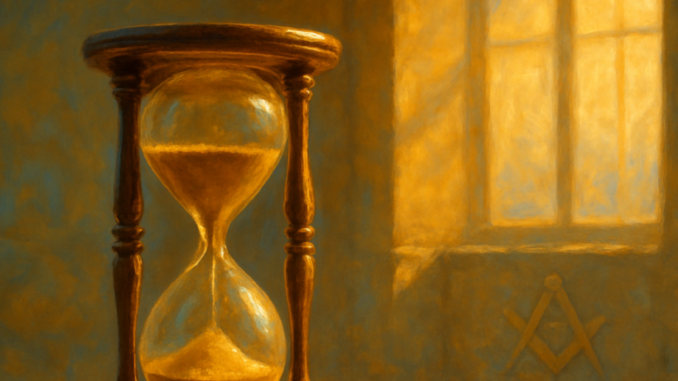
France recently passed a law permitting assisted dying under strict conditions — a decision that strikes at the very heart of how a society thinks about life, death, and human dignity. As public debate intensifies, this moment invites deeper reflection: how did people in earlier centuries approach the end of life, and how does that compare to our modern outlook? Freemasonry, rooted in centuries-old traditions of self-examination, offers a uniquely illuminating perspective on this timeless question.
The Past: Death as a Daily Companion
For our ancestors, death was not a topic to be avoided. In the medieval world, the end of life was ever-present: infant mortality was staggeringly high, epidemics swept through communities without regard for wealth or status, and average life expectancy was a fraction of what we know today. This reality produced a culture that did not hide from death but placed it squarely at the center of daily awareness.
The ars moriendi — the art of dying — flourished as a literary genre in the fifteenth century. Countless manuals appeared to prepare people for a “good death.” This good death had nothing to do with pain management or medical intervention. It was about spiritual readiness. People died surrounded by family, often at home, in full awareness of what was to come. Death was a threshold, not a wall.
The Present: Medical Advances and Moral Questions
Our modern world has pushed death into the background. Hospitals and care facilities are where most people now die, often connected to equipment designed to extend life. Where death once arrived swiftly and inevitably, modern medicine allows us to postpone the end — sometimes by years.
These achievements bring new and difficult questions. When does prolonging life become prolonging suffering? Who decides when enough is enough? The French law passed this week is an attempt to provide answers within carefully defined boundaries. It places the autonomy of the individual at the center while acknowledging the need for rigorous oversight and medical guidance.
Freemasonry and the Contemplation of Mortality
Within Freemasonry, reflecting on one’s own mortality holds a special place. Historically, candidates were confronted with symbols of death during their initiation: a skull, crossed bones, a darkened chamber of reflection. This was never a morbid fascination. It was a deliberate reminder of the finite nature of earthly existence.
The contemplation of death is not meant to inspire fear — it is meant to sharpen our appreciation for life.
This tradition echoes philosophical currents stretching back centuries. From the Stoics to the Renaissance humanists, an awareness of mortality was consistently regarded as a wellspring of wisdom. The person who truly knows that their days are numbered, the reasoning went, will live each day with greater intentionality. Freemasonry absorbed these insights into its ritual practice — not as dogma, but as an invitation to personal reflection.
What Both Perspectives Share
At first glance, the medieval ars moriendi and contemporary legislation on assisted dying seem worlds apart. Yet they share a fundamental core: the desire for dignity in the face of death. Both approaches refuse to reduce dying to a purely biological event. They recognize that death is also a deeply human, meaningful act that calls for attention, care, and respect.
The key difference lies in the question of who holds the reins. In the past, dying was embedded within a larger framework of religious and communal rituals. The dying person followed a prescribed path, supported by clergy and family. Today, the emphasis has shifted toward the individual: it is the person themselves who, within defined limits, may decide about their own end of life.
Lessons for the Seeking Mind
What can we learn from these two worlds? Perhaps this: that thinking about death is not a sign of weakness but an act of courage. Freemasonry teaches that those who dare to face the darkness will appreciate the light all the more. The awareness of our finitude can serve as a compass, guiding us toward choices that truly matter.
The past teaches us not to fear death but to integrate it into life. The present asks us to take responsibility for difficult choices. Both eras reveal that dignity is not a fixed concept — it is an ongoing conversation.
The French law is not the endpoint of that conversation but a new contribution to it. It compels us to think afresh about what it means to be human, to live, and to die. And perhaps that is precisely what our time needs: not so much answers, but the willingness to keep asking the questions.
The debate around assisted dying touches on the deepest questions human beings can ask. By placing the perspective of the past alongside that of the present, we see that every era formulates its own answers — but the underlying search remains the same: how do we live well, and how do we die with dignity? Freemasonry offers no ready-made solutions, but it does offer a space for contemplation. In that stillness, each of us can find, in our own way, the wisdom that fits our time and our own path.
Copyright text & image: devrijmetselaar.nl
Texts are based on the ideas and content of the author of devrijmetselaar.nl, reviewed, corrected, and supplemented with the assistance of OpenAI. Images are created based on the ideas of the author of devrijmetselaar.nl using OpenAI/DALL-E.
Frequently Asked Questions
What is the Masonic perspective on end-of-life decisions?
Freemasonry encourages personal reflection on mortality through contemplation of life's finite nature, rather than prescribing specific answers to end-of-life questions. The tradition teaches that awareness of our mortality helps us live with greater intentionality and wisdom, allowing each individual to make thoughtful decisions aligned with their values. This approach respects both the individual's autonomy and the importance of spiritual readiness.
What is 'ars moriendi' and why is it relevant today?
Ars moriendi, or 'the art of dying,' was a fifteenth-century literary tradition focused on spiritual preparation for death rather than pain management. Freemasonry carries forward this wisdom by teaching that contemplating mortality deepens our appreciation for life and encourages us to live with purpose and integrity. Understanding this historical perspective helps us balance modern medical capabilities with timeless questions about dignity and meaning.
Why does Freemasonry use symbols of death in initiation?
Masonic rituals include symbols like skulls and darkened chambers to remind candidates of life's finite nature—not to inspire fear, but to foster wisdom and intentionality. This practice draws from centuries-old philosophical traditions recognizing that awareness of mortality sharpens our appreciation for life and guides us toward more meaningful living. The contemplation is meant to strengthen character and elevate one's perspective.
How can Freemasonry help people think about life and death?
Freemasonry offers a framework for personal reflection on mortality that encourages wisdom, self-examination, and intentional living. Rather than imposing answers, the tradition invites individuals to contemplate life's deeper questions through ritual and philosophical study. This approach has helped Masons for centuries navigate life's most profound transitions with grace and understanding.

Be the first to comment