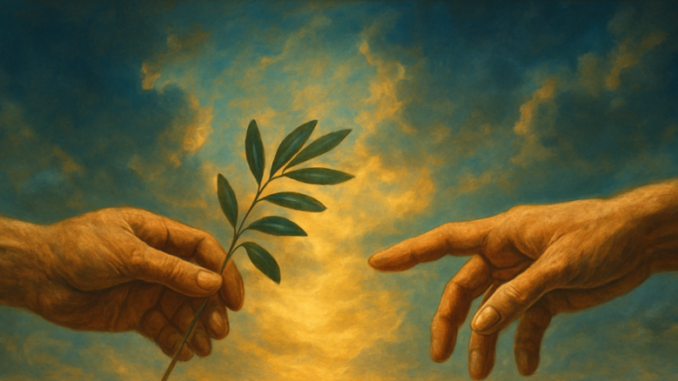
You may have read the headlines and felt a pang of unease. A world leader threatening to “bomb an ally into oblivion” if they refuse to cooperate. The words linger — heavy, menacing. And as you set down the newspaper or put away your phone, you might find yourself wondering: is this where we’re headed? A world where threats become the norm and alliances crumble under the weight of power displays? In Freemasonry, we know a different compass. Not one of intimidation, but one of brotherhood.
The Echo of Threatening Language
When a head of state openly threatens destruction, it touches something fundamental. It goes beyond geopolitics or strategic interests around the Strait of Hormuz. It raises the question of how we as human beings relate to one another. Words create realities. They can build bridges or erect walls. They can invite dialogue or pave the way for conflict.
The Greek philosopher Aristotle understood that language is never neutral. In his Rhetoric, he described how words stir emotions, persuade, but also manipulate. Threatening language on the world stage is not an abstraction. It seeps into the way all of us handle disagreement — in our communities, our workplaces, our homes.
Brotherhood as an Antidote
In Freemasonry, brotherhood does not mean naivety or turning a blind eye to conflict. It is a conscious choice to see the other person as a fellow human being, not as an enemy. The lodge traditions stretch back to the seventeenth century, when men like James Anderson and Jean Theophilus Desaguliers drafted the first constitutions. Within those documents lives a principle that still resonates today: Freemasons gather regardless of background, religion, or political conviction. Not in spite of their differences, but precisely because those differences enrich the dialogue.
This is not a casual commitment. It demands something of you. It asks you to suspend judgment, to listen before you speak, to seek connection where division threatens to take hold. In a world where leaders threaten bombardment, such an attitude is almost radical.
True brotherhood does not arise from the absence of conflict, but from the willingness to transcend conflict through dialogue and mutual respect.
From the Lodge to the World
You might think: what does a Masonic lodge have to do with international tensions? More than you might expect. The lodge is a training ground. It is where you learn to engage with people who think differently. It is where you practice articulating your position without seeking to destroy the other person’s.
The rituals that Freemasons practice are not empty forms. They carry a message: that we are all rough material that can be shaped, that we are all works in progress. The philosopher Immanuel Kant spoke of the human being as an end in themselves, never merely a means. In Freemasonry, that idea becomes a lived reality in how we treat one another.
What would it mean if leaders adopted the same principles? Not weakness, but strength. The strength to respond not from fear or ego, but from a deeper awareness of our shared humanity. The Stoic philosopher Marcus Aurelius, who as Emperor of Rome had every reason to operate from a position of raw power, wrote in his Meditations about the necessity of self-restraint and compassion. Power without wisdom is a dangerous weapon.
The Question That Stays With You
It is easy to point the finger at world leaders. But the real question is far more personal. How do you react when you feel threatened? When someone crosses your path with an opinion that runs counter to everything you believe? Do you reach for verbal weapons, or do you reach for understanding?
Freemasonry does not offer ready-made answers, but it does offer a direction. It is the direction of building. Not the tearing down of others, but the construction of something shared. The temple that Freemasons symbolically build is not a structure of stone. It is a temple of human dignity, of respect, of the recognition that we need each other.
- Brotherhood requires active listening
- Conflict is inevitable, but escalation is a choice
- Words can be weapons or tools
- Seeing the other as a fellow human is a daily practice
An Invitation to Reflect
The headlines about threats and geopolitical tensions will keep coming. That is the world we live in. But you do not have to be swept along by them. Freemasonry reminds us that there is another path — one that does not begin in government buildings or at military installations, but with you. With how you greet your neighbor, address your colleague, approach your opponent.
Voltaire, himself a Freemason, wrote that we must cultivate our own garden. Perhaps that is the most subversive act of all: in a world of threats, choosing connection.
When the language of threats and destruction dominates the headlines, brotherhood is not weakness — it is an act of courage. It is the choice to refuse the spiral of escalation and to keep building what connects us. Freemasonry offers no blueprint for this, but it does offer a compass. And perhaps that is exactly what we need: not more answers, but a better direction.
Copyright text & image: devrijmetselaar.nl
Texts are based on the ideas and content of the author of devrijmetselaar.nl, reviewed, corrected, and supplemented with the assistance of OpenAI. Images are created based on the ideas of the author of devrijmetselaar.nl using OpenAI/DALL-E.
Frequently Asked Questions
How does Freemasonry address conflict differently than threatening language and intimidation?
Freemasonry offers an alternative approach based on brotherhood and mutual respect rather than threats or intimidation. Instead of using power displays or menacing language to resolve disagreements, Freemasons are taught to see others as fellow human beings, suspend judgment, listen before speaking, and seek connection through dialogue. This conscious choice to transcend conflict through respect is rooted in lodge traditions dating back to the seventeenth century, when the first Masonic constitutions established that members gather regardless of background, religion, or political conviction.
What role does language play in shaping how we relate to one another, according to the article?
The article emphasizes that language is never neutral, drawing on Aristotle's understanding that words stir emotions, persuade, and can manipulate. Threatening language used on the world stage doesn't remain abstract—it seeps into how people handle disagreement in their communities, workplaces, and homes. Words create realities and can either build bridges or erect walls, invite dialogue or pave the way for conflict. This is why the choice of language matters fundamentally to human relationships.
How does the Masonic lodge serve as a training ground for handling disagreement in the broader world?
The lodge functions as a practical training ground where members learn to engage with people who hold different beliefs and perspectives. Within the lodge, Freemasons practice the skills of dialogue, mutual respect, and bridging differences. These experiences and attitudes developed in the lodge are meant to extend outward to the larger world, helping members approach international tensions, community conflicts, and personal disagreements with the principles of brotherhood and understanding rather than threats and division.

Be the first to comment