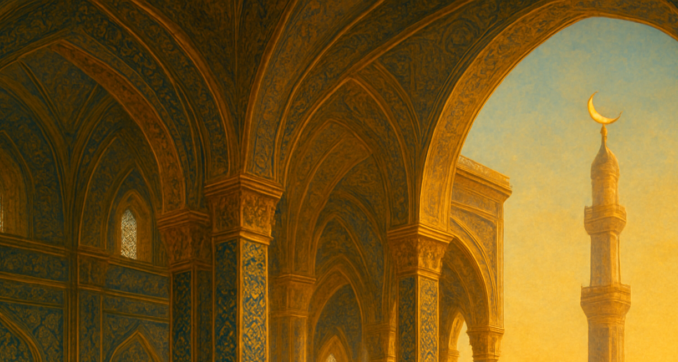
Imagine standing shoulder to shoulder with others, all oriented toward the same purpose — something greater than any single individual. That sense of alignment, of collective devotion, is almost universally recognizable. It is precisely this image that lies at the heart of the thirty-seventh chapter of the Quran: As-Saffat, or The Ranged Ones. While the text is rooted in Islamic tradition, its themes of cosmic order, steadfast devotion, and purposeful formation resonate far beyond any single faith — not least within the tradition of Freemasonry.
What Does Surah 37 Tell Us?
The surah opens with a striking image: angels arrayed in rows, guiding humanity and reciting sacred words. This is not merely poetic ornamentation. It expresses a fundamental principle — that there exists a cosmic order in which everything and everyone has a place. The angels are not scattered at random; they stand in deliberate formation, oriented toward the Divine.
As the surah unfolds, familiar narratives emerge. Noah, who remained steadfast when no one believed him. Abraham, who was willing to make the ultimate sacrifice. Moses and Aaron, who stood together against injustice. Elijah, who single-handedly confronted an entire people about their deviation from truth. These are not isolated anecdotes. They are illustrations of individuals who placed themselves in service of a higher purpose, even when it was profoundly difficult to do so.
The Image of the Row: More Than a Formation
You may recognize the feeling yourself — that moment when you come together with others for something meaningful. A memorial, a ceremony, a shared endeavor. Something shifts when people arrange themselves, literally or figuratively, in a line. The individual steps back, not because they are diminished, but because they are absorbed into something larger. This principle runs through many spiritual traditions, and it is unmistakably present in Freemasonry.
In a lodge, brethren do not stand in random disorder. Every position carries meaning. The arrangement during ritual work is deliberate and thoughtful, much like the rows of angels described in As-Saffat. This is not hierarchy in the sense of power — it is order that creates space for concentration, reflection, and collective focus. When you stand together in silence, oriented toward the same point, an energetic field emerges that is far greater than the sum of its parts.
True brotherhood does not arise in spite of order — it arises precisely because of the willingness to take one’s place within a greater whole.
Prophets as Builders of Inner Temples
The stories of Abraham, Noah, and the other prophets in this surah share a common thread: each of them built something. Not always something tangible, but always something enduring. Noah literally built an ark, yet more importantly he built faith in a time of mockery. Abraham built surrender, even when it seemed to demand the unthinkable. Moses and Aaron built liberation, step by step, against all resistance.
This motif of building resonates deeply with the Masonic tradition. The metaphor of constructing one’s own inner temple is no hollow phrase. It demands daily labor — laying stones that represent virtues, chipping away rough edges, seeking balance and proportion. The prophets in As-Saffat are, in this sense, master builders of the soul. They are examples of how to remain steadfast when the world around you seems consumed by chaos.
For the Freemason, these narratives serve as powerful reminders that the work on the inner temple never ceases, and that the greatest construction projects are often invisible to the outside world.
Purification and the Path Toward Light
Another theme woven throughout As-Saffat is purification — the distinction between truth and falsehood, between sincerity and self-deception. This capacity for discernment does not come naturally. It requires inner work, honesty with oneself, and the courage to face where you fall short.
In Freemasonry, this process is often symbolized as the journey from darkness to light. You begin in a state of unknowing — not as a mark of shame, but as a starting point. Step by step, through study, reflection, and ritual, you move toward greater clarity. Not because someone hands you the answers, but because you learn to ask the right questions. As-Saffat extends a similar invitation to self-reflection: Where do you stand in the row? What is your contribution to the greater whole?
Brotherhood Beyond Boundaries
What is consistently striking about texts like As-Saffat is how universal their message truly is. Whether you are Muslim, Christian, Jewish, or identify with none of these traditions, the image of people standing together around something sacred speaks a primal language. The question is not which tradition has the final truth. The deeper recognition is that human beings, across all ages and cultures, have sought connection, meaning, and a place in the greater story.
Freemasonry offers a space for people of all backgrounds precisely because it emphasizes shared values rather than shared dogmas. As-Saffat reminds us that taking your place in the row does not mean losing your individuality. On the contrary — your individuality only gains its fullest meaning when you place it in service of something that reaches beyond yourself alone.
An Invitation to Reflection
Take a moment today to consider your own place. Not in terms of status or rank, but in terms of where you stand in relation to your ideals, your fellow human beings, your inner compass. The question is not whether you stand at the front or the back. The question is whether you stand consciously — aligned, directed, and present. That is the spiritual lesson As-Saffat holds before us, and it is one that can resonate in every lodge, every community, and every human heart.
Surah 37, The Ranged Ones, is far more than a recounting of ancient stories. It is an invitation to reflect on order, devotion, and the transformative power of collective purpose. Whether you are well-versed in the Quran or encountering this text for the first time, its imagery speaks a language that echoes deeply within the Masonic tradition. Standing in formation does not mean surrendering your individuality — it means elevating your individuality by placing it in service of something greater, brighter, and more enduring than yourself.
Copyright text & image: devrijmetselaar.nl
Texts are based on the ideas and content of the author of devrijmetselaar.nl, reviewed, corrected, and supplemented with the assistance of OpenAI. Images are created based on the ideas of the author of devrijmetselaar.nl using OpenAI/DALL-E.

Be the first to comment