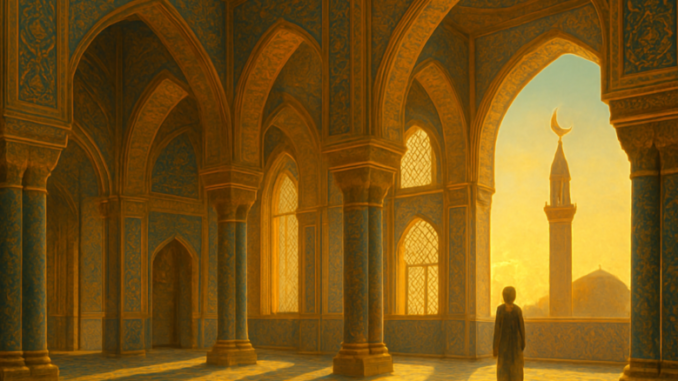
Have you ever wondered why people stand in rows during a ceremony? Or why a choir sings in formation? There is something profoundly meaningful about ordered arrangement — something that reaches far beyond mere practicality. The thirty-seventh surah of the Quran, known as As-Saffat or The Ranged Ones, opens with an image that strikes at the heart of this mystery: rows of beings who align themselves in service of something greater than themselves. For anyone familiar with Freemasonry, the resonance is immediate and unmistakable.
The Opening: A Vision of Cosmic Order
The surah begins with three powerful oaths — by those who range themselves in rows, by those who drive with a reproof, and by those who recite the reminder. This is not random poetry. It paints a picture of a universe governed by order, in which every entity has a place and a function. The angels stand in ranks, not out of compulsion, but out of devotion. Together they form a whole far greater than the sum of its parts.
You may recognize this from your own experience: those moments when you were part of something that transcended you. A team working in unison, a community gathered with shared purpose, a group looking in silence toward the same horizon. The Ranged Ones speaks to that universal longing for connection and meaning — the same longing that draws men to the lodge.
Prophetic Stories as Mirrors for the Self
A large portion of this surah consists of stories about prophets: Noah, Abraham, Moses, Elijah, Lot, and Jonah. Each story presents a human being confronted with a choice. Abraham is tested with the question of whether he can sacrifice his son. Jonah must learn that you cannot flee from your destiny. Noah builds an ark while those around him mock him relentlessly.
These narratives are not history lessons. They function as mirrors. They ask: what would you do when your calling collides with your comfort? When your inner voice points you in a different direction from the crowd? The prophets in The Ranged Ones are not untouchable saints. They are people who struggle, who doubt, and who ultimately choose what they recognize as truth.
In Freemasonry, this same principle is at work. The rituals and allegories of the Craft are not stories about other people — they are tools for self-examination, designed to help each Brother confront his own choices and character.
Brotherhood and the Power of the Row
The image of the ranged ones touches on a central theme in Freemasonry: the brotherhood as an ordered whole. In a lodge, Brethren do not stand randomly. Every position carries meaning. The arrangement reflects an inner order — a willingness to take your place within a greater pattern.
True brotherhood does not arise from uniformity, but from the willingness to consciously stand alongside others who seek the same light.
This is not forced conformity. It is voluntary alignment. Just as the angels in The Ranged Ones arrange themselves out of love, Freemasons choose to work together toward their own improvement and that of the world around them. The row becomes a symbol of conscious dedication — a living expression of the idea that individual purpose and collective harmony are not opposites, but partners.
The Struggle Between Light and Darkness
The Ranged Ones also contains passages about the struggle between truth and deception, between the messengers and those who reject them. This theme of light versus darkness runs like a thread through countless spiritual traditions. In Freemasonry, light is sought in the lodge — both symbolically and inwardly. The candidate emerges from darkness and moves toward the light.
But here is the crucial point: this struggle is not a war against others. It is primarily an inner movement. The darkness you must overcome does not reside outside of you. It lives in your own errors, your automatic reactions, your unconscious patterns. The prophets in this surah do not fight with swords. They fight with steadfastness, with patience, and with faithfulness to their inner compass. This is the same battle every Freemason undertakes when he commits to working on his rough ashlar.
Abraham and the Sacrifice: A Lesson in Surrender
The story of Abraham and his son forms the emotional climax of this surah. Abraham dreams that he must sacrifice his son. He shares this with the boy, who responds: “Do what you have been commanded. You will find me, God willing, among the patient.” At the supreme moment, the sacrifice is averted and replaced by a ram.
This story is not about literal sacrifice. It is about the willingness to examine your deepest attachments. What are you prepared to let go of in service of what you recognize as true? In Freemasonry, this theme is mirrored in the ritual death and rebirth — the shedding of the old self to make room for growth and transformation. Surrender, paradoxically, becomes the gateway to a fuller life.
Spirituality as Living Practice
The Ranged Ones concludes with the assurance that the messengers will prevail and that peace rests upon them. This is not a triumphant ending in any worldly sense. It is the promise that whoever remains faithful to their inner calling will ultimately find peace — not as a reward, but as the natural consequence of a life lived in alignment with one’s deepest values.
The themes woven throughout this surah can be distilled into principles that any seeker will recognize:
Order as an expression of inner devotion. Brotherhood as voluntary alignment with a greater whole. Prophetic stories as mirrors for personal growth. The inner struggle between light and darkness. Surrender as the precondition for transformation.
When you read the Quran with an open heart — regardless of your own background or tradition — you find in surahs like this one universal themes that transcend all boundaries. The Ranged Ones invites you to reflect on your own place in the grand order of things. Not as a passive follower, but as a conscious participant in the mystery of existence.
The thirty-seventh surah of the Quran offers far more than religious prescription. It opens a window onto universal questions about order, brotherhood, and personal transformation. For those who know the language of Freemasonry, these themes resonate deeply. The ranged ones are not merely angels in a cosmic hierarchy. They are also us — whenever we choose to consciously connect with others who seek the same light. Perhaps that is the deepest lesson of all: that spirituality is not a solitary quest, but a journey made in the company of others who look in the same direction.
Copyright text & image: devrijmetselaar.nl
Texts are based on the ideas and content of the author of devrijmetselaar.nl, reviewed, corrected, and supplemented with the assistance of OpenAI. Images are created based on the ideas of the author of devrijmetselaar.nl using OpenAI/DALL-E.

Be the first to comment