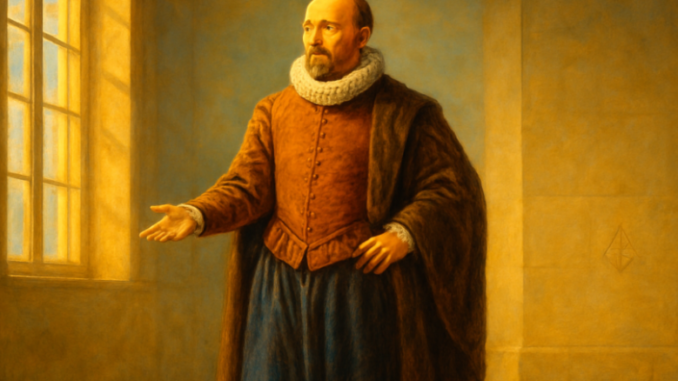
Have you ever wondered why clever plans so often backfire? Why a brilliant strategy — whether on the battlefield or in everyday life — sometimes produces the exact opposite of what you hoped for? Michel de Montaigne asked himself that very question in his essay ‘On Vain Stratagems,’ and he found answers in the greatest thinkers of antiquity. But which philosophical traditions fed his deep distrust of human cunning? And what does any of this have to do with the way Freemasons approach honesty and self-knowledge? Let us trace the intellectual roots of this fascinating essay together.
The Stoic Rejection of Pretense
When you read Montaigne’s essay, the presence of Stoic philosophy is immediately felt. Thinkers such as Seneca and Epictetus taught that reality cannot be bent to our will through clever tricks. The Stoics emphasized that virtue and sincerity are the only reliable guides in a world full of uncertainty. Seneca warned repeatedly that those who rely on cunning ultimately deceive themselves. You cannot outsmart fate through ingenuity alone.
Montaigne, who had a deeply intimate relationship with Seneca’s writings, took this lesson to heart. In ‘On Vain Stratagems,’ he uses military examples to show how elaborate battle plans failed precisely because of their complexity. The Stoic lesson is clear: the more you try to manipulate, the further you drift from the natural order of things. Simplicity and honesty are not signs of weakness — they are sources of strength. This insight resonates profoundly with the way Freemasons understand the craft of character-building: not through cunning, but through sincere labor upon oneself.
Plutarch and the Lessons of History
Alongside Seneca, Plutarch was one of Montaigne’s most cherished sources. The Greek historian and moralist offered a treasure trove of examples in his ‘Lives’ and ‘Moralia’ — stories of leaders who fell through arrogance and contrived strategies. Plutarch systematically compared Greek and Roman generals, demonstrating how character weighed more heavily than tactical brilliance. Alexander the Great, Julius Caesar, Hannibal: for each of them, Plutarch examined the tension between genuine courage and calculating shrewdness.
Montaigne drew eagerly from this material. He did not use historical anecdotes merely as illustrations, but as philosophical evidence. Where Plutarch extracted moral lessons from the past, Montaigne did the same — but with a more personal, introspective perspective. You sense that as a reader of Plutarch, he constantly asked himself: what does this say about me? What does this reveal about the human tendency to believe we have everything under control? That willingness to engage in self-examination is precisely what lies at the heart of Freemasonry: the honest look in the mirror.
Skepticism as a Foundation
Perhaps the deepest philosophical layer in this essay is skepticism. Montaigne was profoundly influenced by Pyrrhonism — the radical tradition of doubt that traces back to the Greek philosopher Pyrrho of Elis and was later transmitted through the writings of Sextus Empiricus. The core principle of Pyrrhonist skepticism is that human knowledge is always uncertain. You may believe you see a situation clearly, that your plan is watertight, but reality is invariably more complex than your mental model of it.
In ‘On Vain Stratagems,’ Montaigne applies this insight concretely to military strategy. A stratagem assumes you can predict your opponent’s reaction. But if your own knowledge is unreliable, how can you possibly fathom the thoughts of another? Skepticism teaches humility: the acknowledgment that you do not know everything, and that this acknowledgment is itself a form of wisdom. Montaigne even had the famous motto ‘Que sais-je?’ (‘What do I know?’) engraved on his personal medal — a question that accompanied him throughout his life.
Montaigne’s true wisdom lies not in rejecting knowledge, but in recognizing that honesty about your own ignorance is worth more than the sharpest stratagem.
Renaissance Humanism and the Measure of Man
Montaigne wrote at the heart of the French Renaissance, a period when the rediscovery of classical texts went hand in hand with a renewed confidence in humanity’s capacity for reason and reflection. Humanists such as Erasmus and Francesco Petrarch had paved the way by making the wisdom of antiquity accessible once more. But where many Renaissance thinkers leaned toward optimism about the human mind, Montaigne was more cautious. He admired the classics, but refused to follow them blindly.
In his essay on vain stratagems, this tension is clearly visible. Montaigne appreciates the inventiveness of military commanders and strategists, yet simultaneously shows how that very inventiveness can be misleading. The humanistic ideal of the well-rounded, thinking individual is nuanced here: yes, you have the capacity for great things, but that capacity has limits. Overestimating yourself is just as human a trait as creativity. This balance between confidence and humility is a theme that recurs continually in Freemasonry — for example, in the way the Entered Apprentice is invited to grow without elevating himself above others.
Aristotle, Practical Wisdom, and the Golden Mean
Although Montaigne draws less explicitly on Aristotle than on Seneca or Plutarch, the Aristotelian concept of phronesis — practical wisdom — resonates clearly throughout this essay. Aristotle taught that true wisdom does not consist of theoretical brilliance, but of the ability to do the right thing in concrete situations. That ‘right thing’ is rarely the most ingenious or the most spectacular option — it is more often the appropriate, the balanced choice.
Montaigne demonstrates in ‘On Vain Stratagems’ that the most effective approach is often the simplest. A direct attack sometimes surpasses the most refined ambush — not because directness is inherently superior, but because simplicity reduces the number of things that can go wrong. Aristotle’s golden mean reminds us that extremes — whether of reckless boldness or of overwrought cleverness — tend to produce failure. The middle path, the measured response, is frequently the wisest course of action.
For Freemasons, this Aristotelian principle holds particular relevance. The Craft consistently encourages its members to seek balance: between knowledge and humility, between ambition and service, between action and reflection. Montaigne’s essay, read through this lens, becomes not merely a critique of military cunning but a meditation on the kind of character that endures — a character built on integrity rather than on cleverness, on self-awareness rather than on self-deception.
Montaigne’s essay on vain stratagems draws from a remarkably rich philosophical heritage — Stoicism, Plutarch’s moral history, Pyrrhonist skepticism, Renaissance humanism, and Aristotelian practical wisdom. What unites these traditions is a shared conviction: that honesty, humility, and self-knowledge are more reliable than any cunning scheme. For Freemasons, this message carries a special resonance. The Craft has always taught that the most important work is not outward strategy but inward reflection — the patient, honest labor of building a better self. Montaigne’s philosophical roots remind us that this insight is not new, but ancient, enduring, and profoundly human.
Copyright text & image: devrijmetselaar.nl
Texts are based on the ideas and content of the author of devrijmetselaar.nl, reviewed, corrected, and supplemented with the assistance of OpenAI. Images are created based on the ideas of the author of devrijmetselaar.nl using OpenAI/DALL-E.
Frequently Asked Questions
What is Montaigne's main argument about cunning stratagems in his essay?
Montaigne argues that clever plans and cunning strategies often backfire because they rely on manipulation rather than virtue and sincerity. He demonstrates through historical and philosophical examples that elaborate schemes fail precisely because of their complexity, and that simplicity and honesty are sources of strength rather than weakness.
How does Stoic philosophy influence Montaigne's views on cunning?
Stoic philosophers like Seneca and Epictetus taught that reality cannot be bent through clever tricks, and that virtue and sincerity are the only reliable guides in an uncertain world. Montaigne adopted this lesson, using military examples to show how those who rely on cunning ultimately deceive themselves and drift from the natural order of things.
What role does Plutarch's historical work play in Montaigne's essay?
Plutarch's 'Lives' and 'Moralia' provided Montaigne with historical examples of leaders like Alexander the Great, Julius Caesar, and Hannibal. Montaigne used these anecdotes not merely as illustrations but as philosophical evidence, extracting moral lessons that demonstrate how character and genuine courage weigh more heavily than tactical brilliance and calculating shrewdness.



Be the first to comment