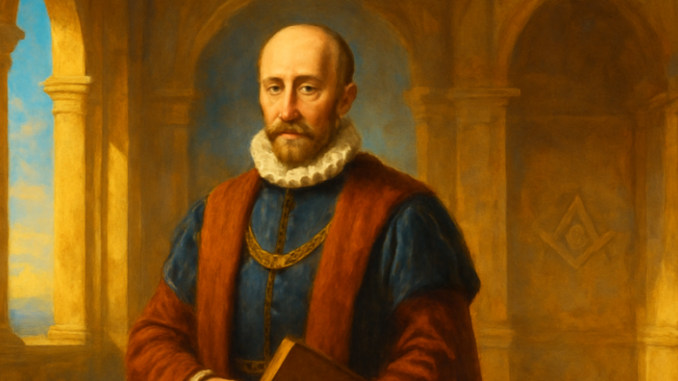
Sometimes a single remark in a conversation strikes deeper than an entire lecture. One sentence lingers, forcing you to reconsider how you relate to others — what genuine connection truly means. Michel de Montaigne had exactly that experience when he examined a phrase by Julius Caesar. In his fifty-third essay from the first book of The Essays, Montaigne explores how words can either bridge or widen the distance between people. That theme resonates profoundly with Freemasonry, where connection is not merely a byproduct of gathering together but the very heart of the brotherhood.
What Caesar Said and Why It Struck Montaigne
Julius Caesar was famous for his directness. He was a general who dominated not only battlefields but also language itself with rare mastery. In this essay, Montaigne seizes on a specific word from Caesar — not for its military context, but for what it reveals about how one person relates to another. Caesar understood that words either unite or divide. He knew that honesty, delivered plainly and concisely, inspires more trust than ornate rhetoric.
Montaigne was fascinated by this ability. In his essay, he poses a question that feels timeless: when does language become a bridge, and when does it become a wall? He observes that many people speak to impress rather than to be genuinely heard or understood. Caesar did the opposite. He spoke to connect, to reach the essence of a matter, to build trust. It is precisely this distinction that compels Montaigne toward self-reflection — and it is precisely this distinction that plays a central role in Freemasonry as well.
Connection as the Foundation of the Lodge
In Freemasonry, connection is not an abstract ideal. It is something you practice — ritual after ritual, meeting after meeting. When brethren gather in the lodge, they set aside their social rank. The banker sits beside the carpenter. The professor next to the mail carrier. What remains is the human being behind the title, the voice behind the role. It is an exercise that mirrors what Montaigne describes when he praises Caesar’s directness: stripping away pretense to arrive at the core of human encounter.
The rituals of the lodge are designed for exactly this purpose. They create a space where words carry weight, where silence speaks as eloquently as speech. The solemnity of ritual reminds everyone present that connection begins with attention — with listening, with the willingness to make yourself vulnerable. Montaigne did this in every essay he wrote. He laid bare his doubts, his questions, and his uncertainties — not to show weakness, but because he understood that sincerity is the shortest path to another human being.
The Virtue of the Honest Word
Montaigne was deeply influenced by the Stoic tradition. Thinkers like Seneca and Marcus Aurelius emphasized that virtue lies not in what you say but in the alignment between your words and your deeds. Caesar embodied this in his brevity: he said what he meant and did what he said. Montaigne saw in this a moral compass that helped him examine his own conduct.
Freemasonry upholds a similar principle. The search for truth — one of the brotherhood’s core values — begins with honesty toward yourself. The mirror the lodge holds up is not always comfortable. It asks you to examine whether your words match your intentions, whether you speak to connect or merely to strengthen your own position. This is no simple exercise. It demands courage — the same courage Montaigne showed when he wrote his essays as a continuous act of self-examination.
Connection does not arise from saying a great deal, but from saying the right thing at the right moment, with genuine attention for the other person.
Self-Reflection as a Path to Others
What Montaigne demonstrates in this essay is that the road to connection paradoxically begins with yourself. You can only truly listen to another once you have learned to listen to your own inner voice. You can only speak with sincerity when you know who you are — with all your flaws and gifts. The self-knowledge Montaigne pursued, captured in his famous motto “Que sais-je?” (What do I know?), is not the endpoint of a quest but its very beginning.
Freemasonry embraces the same paradox. The rough ashlar you work on is yourself. But the goal of that work is not merely individual perfection. The aim is that by becoming a better version of yourself, you become better equipped to contribute to the whole. Every stone that is smoothed fits more precisely into the building. Every brother who knows himself contributes more to the brotherhood. Montaigne would have recognized this immediately. His essays are not monologues — they are invitations to conversation, attempts to build a bridge to the reader through self-reflection.
From Words to True Encounter
Imagine sitting in a lodge. The ritual has concluded, the gavel has sounded for the last time, and the moment has come for fraternal conversation. Someone shares a personal experience — not to impress, but to offer something of themselves. The words are simple, perhaps even clumsily chosen, but they come from within. In that moment, precisely what Montaigne describes when he admires Caesar takes place: language becomes an instrument of connection rather than display.
This is the lodge at its finest. It creates a safe space where words recover their original power — where you do not need to perform with your language but may search for the word that truly matters. Montaigne understood this centuries ago. Caesar understood it even earlier. And every brother who finds the courage to speak honestly on an evening in the lodge rediscovers that same truth anew.
It is no coincidence that Montaigne’s essays are still read today. They speak to something universal — the longing to be known, to be understood, and to understand in return. In Freemasonry, that longing finds a living practice. The lodge is not a place where you go to receive answers. It is a place where you learn to ask better questions — of yourself and of those who sit beside you on the level.
Montaigne, Caesar, and the Masonic lodge may seem like an unlikely constellation, but they share a single profound insight: genuine connection begins with honest speech and honest self-examination. The lodge offers what Montaigne sought throughout his writing life — a space where pretense falls away, where words carry real weight, and where the simple act of listening becomes a form of brotherhood. In a world that often rewards performance over authenticity, that lesson is more relevant than ever. The rough ashlar awaits, and so does the brother sitting next to you.
Copyright text & image: devrijmetselaar.nl
Texts are based on the ideas and content of the author of devrijmetselaar.nl, reviewed, corrected, and supplemented with the assistance of OpenAI. Images are created based on the ideas of the author of devrijmetselaar.nl using OpenAI/DALL-E.

Be the first to comment