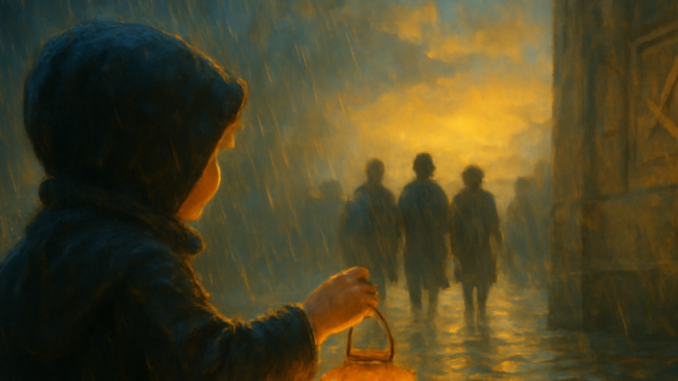
It’s November 10th, and tomorrow thousands of children will brave the rain with paper lanterns in hand. Meanwhile, in the southern Netherlands and across the Rhineland, carnival season kicks off on the Eleventh of the Eleventh. The forecast calls for layers and waterproofs. But why do people venture out at all, despite the cold and the wet? And what does that deep human urge to take to the streets together have to do with an ancient tradition of brotherhood? Let’s sit with that question for a moment — as if gathered around a warm table for a good conversation.
Why Do We Go Outside When the Weather Fights Us?
It’s a question most of us ask ourselves on a bitter November evening. The wind tears through the streets, the rain threatens every paper lantern, and yet parents and children stand shoulder to shoulder, singing at their neighbors’ doors. The same is true for the thousands of revelers who flood cities like Maastricht, Den Bosch, and Eindhoven on November 11th to herald the new carnival season — often in costumes that are anything but waterproof.
The answer is both simple and profound: human beings are wired for connection. Not despite difficult circumstances, but precisely because of them. Headwinds make togetherness more meaningful. Every Freemason recognizes that principle.
What Does St. Martin Have to Do with Brotherhood?
The story of St. Martin of Tours — the fourth-century Roman soldier who shared his cloak with a beggar — is one of the most powerful images of charity in Western tradition. On a freezing winter night, Martin cut his warm cloak in half. Not out of duty, not for recognition, but from a genuine impulse to share. That gesture lies at the heart of St. Martin’s Day: children go door to door and receive something from strangers, a small ritual of giving and receiving that strengthens community bonds.
In Freemasonry, that same impulse is a cornerstone. The fraternity teaches that true connection arises when you are willing to give something of yourself — without conditions and without calculation. James Anderson, who committed the first constitutions of modern Freemasonry to paper in 1723, already emphasized that brethren must support one another in adversity and in prosperity alike. That is precisely what Martin did: sharing when it matters most, especially when the cold bites hardest.
Brotherhood is not waiting for fair weather — it is walking together when the storm picks up.
The Eleventh of the Eleventh: What Can Carnival Teach Us?
On the same date, carnival season begins in the southern Netherlands and across large parts of the Rhineland. The Eleventh of the Eleventh is a day when hierarchy is temporarily suspended: the carnival prince reigns, the mayor hands over the key to the city, and everyone becomes equal. That principle of equality is deeply embedded in Freemasonry.
Within the lodge, every brother leaves his social position at the door. Whether someone is a doctor or a carpenter, a professor or a bus driver — in the temple, all are equal. The carnival ritual mirrors that insight in a boisterous, popular way.
Jean-Jacques Rousseau wrote in the eighteenth century about the importance of festivals where class distinctions dissolve and people come together as equals. He saw in such gatherings the very core of a healthy society. Viewed through that lens, the Eleventh of the Eleventh is not merely the starting gun for a party — it is an annual ritual of renewed equality.
What Do Layers and Rain Jackets Teach Us About Initiation?
Here the conversation becomes more personal. The weather forecast advises layers and a good rain jacket. Practical advice, of course. But there is a beautiful metaphor hidden within it. We all wear layers — social roles, expectations, protective habits. Just as we bundle up for a harsh November evening, we put on layers to shield ourselves from the outside world.
Freemasonry invites its members to examine those layers consciously. Which layer is authentic? Which is armor? And which layer can come off when you find yourself in trusted company? The lodge is, above all, a space where brethren are invited to be vulnerable — to shed a layer now and then, trusting that others will do the same.
Johann Wolfgang von Goethe, himself a devoted Freemason, spoke about the importance of sincerity in human relationships. He believed that true growth is only possible when a person dares to show himself as he truly is — stripped of the protective layers the outside world imposes upon him.
Is Brotherhood a Kind of Shelter?
That’s an important question, and it deserves a nuanced answer. Brotherhood in Freemasonry is not an escape from the world. It is more like a workshop where you prepare yourself for the world. Just as a good rain jacket doesn’t keep you indoors but sends you confidently into the street, the lodge equips its members with tools to step outside more resolutely.
The ritual of the meeting, the silence, the shared meal — these are all moments that strengthen the bond between brethren. And that bond is not an end in itself but a means. A means to share more generously, as Martin of Tours did. To live together more honestly, as carnival in its purest form aspires to do.
Marcus Aurelius, the Roman emperor and Stoic philosopher, wrote in his Meditations that human beings are by nature communal creatures. Our well-being depends not on the weather or our circumstances, but on the quality of our connections with others. That insight is two thousand years old and still very much alive — whether you’re walking through the rain with a paper lantern or sitting beside your brother in a lodge.
Tomorrow, children’s voices will ring out through rainy streets. In the south, people will dance and laugh under threatening skies. And somewhere, in a lodge, brethren will gather — regardless of the weather. What all these gatherings share is the conviction that walking together matters more than comfort. That giving is more valuable than receiving. And that equality is not an abstract ideal, but something you can practice — every single day.
Copyright text & image: devrijmetselaar.nl
Texts are based on the ideas and content of the author of devrijmetselaar.nl, reviewed, corrected, and supplemented with the assistance of OpenAI. Images are created based on the ideas of the author of devrijmetselaar.nl using OpenAI/DALL-E.
Frequently Asked Questions
What is the connection between St. Martin's Day and Freemasonry?
St. Martin of Tours, a fourth-century Roman soldier who shared his cloak with a beggar, embodies the principle of selfless giving that is central to Freemasonry. Both traditions teach that true brotherhood arises when individuals are willing to give something of themselves without conditions or calculation. This principle was emphasized by James Anderson in the first Masonic constitutions of 1723, which stated that brethren must support one another in both adversity and prosperity.
Why do people participate in November celebrations despite bad weather?
Human beings are fundamentally wired for connection, and difficult circumstances often make togetherness more meaningful rather than less. The challenging weather during St. Martin's Day celebrations and the Eleventh of the Eleventh carnival season demonstrates that community bonds are strengthened precisely when people choose to gather together despite adversity. This principle of unity through hardship is a cornerstone of both traditional celebrations and Masonic brotherhood.
How does the ritual of St. Martin's Day strengthen community bonds?
St. Martin's Day involves a ritual where children go door to door to receive gifts from neighbors and strangers. This simple act of giving and receiving reinforces community bonds by creating moments of genuine human connection and mutual support. It mirrors the Masonic concept that brotherhood is not passive—it requires active participation and the willingness to walk together, especially when conditions are difficult.

Be the first to comment