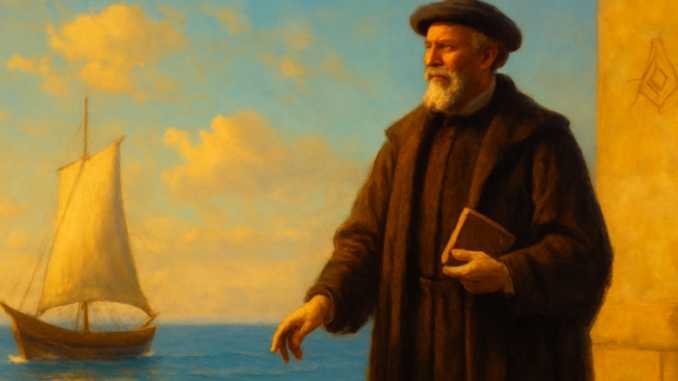
What if the key to genuine human connection lies not in what we add to our lives, but in what we dare to strip away? Michel de Montaigne argues in his brief but penetrating essay ‘On the Frugality of Our Ancestors’ that the strength of the ancient Romans came not from abundance, but from simplicity. At first glance, this seems to have little to do with brotherhood or lodge work. But anyone who sits with the essence of this essay long enough will discover a paradox that surfaces again and again in Freemasonry: only when we rid ourselves of unnecessary adornment does real space open up for authentic connection with others.
The Paradox of Less
In this fifty-second essay of his first book, Montaigne describes how the great Roman statesmen and generals lived with a simplicity that would astonish his contemporaries. Their tables were modest, their clothing functional, their homes unadorned. Yet these were the very men who laid the foundations of a civilization that would endure for centuries. Montaigne points to figures like Cato the Elder, who prepared his meals with his own hands and received guests without any display of pomp. The paradox is striking: fewer possessions, but greater authority. Less outward show, but deeper influence.
This is not a nostalgic longing for some lost golden age. Montaigne is far too sharp for that kind of sentimentality. What he uncovers is a principle: that temperance is not merely a personal virtue, but a precondition for meaningful engagement with others. Those who are perpetually occupied with accumulating and displaying possessions lose sight of what truly matters in their dealings with fellow human beings. The frugality of the ancestors, read this way, was not a matter of poverty but of priority.
Simplicity as a Moral Exercise
For anyone familiar with Freemasonry, Montaigne’s argument rings immediately true. In the lodge, every brother enters the space without outward signs of social rank or wealth. The apron is the same for all. The ritual space is deliberately stripped of personal vanity — not because differences are denied, but because the lodge is a place of practice where the inner life carries more weight than the outer one. The frugality that Montaigne admires in the Romans is closely related to this Masonic practice: a conscious step back from the material in order to create space for the moral.
Aristotle wrote that virtue lies in the mean between two extremes. Montaigne, who knew Aristotle well but also debated him freely, would have agreed on this point. Frugality is neither miserliness nor asceticism, but a deliberate choice to let go of what is superfluous. In Freemasonry, this idea is reflected in the symbol of the rough ashlar that must be worked — not by adding something to it, but by chipping away everything that does not belong to the pure form.
The Connection That Emerges When Pretense Falls Away
Here we arrive at the heart of the matter. Montaigne’s essay is ultimately not about money or possessions. It is about what happens between people when the ornamentation drops away. The ancestors he describes were not only simple in their way of life but also direct in their dealings with one another. There was no layer of polite performance concealing the real person beneath. And it was precisely in that directness, Montaigne argues, that their capacity to inspire trust and hold communities together resided.
Freemasonry recognizes this principle as one of its deepest values. Brotherhood does not arise from what brethren possess or achieve in the outside world, but from what they are willing to share in the protected space of the lodge: their doubts, their insights, their ongoing search. Seneca, whom Montaigne quoted frequently and with whom he carried on a lifelong dialogue through the page, put it succinctly: we suffer more often in imagination than in reality. Applied to human connection, this means that most barriers between people are not real but constructed from status, possessions, and the fear of being seen as we truly are.
True connection begins where excess ends. Only when we release the trappings of status and wealth can we meet one another as brothers.
A Counterpoint: Is Simplicity Enough?
Yet Montaigne’s idealization of the ancestors deserves a critical note. Was their simplicity truly a free choice, or was it merely the result of scarcity? And is it fair to measure the complexity of a modern society against the standards of an agrarian Roman republic? Montaigne himself would probably welcome these questions. His entire method as an essayist revolves around examining one’s own assumptions and continually questioning positions that are too easily accepted as truth.
From a Masonic perspective, the answer is nuanced. Simplicity alone is not sufficient to create connection. Openness is also needed, and courage, and the ability to truly listen. But simplicity does create the precondition: it clears the stage so that the real encounter can take place. Just as James Anderson’s Constitutions of 1723 emphasized a level playing field within the lodge regardless of birth or fortune, Montaigne points to the strength of a society where character, not possessions, is the measure of all things.
The Empty Table as a Meeting Place
If we read Montaigne’s essay as a meditation on connection, then the frugality of the ancestors is not an economic prescription but a philosophical principle. Cato’s simple table was not a sign of poverty but an invitation: come as you are, without a mask, without pretense. In Freemasonry, we know this invitation in a different form. The temple space, stripped of everyday hierarchy, is precisely such an empty table — a place where the search for truth, for light and knowledge, can only succeed when every brother is willing to set aside external distinctions.
Montaigne did not write about Freemasonry, of course. He lived in sixteenth-century France, centuries before the fraternity took its modern institutional form. But his philosophical instincts align remarkably with the Craft’s core convictions. The idea that what you own matters far less than who you are; the belief that vulnerability and directness are not weaknesses but the very foundation of trust; the recognition that a shared meal at a bare table can forge bonds stronger than any display of wealth — these are ideas that resonate as powerfully in the lodge as they do in the pages of the Essais.
Montaigne’s essay on ancestral frugality is a quiet but potent reminder that the most meaningful human connections are built not on what we accumulate, but on what we are willing to let go. In Freemasonry, the lodge itself embodies this truth: a space deliberately emptied of worldly distinction so that something deeper — brotherhood, self-knowledge, moral growth — can take root. The empty table is not bare because it lacks something. It is bare because it is waiting for something far more valuable: an honest encounter between human beings who have chosen to meet one another without pretense.
Copyright text & image: devrijmetselaar.nl
Texts are based on the ideas and content of the author of devrijmetselaar.nl, reviewed, corrected, and supplemented with the assistance of OpenAI. Images are created based on the ideas of the author of devrijmetselaar.nl using OpenAI/DALL-E.



Be the first to comment