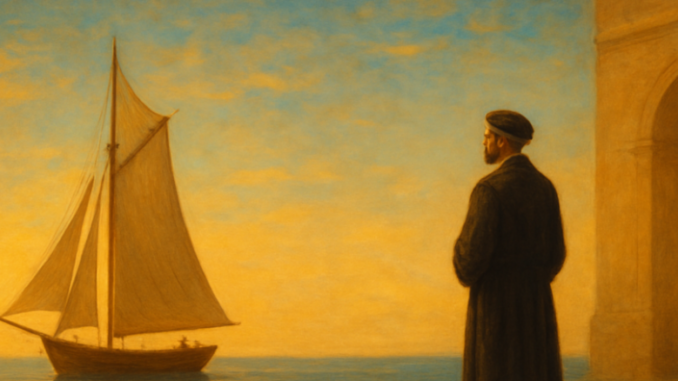
Imagine opening your wardrobe to find more than fifty shirts when you wear no more than three on any given day. Your kitchen cabinets overflow with gadgets used exactly once. Your bank statement reveals you spend more each month on subscriptions than on fresh vegetables. It is a familiar picture in our age of abundance. In the sixteenth century, Michel de Montaigne wrote a short but powerful essay that exposes precisely this tension: ‘Of the Parsimony of the Ancients.’ Found in the first book of his celebrated Essays, it holds up a mirror that, after more than four hundred years, remains sharp enough to give us pause.
The Heart of the Essay
In this fifty-second essay of Book One, Montaigne investigates a question that sounds simple yet runs surprisingly deep: why did our ancestors live so much more soberly than we do, and were they perhaps happier for it? Turning his gaze to Roman and Greek antiquity, he observes that the great statesmen and generals of old led remarkably modest lives. Figures such as Cato the Elder — the stern Roman censor famous for his uncompromising austerity — serve as guiding examples. Montaigne describes how these men bore enormous responsibilities, commanded armies, and governed empires, yet in their personal lives were content with very little.
The essay is brief, even by Montaigne’s standards. It reads almost like a marginal note in the book of history — a collection of observations that invites the reader to draw their own conclusions. Yet a clear message is woven through it: true greatness expresses itself not in outward display but in inner discipline. Montaigne contrasts the simple meals and modest dwellings of the ancients with the luxury that was becoming ever more commonplace among the French nobility of his own era.
The Examples Montaigne Draws Upon
Montaigne draws richly from classical sources. He refers to the writings of Plutarch, who described in detail how Roman consuls and senators worked their own land and labored with their hands before proceeding to the forum to draft laws. The image of a senator plowing his field in the morning and deliberating the fate of a nation in the afternoon is, for Montaigne, not a curiosity but an ideal. He also invokes the figure of Cincinnatus, the legendary Roman who was twice appointed dictator and twice, upon completing his task, returned to his farm. For Montaigne, these are not dusty anecdotes. They are living proof that frugality and decisive action can go hand in hand.
Montaigne then sharpens the contrast with his own contemporaries. The French aristocracy of the sixteenth century poured fortunes into clothing, banquets, and palaces while the country was torn apart by the Wars of Religion. That contradiction, Montaigne suggests, is telling: the more a society spends on outward appearances, the less inner strength it seems to possess.
What Frugality Really Means
It is important to understand that when Montaigne speaks of frugality, he does not simply mean miserliness. He speaks of a deliberate choice for simplicity — a way of living in which your sense of self-worth is not dependent on your possessions. In Freemasonry, this is a deeply familiar principle. The rough ashlar that must be shaped into a perfect cube represents exactly this process: chiseling away the superfluous to arrive at the essence. Frugality, as Montaigne describes it, is not a deficiency but a surplus of inner wealth.
Frugality is not poverty of means but richness of character: the ability to be much with little.
This thought aligns closely with what the Stoic philosopher Seneca expressed centuries earlier and what Marcus Aurelius repeated in his personal meditations: that a person of true worth is distinguished by what they can let go of, not by what they accumulate. Montaigne consciously places himself within that tradition and makes it accessible for his own readers — and, by extension, for us.
Practical Lessons for Everyday Life
What can you actually do with this essay in your own life? Montaigne’s message translates into remarkably practical steps. Consider the following exercises, drawn directly from the spirit of his writing:
First, take an inventory of your possessions in a single room. For each object, ask yourself: does this contribute to who I want to be, or does it merely fill space? Second, choose one week each month in which you deliberately make no impulse purchases, and observe what happens to your state of mind. Third, replace one evening per week that you would normally spend money on entertainment with an activity that costs nothing — a walk, a meaningful conversation, reading a book. Fourth, at the end of each day, write down three things you enjoyed that did not involve spending money.
These exercises are not an ascetic program. They are an invitation to discover, as the ancients Montaigne writes about discovered, that less truly is more. The aim is to shift your attention from the external to the internal, from having to being.
A Mirror for Our Own Time
Montaigne’s essay is strikingly relevant in a world dominated by consumption and self-presentation. Social media tempt us daily to measure our happiness by what we own and display. The ancestors Montaigne describes knew no such pressure, but the lesson they embody is universal: real strength comes from moderation and self-knowledge, not from abundance.
In Freemasonry, this insight is practiced ritually. Every lodge meeting reminds brethren that the work on one’s own character deserves the highest priority. It is not the outward ornaments of life but the inner architecture that determines a person’s true worth. Montaigne would undoubtedly have recognized himself in that thought. His essay, though barely a few pages long, carries a weight that transcends centuries — a quiet yet insistent reminder that the measure of a life is found not in what surrounds us, but in what sustains us from within.
Montaigne’s brief meditation on the frugality of the ancients remains a powerful call to self-examination. In a culture that relentlessly encourages accumulation, his words invite us to pause and reconsider what we truly need. For Freemasons, who are already committed to the lifelong work of refining the self, this essay offers a welcome reminder: the greatest treasures are not those we acquire but those we cultivate within. Let the rough stone be shaped, the superfluous fall away, and the essence — strong, simple, and enduring — stand revealed.
Copyright text & image: devrijmetselaar.nl
Texts are based on the ideas and content of the author of devrijmetselaar.nl, reviewed, corrected, and supplemented with the assistance of OpenAI. Images are created based on the ideas of the author of devrijmetselaar.nl using OpenAI/DALL-E.
Frequently Asked Questions
What is the main argument Montaigne makes in 'Of the Parsimony of the Ancients'?
Montaigne argues that ancient Roman and Greek leaders lived remarkably modest and frugal lives despite their enormous power and responsibilities, suggesting they may have been happier for it. He contrasts their simplicity with the luxury and excess becoming common among French nobility in his own sixteenth-century era, proposing that true greatness comes from inner discipline rather than outward display.
Which historical figures does Montaigne use as examples of frugality?
Montaigne primarily references figures from classical antiquity, including Cato the Elder, a Roman censor famous for his austerity, and Cincinnatus, a legendary Roman leader who was twice appointed dictator but returned to farming after completing his duties. He also draws on Plutarch's writings about Roman consuls and senators who worked their own land before deliberating in the forum.
How does Montaigne's essay relate to modern consumer culture?
Although written over four hundred years ago, Montaigne's essay remains relevant to contemporary life. The essay opens by highlighting modern excess—overflowing wardrobes, unused kitchen gadgets, and excessive subscription spending—to show that the tension between abundance and simplicity has persisted. Montaigne's observations about the ancients' modest living serve as a mirror for readers to examine their own relationship with consumption and possessions.

Be the first to comment