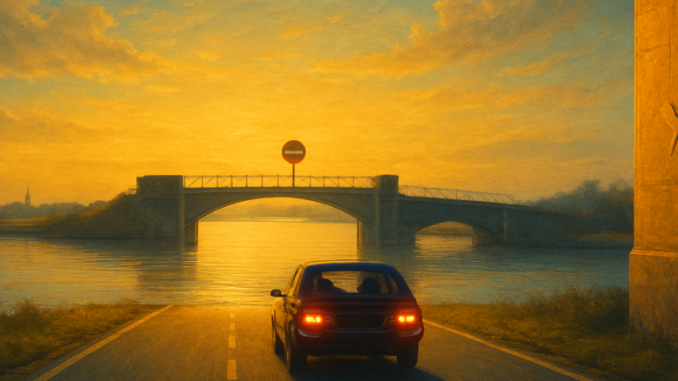
Imagine you’re driving down the highway, heading to a meeting, an appointment, or someone you love. Then a sign appears: the bridge ahead is closed. At least 48 hours. As a precaution. Your plans crumble, frustration rises. But what if this forced stop is more than an inconvenience? What if every blocked road in life is an invitation to turn inward?
The Paradox of Precaution as Wisdom
The word “precaution” carries a curious duality. On one hand, it implies fear of what lies ahead. On the other, it speaks of prudence — the ability to see beyond immediate utility. The decision to close a bridge is not a sign of weakness but of deeper insight: some structures deserve inspection before they collapse.
This principle already echoed through the writings of Marcus Aurelius, who wrote in his Meditations about the importance of self-examination before the soul develops cracks. The Stoic emperors understood that prevention is not cowardice — it is wisdom. The same wisdom runs through Freemasonry, where ritual silence precedes every piece of work. Before the gavel falls, there is reflection.
Stillness as a Spiritual Necessity
Modern culture has an uneasy relationship with standing still. We are perpetually on the move, always connected, ceaselessly productive. The closure of a major road confronts us with an ancient question: what happens when the constant motion stops? For the motorist, it means traffic jams, detours, and delays. But for the searching mind, another possibility opens up.
Every blocked road in the outer world is an invitation to walk the inner path.
In Freemasonry, the concept of the “Chamber of Reflection” is a foundational experience. Before a candidate is initiated, he sits in silence and darkness, cut off from the outside world. This is not a punishment but a gift — the opportunity to meet one’s own soul without distraction. A closed bridge, seen in this light, functions as a collective Chamber of Reflection for everyone forced to stop.
The Bridge as a Symbol of Connection
A bridge is never merely a functional structure. It represents the human urge to connect separated worlds, to span the chasms that nature has carved. The architect does not simply erect a construction of steel and concrete — he materializes an idea. Plato would say that every physical bridge is a shadow of the ideal Bridge, the archetype of connection itself.
When such a bridge temporarily becomes impassable, we suddenly experience the vulnerability of our connections. The rivers and channels we cross without a second thought every day reveal themselves as obstacles once more. This realization can be discouraging, but it can also be illuminating. It reminds us that connection is never to be taken for granted — that every bridge, literal and figurative, requires maintenance.
Brotherhood in the Detour
Perhaps the deepest lesson lies not in the closure itself but in what follows. Drivers seek alternative routes, share information, and help each other navigate unfamiliar terrain. In the discomfort of the detour, something emerges that is often absent under normal circumstances: a shared experience, a temporary community of the stranded.
Freemasonry knows this phenomenon as brotherhood — not as an abstract ideal but as a lived reality. When brethren work through a challenging ritual together, when they collectively wrestle with symbols and their meanings, a bond forms that transcends the individual. The same can happen in a traffic jam: in the shared inconvenience, in the collective search for a way through, something precious can grow.
The Inner Bridge to Self-Knowledge
Aristotle distinguished between different forms of knowledge but placed self-knowledge above all others. “Know Thyself” was inscribed above the temple at Delphi — a maxim that has inspired both the ancient Greeks and Freemasons to this day. The question then becomes: how do we arrive at that self-knowledge?
Often it is precisely the interruptions — the moments when our plans fail — that force us into reflection. A closed bridge, in this sense, is an opportunity. While the engine idles and the minutes stack up, a space opens. What is driving me forward? Where was I actually headed? And is that destination truly as urgent as I thought?
Interruption compels reflection. Stillness reveals what motion conceals. Detours open new perspectives. Shared discomfort forges connection.
An Invitation to Wait
The ancient mystery schools taught that initiation cannot be forced. The candidate must wait until the moment is ripe, until the doors open of their own accord. Patience is not a passive state but an active posture of receptivity. Perhaps we can regard an enforced pause as a collective initiation — an exercise in enduring uncertainty.
The bridge will reopen. That much is certain. But what we take with us from this period of forced stillness depends on our willingness to see the closure not merely as an obstacle but also as a teacher. Spinoza wrote that the highest freedom lies in understanding the necessity of things. The bridge had to close. The question now is: what do we do with that knowledge?
When the road reopens, most of us will quickly forget there was ever a closure at all. That is human nature. But perhaps for a few, something will linger: the realization that every interruption can be a mirror. That stillness is not the opposite of progress but a precondition for it. And that the road inward only becomes visible when the road outward is blocked. What bridge do you need to build to reach yourself?
Copyright text & image: devrijmetselaar.nl
Texts are based on the ideas and content of the author of devrijmetselaar.nl, reviewed, corrected, and supplemented with the assistance of OpenAI. Images are created based on the ideas of the author of devrijmetselaar.nl using OpenAI/DALL-E.
Frequently Asked Questions
What is the Masonic concept of the 'Chamber of Reflection' mentioned in this article?
The Chamber of Reflection is a foundational Masonic experience where a candidate sits in silence and darkness before initiation, cut off from the outside world. Rather than being a punishment, it is described as a gift that allows the individual to meet their own soul without external distractions. The article uses this concept to explain how forced stops in life, like a closed bridge, can serve as opportunities for inner spiritual work.
How does Freemasonry view the concept of precaution and prevention?
According to the article, Freemasonry views precaution not as a sign of weakness or fear, but as wisdom and prudence. Drawing from Stoic philosophy and Marcus Aurelius, the article explains that prevention demonstrates deeper insight—the ability to see beyond immediate utility. In Freemasonry, ritual silence and reflection precede action, embodying the principle that careful inspection and self-examination prevent deterioration of both physical structures and the soul.
What symbolic meaning does a bridge hold in Masonic philosophy?
In Masonic philosophy, a bridge represents far more than a functional structure—it symbolizes humanity's urge to connect separated worlds and span the chasms created by nature. The article explains that a bridge materializes the idea of connection itself. Drawing on Platonic philosophy, every physical bridge is seen as a shadow of the ideal Bridge or archetype of connection. When a bridge becomes impassable, it reveals the vulnerability of our connections and invites reflection on what truly binds us.

Be the first to comment