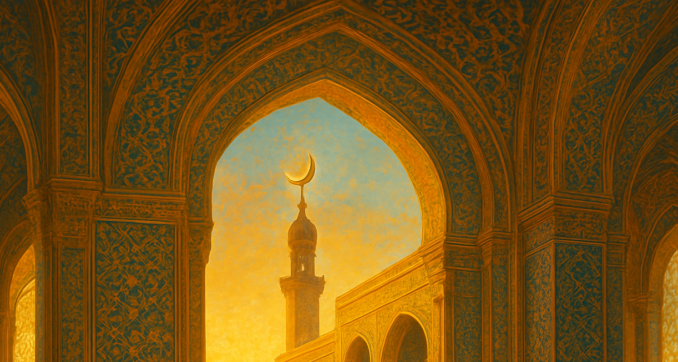
In the year 622 CE, a small community of believers fled from Mecca to Medina. This hijra, or emigration, marked not only the beginning of a new calendar but also a turning point in the history of forgiveness as a spiritual concept. Among the surahs revealed during this period, we find Ghafir — literally, The Forgiver. This fortieth chapter of the Quran bears a name that points directly to one of the most fundamental qualities humanity has ever attributed to the divine: the capacity to forgive. For Freemasons, who strive toward moral refinement and inner transformation, this ancient text offers surprisingly rich insights.
A Name with Ancient Roots
The surah takes its name from the third verse, in which the divine attribute of forgiveness takes center stage. In early Islamic tradition, surahs were often named after a striking word or theme in their opening verses. Ghafir, in Arabic, means “the one who covers” or “the one who removes” — a reference to the removal of sins. This etymology resonates with older Semitic traditions in which forgiveness was understood as a form of spiritual purification.
The fortieth surah belongs to the so-called Meccan revelations and was revealed during a time of immense trial for the early Muslim community. Persecution, social exclusion, and existential doubt formed the backdrop against which this message of forgiveness rang out. It is precisely this historical context that gives the text its depth: forgiveness is not presented here as a casual virtue but as a survival strategy for the soul.
The Believer at Pharaoh’s Court
One of the most remarkable passages in this surah tells the story of an anonymous believer at the court of the Egyptian Pharaoh. This figure, sometimes referred to as “the believer of the house of Pharaoh,” secretly advocates for the life of Moses when the prophet faces a death sentence. He does so not through open rebellion but through careful argument and concealed faith. This narrative connects the surah to the Old Testament tradition of Moses — a figure who also plays an important symbolic role in Masonic ritual.
The anonymous believer embodies a particular kind of courage: not the courage of the sword, but the courage of the word spoken at exactly the right moment. He urges those around him to reflect before they judge, to allow for the possibility that they themselves might be wrong. This theme of humility in judgment also appears in the writings of Montaigne, who in his essays argued that intellectual humility was the highest form of wisdom.
Forgiveness as Inner Architecture
For Freemasons, who see themselves as builders of an inner temple, the concept of forgiveness offers a fundamental building block. The rough ashlar cannot be polished without first acknowledging its imperfections. Forgiveness — both of others and of oneself — creates the space necessary for genuine transformation. Without that space, inner construction stalls, trapped in the repetition of old patterns.
Forgiveness is not weakness but the cornerstone of every spiritual edifice: only those who can let go can truly build.
The surah emphasizes that forgiveness is a divine quality that human beings can cultivate. This aligns with the Masonic tradition in which the work upon the rough stone is a lifelong process. Centuries later, Spinoza wrote about reason as a path toward liberation from destructive emotions. Though he worked within a different philosophical framework, he touched on the same essential truth: human beings possess the capacity to transform themselves through conscious inner labor.
Knowledge and the Danger of Pride
Ghafir also contains warnings against pride — specifically the pride that springs from knowledge. The text describes how earlier civilizations were destroyed not in spite of their knowledge but precisely because of the arrogance that their knowledge fed. This theme has direct relevance for the Masonic tradition, where the search for light and knowledge stands at the very center of the Work, yet must always be accompanied by humility.
The ancient Greek philosophers recognized this principle well. Socrates’ famous declaration that he knew nothing echoes through the centuries. Aristotle warned of the dangers of knowledge without virtue. In the Islamic tradition, we find comparable insights: knowledge without humility is like a building without a foundation. It may look imposing, but it will not stand.
The Present in the Light of the Past
What can we, in 2026, learn from a text revealed fourteen centuries ago? The core message of Ghafir remains remarkably relevant. In an age where polarization and intransigence dominate public discourse, the concept of forgiveness offers a powerful counterweight — not as naivety or weakness, but as a conscious choice to create space for growth.
Consider these enduring principles:
- Forgiveness creates space for inner transformation.
- Humility in judgment is a mark of genuine wisdom.
- Knowledge without humility inevitably leads to pride.
- Courage can express itself in words just as powerfully as in deeds.
The Masonic lodges of the eighteenth century brought together men of different religious backgrounds around shared values. Voltaire, himself a Freemason, wrote about religious tolerance as a necessary condition for an enlightened society. The study of sacred texts from diverse traditions fit naturally within this ideal — not to claim one single truth, but to recognize the multitude of wisdom traditions as facets of a greater whole.
The Lesson for Today
Ghafir reminds us that forgiveness is not a destination but an ongoing process. The believer at Pharaoh’s court had to choose his concealed faith anew each day. In the same way, the modern seeker must choose daily: growth over resentment, openness over closure. The ancient text offers no ready-made answers, but it poses the right questions — and in Freemasonry, as in all genuine spiritual traditions, it is the questions that illuminate the path far more than any answer ever could.
Whether we encounter the concept of forgiveness through the Quran, the Bible, the writings of Spinoza, or the symbolism of the Masonic lodge, the underlying message converges on a single point: to forgive is to build. It is the act of clearing away the rubble of past grievances so that something new and enduring can rise in its place. For the Freemason committed to the lifelong work upon the rough stone, forgiveness is not merely a moral aspiration — it is the very mortar that holds the inner temple together.
Copyright text & image: devrijmetselaar.nl
Texts are based on the ideas and content of the author of devrijmetselaar.nl, reviewed, corrected, and supplemented with the assistance of OpenAI. Images are created based on the ideas of the author of devrijmetselaar.nl using OpenAI/DALL-E.


Be the first to comment