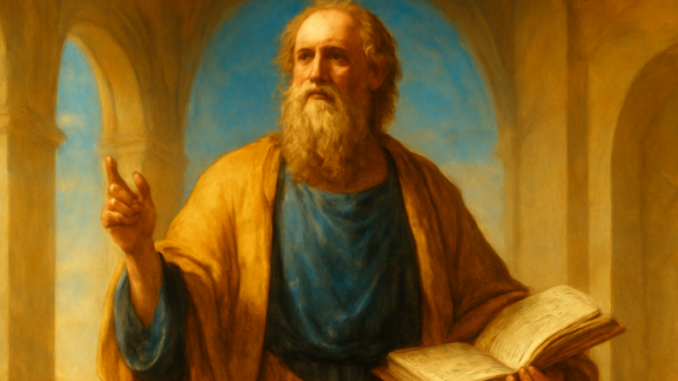
When you open Plato’s Parmenides, you enter a world of thought where the apparent contradiction between unity and multiplicity is pushed to its very limits. Written around 370 BCE, this dialogue marks a turning point in Plato’s philosophical development — and it casts a revealing light on tensions that still echo through modern Freemasonry. How do the indivisible One and the visible world of diversity relate to each other? And what does this teach us about the way Brethren in the Lodge seek truth?
The Eleatic Legacy: Parmenides as Teacher
To understand Plato’s Parmenides, we first need to step back to the historical Parmenides of Elea, a fifth-century BCE thinker who defended a radical position: only the One — unchanging, indivisible Being — is real. Change, motion, and multiplicity are mere illusions produced by the senses. His student Zeno of Elea supported this claim with famous paradoxes that seemed to prove the impossibility of movement itself.
Plato grew up in an intellectual environment where these Eleatic ideas still carried enormous weight. At the same time, he had learned from his own teacher Socrates that philosophy must never remain purely abstract — it must engage with the question of how to live well. In the Parmenides, Plato stages a conversation between the young Socrates and the elderly Parmenides, accompanied by Zeno. This is no casual arrangement: it is a deliberate confrontation between generations and between two fundamentally different ways of thinking about reality.
The Theory of Forms Under Fire
In the dialogue, the young Socrates gets the opportunity to defend his celebrated Theory of Forms. According to this doctrine, there exist perfect, unchanging Forms or Ideas — the Beautiful itself, the Just itself, the Good itself — and the visible world of multiplicity is merely a reflection of this higher reality. But the elder Parmenides asks questions that shake this theory to its foundations.
How can the many things in the world participate in a single Form? Doesn’t the Form then become divided? And if each Form requires yet another Form to be understood, doesn’t that create an infinite regress? This criticism, known as the Third Man Argument, reveals Plato’s remarkable intellectual honesty. He allows his own theory to be dismantled by a venerable predecessor. This is not weakness but strength: the willingness to scrutinize your own assumptions lies at the very heart of philosophical growth.
Two Perspectives: The Philosopher and the Freemason
From the perspective of the academic philosopher, the Parmenides is a technical masterpiece. The second half of the dialogue contains a series of eight hypotheses about the One, in which Plato systematically explores what follows if the One does or does not exist, if it does or does not participate in Being. This exercise in dialectic is so abstract that some scholars treat it as a purely intellectual puzzle, while others read it as a mystical text.
The Freemason approaches the same questions from a different starting point. In the Lodge, Brethren work with symbols that point toward unity amid diversity. The Great Architect of the Universe represents an ordering principle that binds all Brethren together, regardless of personal belief. The rough ashlar that must be shaped into a perfect cube symbolizes the individual journey from multiplicity to unity, from chaos to harmony.
The tension between the One and the Many is not a problem to be solved — it is a mystery to be lived.
Neoplatonism as a Bridge
The influence of the Parmenides reached far beyond Plato’s own Academy. In the third century CE, Plotinus — the founder of Neoplatonism — built his entire metaphysical system on the notion of the One that generates all reality through emanation. For Plotinus, the One was not merely an abstract concept but the source of all being, beauty, and goodness. The human soul, through contemplation, could return to this origin.
This Neoplatonic tradition was later absorbed into Christian thought through Augustine and rediscovered during the Renaissance by Marsilio Ficino, who translated Plato’s complete works into Latin. The Hermetic and Kabbalistic currents that influenced early Freemasonry drew deeply from the same well. When Brethren speak of seeking the Light, they echo a longing that reaches back to Plato’s cave — and further still, to Parmenides’ indivisible Being.
What Both Perspectives Share
Despite their different methods, the philosophical tradition and Freemasonry share a fundamental conviction: the search for truth is more valuable than claiming definitive answers. The Parmenides ends without a conclusion. The hypotheses are worked through meticulously, but Plato never tells us which interpretation is correct. This open ending is not a failure — it is an invitation.
In the Lodge, this attitude is mirrored in the principle that every Brother must develop his own understanding of the symbols. There is no catechism that prescribes what the square and compasses mean. The symbols speak to each individual in their own way, depending on life experience, background, and inner maturity. Unity, then, is not achieved through uniformity but through a shared devotion to the search itself.
Lessons for the Modern Seeker
What can we learn from this ancient dialogue in an age of fragmentation and information overload? First, that the most difficult questions are often the most fruitful. The tension between unity and multiplicity does not disappear by ignoring it — it demands our engagement. Second, that intellectual humility is not a weakness. Plato allowed his own theory to be challenged because he understood that truth matters more than being right.
For the Freemason, the Parmenides holds a special lesson. The symbols in the Lodge are not puzzles with a single solution but windows onto a reality that always exceeds our grasp. Just as Plato’s hypotheses about the One reveal ever new dimensions without arriving at a final answer, so the Masonic journey unfolds layer by layer — each degree, each meditation on a symbol, opening a deeper understanding of the relationship between the individual and the whole.
Plato’s Parmenides reminds us that the interplay between the One and the Many is not a riddle to be solved once and for all, but a living tension that drives both philosophical inquiry and the Masonic quest for Light. In the Lodge as in the dialogue, it is the willingness to keep asking — to resist the comfort of easy answers — that transforms the seeker. The open ending of the Parmenides is, in the deepest sense, a Masonic ending: not a conclusion, but an invitation to continue the work.
Copyright text & image: devrijmetselaar.nl
Texts are based on the ideas and content of the author of devrijmetselaar.nl, reviewed, corrected, and supplemented with the assistance of OpenAI. Images are created based on the ideas of the author of devrijmetselaar.nl using OpenAI/DALL-E.

Be the first to comment