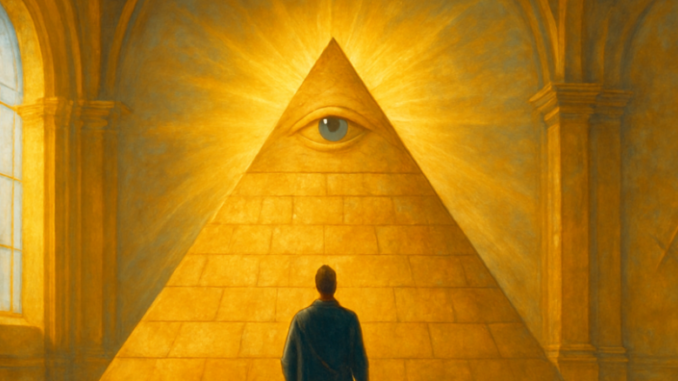
Few topics generate as much confusion as the relationship between the Order of the Illuminati and Freemasonry. In popular culture, the two are routinely lumped together as though they are simply different names for the same secret society. The historical reality, however, is far more nuanced — and from a spiritual perspective, the two movements spring from fundamentally different foundations. This article places both worlds side by side: the short-lived Bavarian order of the eighteenth century and the much older fraternity of Freemasons. What is historically established, what belongs to the realm of myth, and where did their paths actually cross?
The Bavarian Order: A Historical Sketch
On May 1, 1776, Adam Weishaupt — a professor of canon law at the University of Ingolstadt — founded a secret society he initially called the Order of the Perfectibilists. The name was later changed to the Order of the Illuminati. Weishaupt was deeply influenced by the Enlightenment philosophy of thinkers such as Voltaire and Jean-Jacques Rousseau. His ideal was a society in which reason and moral self-improvement would replace what he regarded as superstition and arbitrary exercises of power.
The order grew rapidly and at its peak counted an estimated two to three thousand members spread across Bavaria, Austria, and other parts of the German-speaking world. A key figure in that growth was Adolph Freiherr von Knigge, an experienced Freemason who joined in 1780 and thoroughly restructured the organization. Von Knigge not only recruited new members but also introduced a degree system that deliberately borrowed from Masonic ritual. This is the historical point where the two movements intersected — and it is largely the source of the confusion that persists to this day.
Freemasonry: An Older and Broader Tradition
Freemasonry as an organized fraternity traces its formal beginning to 1717, when four lodges in London came together to form the first Grand Lodge. Figures such as James Anderson and Jean-Théophile Desaguliers laid the groundwork in subsequent years for the constitutions and rituals that are still practiced today. The roots of the Craft, however, reach much further back — to the medieval guilds of stonemasons and the building lodges attached to great cathedrals.
Where the Bavarian order pursued an explicitly political and philosophical program, Freemasonry is characterized by a spiritual openness that prescribes no specific agenda. The fraternity invites its members to pursue inner growth and moral deepening but leaves the substance of that journey to the individual conscience. This fundamental distinction is crucial: Freemasonry is not an ideological movement but a path of personal development that unfolds within the shelter of ritual and brotherhood.
Two Forms of Enlightenment: Political Ideal vs. Spiritual Quest
Here the most essential difference reveals itself. Adam Weishaupt pursued a concrete societal transformation. His order had an elaborate hierarchy with objectives designed to lead, step by step, toward a new kind of society. His aim was the triumph of reason over institutional power. This was the Enlightenment in its most radical, activist guise.
Freemasonry, by contrast, places the inner light at its center. Its rituals — rooted in the legend of master builder Hiram Abiff and the construction of King Solomon’s Temple — do not point toward a political goal but toward the inner temple that every person can build within themselves. The “enlightenment” a Freemason seeks is not a blueprint for social reform but a spiritual awakening: the capacity to stand in the world with greater awareness, compassion, and wisdom. Johann Wolfgang von Goethe, himself a Freemason, expressed this aspiration toward inner growth throughout much of his literary work, where the journey of the human soul returns again and again as a central theme.
Put simply: the Illuminati sought to change the world through reason; Freemasonry invites the individual to change himself through inner light.
Where the Paths Crossed — and Parted Again
It is historically documented that members of the Bavarian order deliberately joined Masonic lodges in order to recruit new members from within. Von Knigge was particularly active in this effort. As a result, some lodges came temporarily under the influence of the order, but this was never a merger — let alone a fusion — of the two movements. When Elector Karl Theodor of Bavaria banned the order by decree in 1784 and 1785, it effectively ceased to exist as an organized body. Freemasonry, by that time nearly seventy years old as a Grand Lodge structure, simply carried on.
What the two movements did share was a certain vocabulary of degrees, rituals, and initiation structures, as well as a common background in the European Enlightenment. But the similarities are better compared to two rivers that briefly merge and then resume their own course, rather than a single stream.
Separating Fact from Fiction
Several things are historically established beyond reasonable doubt. The Order of the Illuminati was founded in 1776 and banned in 1784–1785. It existed as an active society for less than ten years. Freemasonry as an organized Grand Lodge structure has existed since 1717 and remains active worldwide to this day. There was personal overlap: some members of the Bavarian order were also Freemasons, but the vast majority of Freemasons had no connection whatsoever to the order. Freemasonry has never had a political program; the Bavarian order emphatically did.
On the other side of the ledger stands myth. The idea that the Bavarian order secretly survived its prohibition has never been substantiated by historical sources. The claim that Freemasonry and the Illuminati are two names for the same society is historically incorrect. Conspiracy theories linking both movements to global domination rely on speculation and fabrication rather than documented evidence.
When we look honestly at the historical record, a clear picture emerges. The Illuminati and Freemasonry were two distinct movements that briefly intersected in eighteenth-century Bavaria before diverging permanently. One was a short-lived political project; the other is a centuries-old spiritual fraternity still practiced around the world. Understanding the difference not only corrects a persistent popular misconception — it also helps illuminate what Freemasonry truly is: not a vehicle for political conspiracy, but an invitation to build a better self through reflection, ritual, and brotherly fellowship.
Copyright text & image: devrijmetselaar.nl
Texts are based on the ideas and content of the author of devrijmetselaar.nl, reviewed, corrected, and supplemented with the assistance of OpenAI. Images are created based on the ideas of the author of devrijmetselaar.nl using OpenAI/DALL-E.
Frequently Asked Questions
What is the main difference between the Illuminati and Freemasonry?
The Bavarian Order of the Illuminati was a short-lived secret society founded in 1776 by Adam Weishaupt that pursued an explicitly political and philosophical program rooted in Enlightenment ideals. Freemasonry, by contrast, is a much older fraternity dating back to 1717 (with roots to medieval stonemason guilds) that is characterized by spiritual openness and prescribes no specific political agenda.
Why are the Illuminati and Freemasonry often confused with each other?
The confusion largely stems from a historical intersection point around 1780, when Adolph Freiherr von Knigge, an experienced Freemason, joined the Illuminati and restructured the organization. Von Knigge introduced a degree system to the Illuminati that deliberately borrowed from Masonic ritual, creating the connection between the two movements that fuels the confusion in popular culture today.
How long did the Bavarian Order of the Illuminati last?
The Order of the Illuminati was short-lived. Founded on May 1, 1776, by Adam Weishaupt, it grew rapidly to an estimated two to three thousand members across Bavaria, Austria, and other German-speaking regions at its peak, but did not endure as a long-term organization like Freemasonry has.


Be the first to comment