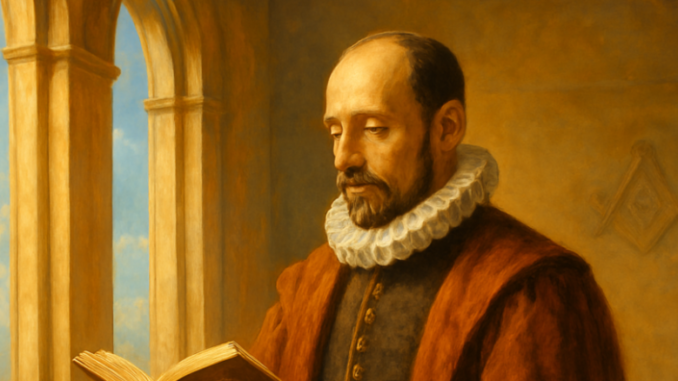
When Michel de Montaigne wrote about conscience in the sixteenth century, he did so as a solitary thinker perched in his tower in the Dordogne. When a Freemason reflects on the same theme, he does so surrounded by brethren, in a ritual space rich with meaning. One seeks truth in solitude, the other in fellowship. Yet their paths intersect at surprising points. How do these two traditions relate when it comes to the deepest moral questions we can ask?
The Solitary Thinker: Montaigne’s Conscience as an Inner Compass
Michel de Montaigne wrote his essay “Of Conscience” during a period of religious wars, betrayal, and widespread public distrust. In Book 2, Essay 5, he examines how conscience functions as an inner judge. His central observation is as sharp as it is timeless: feelings of guilt betray a person even when no external evidence exists. Conscience speaks when the outside world remains silent. Montaigne describes how suspects under pressure confess not because the evidence against them is overwhelming, but because their own inner voice gives them away.
For Montaigne, conscience is not a product of law or religion but of human nature itself. He draws on classical thinkers like Aristotle and stories from antiquity to show that the mechanism of conscience is universal. We each carry our own judge within us. This makes conscience both a blessing and a burden: it compels honesty but offers no escape. Montaigne writes about this with the sober wonder that characterizes his entire body of work. He does not judge — he observes. And it is precisely in that observation that his power lies.
The Brother in the Lodge: Conscience as a Shared Tool
Where Montaigne approaches conscience as a deeply personal phenomenon, Freemasonry places it within a broader framework. In the Masonic tradition, self-reflection is not a solitary pursuit but a discipline practiced in the context of brotherhood. The ritual invites the Freemason to examine himself — not only for his own benefit but for the sake of the community as well. The question is not merely “what does my conscience tell me?” but also “how does my inner voice relate to the moral order we collectively strive toward?”
Central to Masonic thought is the concept of the “rough ashlar.” Every brother is seen as an unworked piece of stone that must be refined through labor, study, and reflection into a perfect ashlar. That work of refinement is impossible without a functioning conscience. It is conscience that tells the Freemason where the rough edges remain, where further shaping and polishing are needed. Where Montaigne describes conscience as an inner prosecutor, the Freemason sees it more as an inner teacher — stern, but constructive.
Where the Two Paths Converge
At first glance, the worlds of Montaigne and Freemasonry seem far apart. The sixteenth-century essayist writes from a position of radical individuality. Freemasonry, which took its modern form in the eighteenth century with the constitutions of James Anderson and the work of Jean-Théophile Désaguliers, is by definition a collective endeavor. Yet they share a deeply rooted conviction: a person can only grow by looking at himself honestly.
Montaigne and the Masonic tradition also share a fundamental trust in human reason. While the religious wars of Montaigne’s era tied conscience to theological doctrine, he liberated the concept from that framework. Conscience does not need to be religious to be powerful, he argued. This idea resonates strongly within Freemasonry, which is emphatically not a religion but offers a space for brethren of all faiths. The Great Architect of the Universe is not a dogmatic image of God but an invitation to acknowledge the transcendent in whatever way suits the individual brother.
Conscience is the point where Montaigne’s philosophy and Freemasonry meet: both traditions see honest self-reflection as the indispensable condition for a virtuous life.
What This Comparison Teaches Us
The strength of Montaigne’s approach lies in his honesty. He disguises nothing, he feigns no certainty. His essays are exercises in intellectual humility — an attitude he shared with thinkers like Socrates, to whom he repeatedly appeals. The strength of Freemasonry lies in its ability to anchor that same honesty within a living community. Where Montaigne invites the reader to embark on inner investigation, the lodge provides a space where that investigation can be shared, tested, and deepened.
Neither path is superior to the other. Montaigne’s solitary self-reflection and Freemasonry’s ritual brotherhood are two expressions of the same human need: the need to know who we truly are, beyond the masks we wear for the outside world. Montaigne’s famous motto “Que sais-je?” — “What do I know?” — is essentially the same question the candidate asks himself upon entering the Chamber of Reflection: who am I, stripped of all externalities?
Three Shared Values
Self-reflection as a moral duty. Both Montaigne and Freemasonry consider the unexamined life to be incomplete. The Socratic imperative to “know thyself” runs like a golden thread through Montaigne’s Essays and through every degree of Masonic initiation alike.
Tolerance as a foundation. Montaigne advocated tolerance in a France torn apart by religious conflict. Freemasonry welcomes brethren regardless of their faith. Both understand that moral growth requires an open mind and a willingness to listen to those who think differently.
The search for truth over dogma. Both traditions prefer honest questioning to the blind acceptance of answers. Neither offers final truths — instead, they offer methods for seeking truth with integrity and humility.
An Invitation to Connect
Reading Montaigne alongside Masonic philosophy does not yield a definitive answer — and that is precisely the point. Both traditions warn against the person who believes he knows everything. Both celebrate the process over the result, the journey over the destination. For anyone interested in personal growth and moral deepening, the combination of these two traditions offers a rich and enduring source of inspiration.
Montaigne’s solitary tower and the Masonic lodge may seem like vastly different spaces, but they serve the same purpose: they are sanctuaries for honest self-examination. Whether you find your truth in the quiet pages of the Essays or in the shared rituals of the lodge, the work of conscience remains the same. It asks us to look inward without flinching, to accept what we find, and to keep refining the rough stone within. In a world that often rewards certainty and speed, both Montaigne and Freemasonry remind us that the most meaningful journey is the slow, honest one we take toward ourselves.
Copyright text & image: devrijmetselaar.nl
Texts are based on the ideas and content of the author of devrijmetselaar.nl, reviewed, corrected, and supplemented with the assistance of OpenAI. Images are created based on the ideas of the author of devrijmetselaar.nl using OpenAI/DALL-E.
Frequently Asked Questions
How does Montaigne's view of conscience differ from the Masonic understanding?
Montaigne views conscience as a deeply personal, inner compass that functions within solitude—a universal human mechanism independent of law or religion. In contrast, Freemasonry situates conscience within a communal framework, where self-reflection serves both individual refinement and the collective moral order of the brotherhood.
What did Montaigne believe about the nature of guilt and confession?
Montaigne observed that conscience acts as an inner judge that compels confession and betrays guilt even without external evidence. He argued that suspects confess not because overwhelming evidence exists, but because their own inner voice gives them away, demonstrating that conscience is a universal aspect of human nature.
What is the concept of the 'rough ashlar' in Freemasonry and how does it relate to conscience?
In Masonic tradition, the 'rough ashlar' represents each brother as an unworked stone that must be refined through labor, study, and reflection into a perfect ashlar. Conscience is essential to this refinement process, as it guides the brother's moral development and self-examination within the context of the brotherhood's shared values.


Be the first to comment