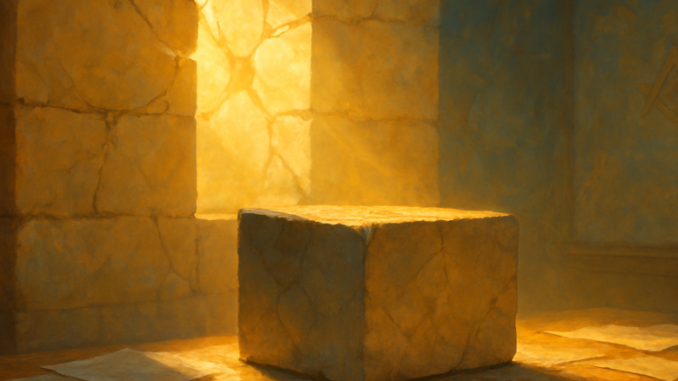
When an airstrike damages the Dutch embassy in Kyiv — amid existing controversy over a company’s involvement — two worlds collide: the external world of geopolitical violence and the internal world of human character. How a person responds to crisis reveals more about their personality than years of calm ever could. That insight is not new. It has been at the heart of Masonic thinking about character formation for centuries.
The Outer World: When Walls Crack
The news of the damaged embassy in Kyiv hits like a shockwave. A diplomatic post — intended as neutral, inviolable ground — is struck by violence that makes no distinctions. At the same time, a heated debate rages over the role of a company linked to the events surrounding the embassy. The outside observer sees only what is visible: stones cracking, windows shattering, and then the inevitable question of who is responsible. The first impulse is to point fingers, to assign blame, to express outrage.
This is the world of the outward reaction — the world where emotions surge raw and unfiltered to the surface. It is an understandable response, because destruction awakens fear, and fear awakens a need for control. In the public debate, we watch as commentators, politicians, and citizens immediately take positions. Demands are made, accusations are leveled, and condemnations are issued. All of this comes from genuine concern, but it happens quickly, without the inner stillness needed to truly grasp what is unfolding.
The Inner World: The Rough Ashlar of Character
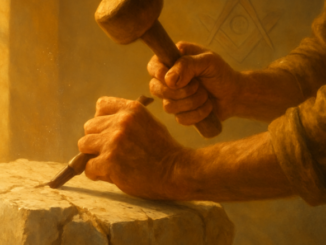
The Freemason approaches the same event from a different starting point. Not because he is indifferent to suffering, and not because geopolitics leaves him cold, but because his formation has taught him to look inward before acting outward. In Freemasonry, personality is understood as something you actively build — not something that merely happens to you. The rough ashlar, one of the oldest ritual symbols in the Lodge, represents the human being in an unrefined state. It is only through conscious labor upon that stone that a fully formed personality emerges.
Marcus Aurelius, the Roman emperor and Stoic philosopher, wrote in his Meditations that the soul takes on the color of its thoughts. That observation touches the very core of what Freemasonry understands by personality formation. It is not about what happens to you, but about how you inwardly respond to what happens to you. A damaged embassy is a fact. The question is: what does that fact do to your own inner edifice?
Two Perspectives on the Same Cracks
Place these two worlds side by side and a fascinating comparison emerges. The outsider sees the damaged wall and asks: who did this, and how do we punish the perpetrator? The Freemason sees those same cracks and asks an additional question: what does my reaction reveal about my own inner structure? Both questions are valuable. The first is necessary for justice; the second is necessary for wisdom.
Johann Wolfgang von Goethe, himself an initiated Freemason in the Lodge Amalia in Weimar, described personality as the highest happiness of the children of earth. For Goethe, character was not a static given but an ongoing process of refinement. His vision aligns seamlessly with the way the Lodge regards the human being: as a project in progress, not a finished product. It is precisely in times of crisis — when diplomatic buildings are damaged and public outrage sets the tone — that it becomes visible how far someone has progressed in that process.
Personality is not a mask you put on in good times. It is the foundation that holds firm when the walls around you crack.
What the Two Worlds Share
Despite their different starting points, the outsider and the Freemason share a deep longing: the longing for a world that is not shattered by violence. One expresses that longing through political action, the other through inner labor. But neither holds a monopoly on truth. In fact, they need each other. Without outward action, nothing changes about the circumstances. Without inner formation, nothing changes about the person who creates those circumstances.
The philosophy of Aristotle, who formulated virtue ethics as a practice of daily exercise, resonates here. For Aristotle, courage was not a one-time act but a habit built through repeatedly acting courageously. In the same way, personality in the Masonic tradition is not a trait you possess but a quality you practice — every day, and especially on the days when the world trembles.
The Lesson for Those Willing to Listen
What can we learn from this comparison? First, that the initial reaction is rarely the best one. The public outcry surrounding the company involved in the embassy affair illustrates how swiftly public judgment falls. But a judgment formed without reflection is like a rough stone placed into a wall without being worked: it may hold for a moment, but at the first pressure, it crumbles.
Second, it teaches us that character reveals itself most clearly in emergencies. Michel de Montaigne, whose essays have been discussed on this site in relation to conscience and the art of deferring judgment, wrote that we come to know ourselves best in the trial. His observation is timeless. The embassy staff in Kyiv who had to act under pressure, the diplomats who had to respond, the citizens who watched the images — all of them were confronted in that moment with the quality of their own inner edifice.
Three Questions for Self-Reflection
When crisis strikes — whether on the world stage or in your own life — consider these three questions as a Masonic exercise in self-examination:
1. Am I reacting from fear, or from a thoughtful inner compass? Fear is natural, but it should not be the architect of your response. The Masonic practice of pausing before acting — of moving from the rough ashlar toward the perfect one — begins with this distinction.
2. Am I building my personality in quiet times, so that I can withstand the storm? Character is forged long before the crisis arrives. The daily work in the Lodge — the rituals, the reflection, the brotherhood — is preparation for precisely those moments when the ground shakes beneath your feet.
3. Am I only looking for someone to blame outside myself, or do I dare to examine my own patterns of reaction? It is far easier to point at the cracks in someone else’s wall than to inspect the fractures in your own foundation. True Masonic labor demands both: accountability in the world and honesty within the self.
A damaged embassy is a stark reminder that the structures we build — both physical and psychological — are never guaranteed to hold forever. The outer world will always present us with forces beyond our control. What remains within our power is the quality of our inner architecture. Freemasonry does not offer a shield against the storms of the world, but it does provide the tools to build a character that can endure them. In that sense, every crisis is also an invitation: to pick up the gavel, to return to the rough stone, and to continue the work that is never truly finished.
Copyright text & image: devrijmetselaar.nl
Texts are based on the ideas and content of the author of devrijmetselaar.nl, reviewed, corrected, and supplemented with the assistance of OpenAI. Images are created based on the ideas of the author of devrijmetselaar.nl using OpenAI/DALL-E.
Frequently Asked Questions
What is the main connection between the damaged Dutch embassy in Kyiv and Freemasonry?
The article uses the damaged embassy as an example of how crisis reveals true character. It draws a parallel between the external event of geopolitical violence and the Masonic principle that personality is actively built through conscious labor, not determined by circumstances. The Freemason's approach to such crises differs from the typical public reaction by emphasizing inward reflection before outward action.
What does the 'rough ashlar' symbol represent in Freemasonry according to this article?
The rough ashlar is an ancient Masonic ritual symbol that represents the human being in an unrefined, raw state. In Freemasonry, it signifies that personality is not something that happens passively to a person, but rather something that must be actively shaped and refined through conscious labor and self-work, much like a stone is worked by a mason.
How does the article use Marcus Aurelius to explain Masonic personality formation?
The article quotes Marcus Aurelius's observation from Meditations that 'the soul takes on the color of its thoughts' to illustrate the core Masonic principle that personality is shaped by inner response rather than external circumstances. This highlights that in both Stoic and Masonic philosophy, what matters is not what happens to you (like a damaged embassy), but how you inwardly respond to it.

Be the first to comment