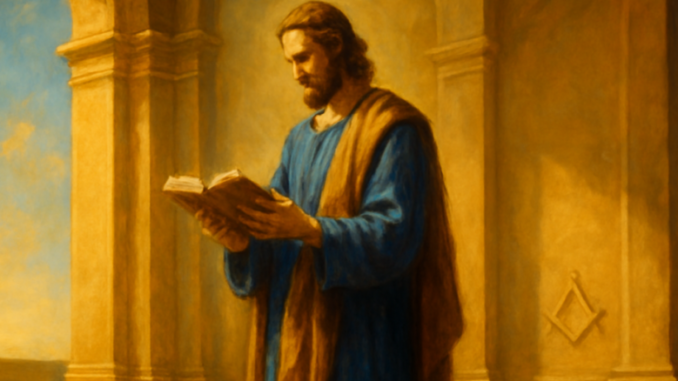
A painting is never just pigment on canvas. Anyone who gazes long enough at Leonardo da Vinci’s The Last Supper senses something vibrating beneath the surface — something that resists easy articulation. It is precisely this ineffable feeling that Dan Brown’s novel The Da Vinci Code taps into. The book claims that Leonardo deliberately embedded hidden messages in his masterpieces, secrets understood for centuries by initiates and overlooked by the rest of the world. But what exactly does the novel assert, and what deeper layers emerge when we examine those claims through the lens of Freemasonry?
The Painting as a Cipher
In The Da Vinci Code, Dan Brown presents Leonardo da Vinci as a deliberate encoder. According to the story, the Florentine master planted hidden clues in works like The Last Supper and the Mona Lisa. These are not subtle aesthetic choices or stylistic quirks — they are carefully constructed visual codes designed to reveal an alternative reading of Christian history. The figure seated next to Christ in The Last Supper is said to be not a male apostle but Mary Magdalene. The V-shape formed between the two figures supposedly represents a feminine symbol. The absence of a chalice on the table suggests that the Holy Grail is not an object at all, but a person.
Brown takes this reading further by presenting Leonardo as a member — even a Grand Master — of a secret society called the Priory of Sion, an organization said to have guarded the truth about this alternative history for centuries. The painting thus becomes a visual language for initiates, a pictorial testament awaiting decipherment by those who possess the right key.
The Allure of the Hidden
What makes Brown’s novel so culturally significant is not so much its historical claims as the deep human longing it speaks to. There is something profoundly natural in the belief that reality contains more than what the eye immediately perceives — that behind the visible lies an invisible order, and that a work of art says more than it shows. This longing is nothing new. It runs like a thread through the Western philosophical tradition, from Plato’s Allegory of the Cave to the Hermetic wisdom that blossomed anew during the Renaissance.
Leonardo da Vinci himself was steeped in this tradition. He was a pupil of Andrea del Verrocchio, moved in the intellectual circles of Florentine Neoplatonism surrounding Marsilio Ficino, and regarded nature as a book filled with hidden laws waiting to be unraveled through observation and reason. His famous mirror writing and his habit of keeping coded notebooks naturally feed the fascination. But there is an essential difference between an artist who embeds complex layers in his work and an artist who deliberately conceals secret messages designed to support a specific historical thesis.
What Freemasonry and the Novel Share
For Freemasons, the idea that reality operates on multiple levels is not a novelistic invention — it is a lived experience. The entire ritual work within the Lodge is built around the principle that concrete objects and actions point toward deeper truths. A rough ashlar is not merely a stone; it is also the unworked self. A square is not merely a tool; it is an invitation to act with integrity. This way of seeing — this symbolic reading of reality — connects Freemasonry to the broad philosophical current stretching back to Pythagoras, Plato, and the very Hermetic writings that captivated Leonardo’s contemporaries.
Dan Brown touches on this universal principle in The Da Vinci Code, but gives it a specific, sensational twist. Where Freemasonry treats symbolic understanding as a personal, inward journey, the novel transforms it into a historical conspiracy. Where the Masonic tradition teaches that symbols are multivalent and can never be reduced to a single meaning, the book opts for one hidden truth concealed behind the painting. That distinction is crucial.
A symbol that hides only one secret is no longer a symbol — it is a code. Genuine symbolic depth invites endless reflection, not a single unmasking.
Leonardo Between Fact and Fiction
It is important to distinguish between what Dan Brown claims and what the public discourse around the book has revealed. The Priory of Sion — the secret society of which Leonardo da Vinci was supposedly Grand Master — has been thoroughly debunked by historians. The documents on which this claim rests, the so-called Dossiers Secrets, turned out to be forgeries from the 1950s. Isaac Newton and Sandro Botticelli, who are also presented in the book as Grand Masters, had no demonstrable connection to any such organization.
Yet it would be too easy to dismiss Brown’s novel as mere deception. The book prompted millions of people to look again at artworks they thought they knew. It revived conversations about hidden layers in art, religion, and history. And it raised — perhaps unintentionally — a fundamental question that every Freemason recognizes: what is the relationship between the visible and the invisible?
Seeing as a Craft
In Freemasonry, the gaze is trained — not to uncover conspiracies, but to perceive a richer reality beneath the surface of existence. As Michel de Montaigne wrote in his Essays about the art of looking, truly seeing is an exercise in humility. In much the same way, the Masonic tradition teaches that a symbol does not lead to one conclusive explanation but to a continual deepening of understanding.
Leonardo da Vinci understood this better than anyone. His sfumato technique — the deliberate blurring of sharp contours — is itself a visual philosophy. It tells us that the boundary between one thing and another is never as clear as we might wish. Edges dissolve; meaning remains in motion. This is far removed from the neat decoder-ring approach that The Da Vinci Code applies to his work, and far closer to the spirit of Masonic symbolism, where every answer opens a new question.
The real lesson Leonardo’s art offers is not that there is one secret waiting to be cracked. It is that looking itself is a discipline — one that rewards patience, demands humility, and grows richer with every return visit. That is a truth the Lodge has long understood.
Dan Brown’s The Da Vinci Code captured the imagination of millions by suggesting that Leonardo da Vinci hid a single explosive truth in his paintings. The claim is historically unfounded, yet the novel’s enduring appeal reveals something genuine: humanity’s deep desire to find meaning beyond appearances. Freemasonry shares that desire but approaches it very differently. Rather than seeking one hidden answer, the Masonic tradition embraces the symbol as an invitation to perpetual inquiry. Leonardo, the master of sfumato who blurred every hard edge, would likely have appreciated the difference. The real mystery is not a secret to be decoded — it is a depth to be explored, again and again.
Copyright text & image: devrijmetselaar.nl
Texts are based on the ideas and content of the author of devrijmetselaar.nl, reviewed, corrected, and supplemented with the assistance of OpenAI. Images are created based on the ideas of the author of devrijmetselaar.nl using OpenAI/DALL-E.
Frequently Asked Questions
What does Dan Brown claim Leonardo da Vinci hid in The Last Supper?
According to The Da Vinci Code, Leonardo deliberately embedded hidden messages in The Last Supper as visual codes. Brown claims the figure next to Christ is Mary Magdalene rather than a male apostle, the V-shape between the two figures represents a feminine symbol, and the absence of a chalice suggests the Holy Grail is actually a person, not an object.
What role does the Priory of Sion play in The Da Vinci Code's interpretation of Leonardo?
In Brown's novel, Leonardo da Vinci is presented as a member—even a Grand Master—of the Priory of Sion, a secret society said to have guarded an alternative history of Christianity for centuries. The painting becomes a visual language for initiates of this organization to communicate hidden truths.
Why does The Da Vinci Code's interpretation of Leonardo's work resonate with readers?
The novel taps into a fundamental human longing to believe that reality contains more than what is immediately visible, and that hidden meanings lie beneath the surface of great artworks. This desire for hidden wisdom has deep roots in Western philosophy, from Plato to Renaissance Hermetic traditions that Leonardo himself was familiar with through his engagement with Florentine Neoplatonism.


Be the first to comment