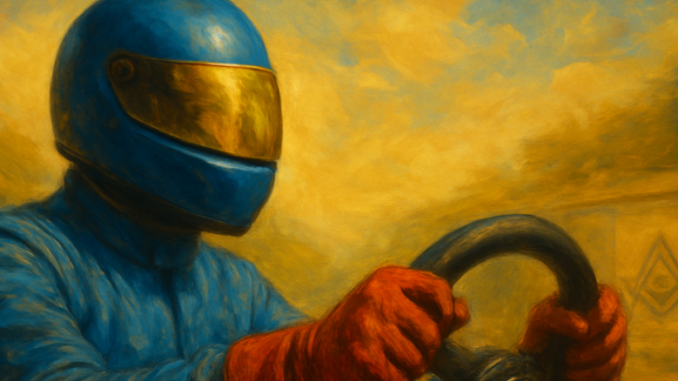
There is something deeply paradoxical about speed. A driver tearing through the corners of Spa-Francorchamps at blistering pace seems to have no room for reflection. And yet, in that fraction of a second — the split-second decision to brake or commit — the entire personality of the driver is laid bare. A top result in free practice is a sporting achievement, certainly. But what does speed actually reveal about character? And what might a Freemason learn from someone who repeatedly puts himself to the ultimate test?
Personality Reveals Itself Under Pressure
Let us begin with a provocative thought: perhaps personality is not what someone claims to be, but what someone does when the pressure is at its peak. A racing car cutting through the Ardennes forest at three hundred kilometers per hour offers no time for masks. There is no room for façade. The driver, in that moment, is entirely himself — fear, courage, calculation, instinct. Everything that makes a person who they are concentrates itself into an action lasting mere seconds.
This raises a compelling question: is personality a verb rather than a noun? Not a fixed quality, but something that continuously reshapes itself in confrontation with the world?
Character as a Living Structure
In Freemasonry, we often use the metaphor of the rough ashlar — the unpolished stone that must be shaped and refined. But perhaps that metaphor is too passive. The stone, after all, lies still, waiting for the hammer. A human being, by contrast, is not shaped solely by external forces but through active confrontation with challenges. Character formation is not a passive process; it is a continuous dialogue between inner disposition and outer circumstance.
Consider the driver who sets the fastest lap. Years of practice, thousands of hours in simulators, countless mistakes and corrections have brought him to this point. But there is also a specific temperament that drives him to choose risk where others hesitate, a mental resilience that absorbs setbacks like a sponge. Is that character innate or learned? The answer is likely: neither entirely, and both at once.
The Shadow Side of Speed
But let us not celebrate speed as a virtue too hastily. There is danger in the glorification of performance. Philosophers have written for centuries about the vanity of human enterprise. Someone who only wants to go faster eventually loses sight of the essential questions: to where? And why?
The true measure of a person lies not in what they achieve, but in how they handle their limitations.
In the lodge, we learn that progress is not measured solely by external accomplishments. The Brother who turns quietly inward, who acknowledges his own shortcomings without falling into self-contempt — he practices a courage that is less visible than the courage of the racing driver, but no less valuable. Personality has many dimensions, and speed illuminates only one of them.
Personality as an Ongoing Ritual
Here is where speed and reflection meet in an unexpected way. The racing driver prepares for every race with rituals. Adjusting the seat, checking the gloves, controlling the breath before the lights go out. Ritual as a technique to focus the mind, to channel character in service of the task at hand. Is this not precisely what we do in the lodge?
The Masonic ritual is no empty form — it is an exercise in attention. Every gesture, every step, every greeting carries meaning. And through that repeated practice, something emerges that is greater than any single moment: a character that finds steadiness amidst change. The personality that takes shape through this process is not rigid but resilient. Not fast in the sense of hasty, but responsive — ready to act when the moment demands it.
Key Reflections
Personality reveals itself in deeds, not in words. Character formation is active, not passive. Speed without direction is hollow. Ritual sharpens the mind for the decisive moment.
The Question That Remains
And so we return to the paradox with which we began. The fastest lap of the day was the result of years of preparation, compressed into a few minutes. But was that lap the expression of an already formed character, or was it a moment that further shaped the character? Does a person change through their actions, or do actions merely reveal what was already there?
The Freemason understands that this distinction may be a false one. We are not either the product of our past or the architect of our future — we are both, simultaneously. The rough ashlar is worked, yes. But the stone also works back upon the craftsman. And in that reciprocal labor, something emerges that we call character, though it might be better described as a living process. A perpetual becoming.
The next time you watch a driver commit to a corner at impossible speed, or the next time you yourself stand before a difficult decision, consider this: personality is not a possession but a practice. It is what you do in the moment that counts. And the question that lingers — for the racing driver as much as for the seeker of light — may well be the oldest question there is: who do you want to be when it truly matters?
Copyright text & image: devrijmetselaar.nl
Texts are based on the ideas and content of the author of devrijmetselaar.nl, reviewed, corrected, and supplemented with the assistance of OpenAI. Images are created based on the ideas of the author of devrijmetselaar.nl using OpenAI/DALL-E.
Frequently Asked Questions
What does Freemasonry teach about character development?
Freemasonry teaches that character is not a fixed quality, but something that develops through active confrontation with challenges and self-reflection. The fraternity uses the metaphor of the rough ashlar—an unpolished stone that must be shaped and refined—to represent the ongoing process of personal improvement. Masons learn that true character is revealed through how we handle pressure, limitations, and adversity rather than through external achievements alone.
How does Freemasonry view personal achievement and success?
While Freemasonry acknowledges the value of accomplishment, it teaches that the true measure of a person lies not in what they achieve, but in how they handle their limitations and what they learn from setbacks. The fraternity encourages Brothers to balance ambition with introspection, recognizing that meaningful progress includes quiet self-examination and the acknowledgment of one's shortcomings without self-contempt.
What does Freemasonry say about the relationship between personality and pressure?
Freemasonry teaches that personality is revealed most authentically under pressure, when there is no room for pretense or facades. In challenging moments, a person's true nature—their fears, courage, instincts, and values—becomes evident. This principle encourages Masons to view difficulties as opportunities for genuine self-discovery and character refinement.
Does Freemasonry believe character is innate or learned?
Freemasonry teaches that character is developed through both innate temperament and continuous learning, making it neither entirely one nor the other. Through lodge work and personal discipline, Masons shape their character by combining natural disposition with deliberate practice, reflection, and engagement with challenges over time.


Be the first to comment