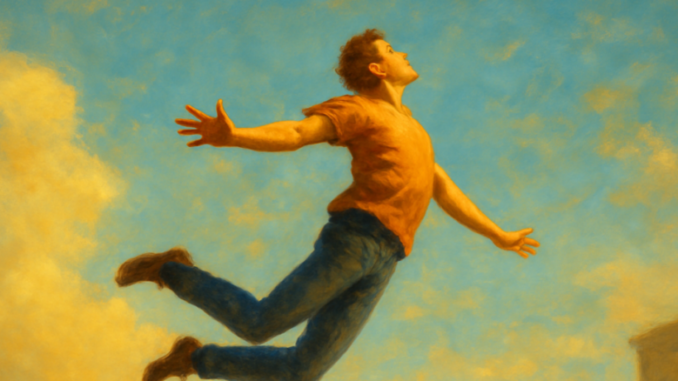
Picture this: you’re standing on a platform, about to be launched through the air by a human catapult. Below you lies a landing zone. Around you stands a team that has gone over every detail. And yet, things go wrong. A stuntman recently broke his ankle after a jump with a human catapult at a major festival. The news struck me — not just because of the pain involved, but because of the deeper question it raises: what does it truly mean to surrender yourself to a system, to other people, to the unknown?
The Leap and the System
A stuntman who allows himself to be launched into the air does something most of us would never dare. It’s not just about the physical courage required — it’s about the trust that precedes the leap. A structure has been built. Calculations have been made. People stand ready to catch you. You surrender yourself to a system that is larger than you are. And sometimes, despite every preparation, things go wrong.
This isn’t some abstract philosophical puzzle. It’s the reality of everyday life for each one of us. Perhaps not as spectacular as a human catapult, but equally real. Every time you get into a car, board a plane, or even cross a bridge, you place your trust in invisible hands that made it all possible. Engineers, construction workers, inspectors, regulators — an entire network of people you will never meet, yet on whom your life depends.
The Invisible Fabric of Society
In Freemasonry, we often speak of building. Not merely the construction of physical buildings, but the building of character, of community, of a better world. The metaphor of building is no accident. A structure stands or falls on its invisible foundations, on the craftsmanship of people who do their work without expecting applause. Society works the same way. The vast majority of contributions that make our lives possible go entirely unnoticed.
Consider how much trust you extend every day without a second thought. The baker who makes your bread. The mechanic who checked your brakes. The programmer who wrote the software you’re using to read this very article. We live within a web of mutual dependence so finely woven that we barely notice it anymore — until something goes wrong. Until a stuntman breaks his ankle and we pause, even briefly, to consider the fragility of every system we rely on.
Trust as the Foundation of Brotherhood
What makes people willing to take such risks? Partly it’s the thrill, the challenge, the desire to push beyond limits. But without trust in the people around you, no one would ever make that leap. Trust is the cement that holds communities together. Without it, every collaboration, every relationship, every society crumbles into suspicion and isolation.
It is not the absence of danger that makes us free, but the presence of trustworthy people around us.
In the lodge, we practice this trust on a smaller scale. We meet as equals, regardless of background or status. We share stories, doubts, and insights. We learn that vulnerability is not weakness but a prerequisite for genuine connection. This truth extends far beyond the walls of the lodge — it applies to every community where people are truly willing to carry one another.
When the System Fails
Of course, things sometimes go wrong. An ankle breaks. A bridge collapses. Trust is betrayed. The question is not whether systems are fallible — they always are. The question is how we respond when failure happens. Do we retreat into cynicism and distrust? Or do we acknowledge that failure is inevitable and look for ways to do better?
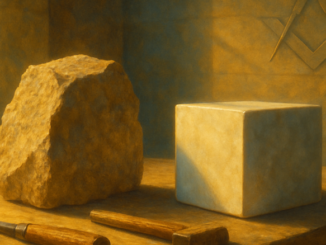
The stuntman who broke his ankle will heal. The team around him will analyze what went wrong and make adjustments. That is how progress works — not by demanding perfection, but by learning from what goes wrong. In Freemasonry, we call this working the rough stone. No one starts out perfect. We are all works in progress, and so are the systems we build together.
Your Leap Into the Unknown
You might be thinking: thankfully, I don’t need to climb onto a human catapult. But in a sense, you do — every single day. Every time you start a new project, enter a relationship, or simply walk out your front door, you surrender yourself to a world you cannot fully control. The question is not whether you face risk, but whether you have the courage to leap anyway, trusting that others will be there to carry you.
Trust begins with acknowledging your own vulnerability. Community is born where people dare to support one another. Failure is not an endpoint but an invitation to learn. And the invisible contributions of others are what make your life possible.
The next time you read about an accident, a mistake, or a system that failed, I invite you to pause. Not to dwell on what went wrong, but to appreciate everything that goes right every day — precisely because people do their work faithfully, often without anyone noticing. That is the quiet miracle of society. That is the brotherhood that carries us, even when we don’t realize it.
A broken ankle at a festival is more than a headline. It is a reminder of the vulnerability inherent in every system and the courage it takes to trust. Whether you’re standing on a catapult or simply living your daily life, you are connected to countless others who make your existence possible. That connection requires maintenance, attention, and the willingness to be trustworthy yourself. Perhaps that is the very heart of every community — not perfection, but a shared willingness to carry one another, especially when things go wrong.
Copyright text & image: devrijmetselaar.nl
Texts are based on the ideas and content of the author of devrijmetselaar.nl, reviewed, corrected, and supplemented with the assistance of OpenAI. Images are created based on the ideas of the author of devrijmetselaar.nl using OpenAI/DALL-E.
Frequently Asked Questions
What does Freemasonry have to do with trust and brotherhood?
Freemasonry teaches that trust is the foundation of all meaningful human connection and community. In the lodge, members practice this trust by meeting as equals, sharing vulnerabilities, and learning to depend on one another—much like the invisible networks of trust that hold society together every day.
How does Freemasonry relate to building and craftsmanship?
Freemasonry uses building as a central metaphor, not just for physical construction but for building character, community, and a better world. Freemasons honor the craftsmanship of those who do essential work without seeking recognition, recognizing that society depends on countless invisible contributions.
What can Freemasonry teach me about taking meaningful risks?
Freemasonry teaches that true freedom comes not from the absence of danger, but from being surrounded by trustworthy people who have your back. By practicing trust and mutual dependence in the lodge, members learn to face life's challenges with courage grounded in genuine brotherhood.
Is Freemasonry about more than just ritual and ceremony?
Yes—Freemasonry is fundamentally about building trust, character, and community through shared experiences and mutual support. While ritual is part of the practice, the deeper purpose is creating spaces where people can be vulnerable, honest, and connected to something larger than themselves.

Be the first to comment