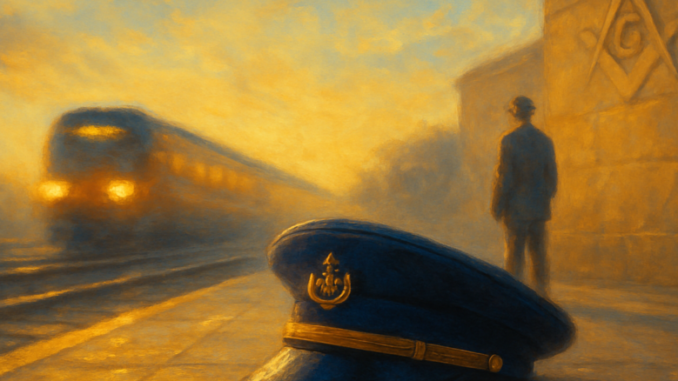
Picture this: you’re standing in a moving train, tensions rising, words turning into weapons, and before you know it, the unthinkable happens. A railway employee falls from the train during an altercation with a passenger. The news from Germany is shocking — but it also raises deeper questions. How can an everyday encounter spiral so far out of control? And what does it tell us about the fragile threads that bind us together as human beings?
The Thin Line Between Order and Chaos
You’ve probably experienced it yourself: standing in a crowded train, someone pushes, another grumbles, and you feel the atmosphere shift. Most of the time, it ends with an angry glance or a muttered remark. But sometimes — very rarely — it escalates. The incident involving a German railway worker who fell from a moving train during a dispute with a passenger shows just how quickly the thin line between order and chaos can vanish. It reminds us that every encounter, no matter how fleeting, carries the potential to heal or to wound.
In Freemasonry, we often speak of building a better world, stone by stone. But what happens when those stones collide? What happens when the structure we’re trying to raise together cracks under a moment of lost control? This incident invites us to reflect on how we handle conflict in our daily lives — and whether we’re truly laying our stones with care.
The Passenger and the Worker: Two Worlds Colliding
When you step onto a train, you enter a temporary community. Strangers share the same space, the same air, the same journey. The conductor or railway employee plays a specific role: representing order, rules, and the greater system. The passenger carries a different story — their own worries, their own destination. Two worlds that cross paths, often without making any real contact.
And yet, they are connected, if only for the duration of the ride. In Freemasonry, we understand that brotherhood is not something that happens by default. It is something that must be actively cultivated. It demands the ability to look beyond the role — beyond the uniform or the ticket — and to see the human being underneath. When that ability disappears, when we reduce someone to their function rather than recognizing their humanity, conflict becomes almost inevitable.
The Ritual of De-escalation
You could say that every tense situation has its own ritual. There is a moment when you face a choice: do you hit the brakes, or do you accelerate? Freemasonry is steeped in ritual — not for the sake of ritual itself, but for what it produces. A ritual slows things down. It creates space. It invites reflection. It breaks the autopilot of reaction and rage.
He who masters his words masters his world.
In everyday life, we rarely have the luxury of a formal ritual. But we can develop an inner one: a breath, a conscious pause, the question “What would I want the other person to do right now?” It sounds simple, but in the heat of the moment, it is one of the hardest things a person can do. Yet it is precisely this skill that makes the difference between a conflict that spirals and one that resolves.
Brotherhood as a Daily Practice
Brotherhood is not an abstract ideal reserved for special occasions. It is a way of being in the world, renewed every single day. It means approaching the bus driver, the cashier, the stranger on the train with a basic attitude of respect and goodwill. Not because they have earned it, but because you have chosen to live that way.
Brotherhood demands patience, even when the other person is impatient. It demands listening, even when you would rather speak. It demands self-control, especially when emotions are running high.
This is not weakness — it is strength. It is the strength to refuse being dragged into a spiral of escalation. It is the strength to keep both feet firmly on the ground, even on a moving train.
What a Tragic Moment Can Teach Us
It’s tempting to dismiss this incident as an exceptional case — something that could never happen to “us.” But honesty compels us to admit that the ingredients of escalation exist in all of us. Fatigue, frustration, the feeling of not being seen — they can simmer beneath the surface until someone strikes the wrong chord.
Freemasonry teaches us to know ourselves, including our shadow sides. It is no coincidence that self-reflection sits at the heart of the Masonic tradition. He who knows himself, who recognizes his own triggers, has an advantage when it matters most. That self-knowledge is no guarantee against mistakes, but it is a foundation on which something better can be built.
The Journey We Share
In the end, we’re all on the same train. The destination is uncertain, the route sometimes bumpy, and our fellow passengers not always to our liking. But the choice of how we make that journey is ours. Do we choose distance or connection? Defense or understanding? A clenched fist or an outstretched hand?
The news from Germany is a painful reminder of what can happen when that choice goes wrong. But it is also an invitation to pause and ask ourselves how we deal with the daily frictions of existence. Brotherhood doesn’t begin in the lodge — it begins in the train carriage, on the street, at the kitchen table. Wherever people meet.
Perhaps the most important lesson from this tragic event is not what went wrong, but what could have gone differently. Every day offers new opportunities to choose connection over conflict, understanding over judgment. The next time you find yourself in a tense situation, ask yourself: which stone am I laying right now? Am I building a bridge, or am I widening the gap? The answer to that question shapes not only your own journey, but also the journey of everyone around you.
Copyright text & image: devrijmetselaar.nl
Texts are based on the ideas and content of the author of devrijmetselaar.nl, reviewed, corrected, and supplemented with the assistance of OpenAI. Images are created based on the ideas of the author of devrijmetselaar.nl using OpenAI/DALL-E.
Frequently Asked Questions
How does Freemasonry teach us to handle conflict in everyday situations?
Freemasonry emphasizes seeing the humanity in every person, beyond their role or function, which is essential for preventing conflicts from escalating. Through ritual and reflection, Masons learn to pause, breathe, and make conscious choices rather than react with anger—a practice that can transform tense encounters into opportunities for understanding and connection.
What does Freemasonry mean by 'building stone by stone'?
This phrase represents the gradual, intentional construction of a better world through careful individual actions and ethical living. Each Mason is responsible for laying their stones with care, meaning every interaction, decision, and moment of kindness contributes to a stronger, more harmonious society built on principle and brotherhood.
How can Masonic principles help prevent everyday conflicts from escalating?
Freemasonry teaches that brotherhood must be actively cultivated through conscious effort and the practice of self-mastery. By developing an inner ritual of pause and reflection—such as taking a breath and considering the other person's perspective—we can interrupt the autopilot of reaction and choose compassion over conflict.
Why does Freemasonry place emphasis on ritual and reflection?
Ritual in Freemasonry is not ceremonial for its own sake, but rather a tool that slows us down, creates space for thought, and invites deeper reflection. This practice helps break the cycle of automatic reactions, allowing us to respond with intention and wisdom rather than impulse, leading to more peaceful and constructive outcomes in all areas of life.

Be the first to comment