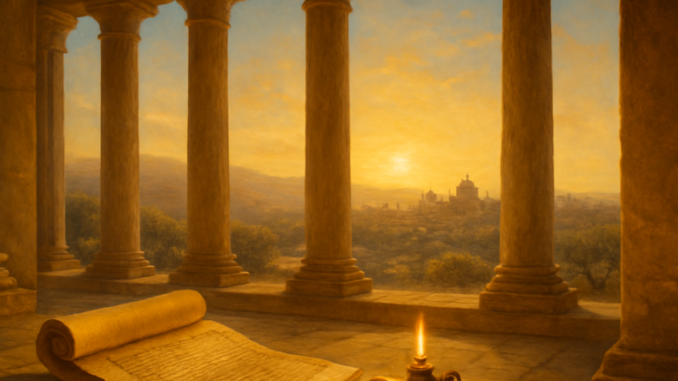
The Book of Hosea occupies a remarkable place in the Hebrew Bible. Written by an eighth-century BCE prophet, it speaks of broken promises, unfaithfulness, and the possibility of restoration. But what happens when a biblical scholar and a Freemason each pick up the same text? Both approaches open windows onto deep symbolism — though from very different rooms.
The Biblical Scholar Reads: A Covenant History
For the biblical scholar, Hosea is first and foremost a historical document. The book emerged during a time of political instability, when the Northern Kingdom of Israel was caught between rival empires. The prophet received an extraordinary commission: he was to marry a woman who would be unfaithful to him. This marriage became a living metaphor for the relationship between the Divine and His people. The scholar analyzes linguistic structures, compares manuscripts, and situates the text within its original context. Unfaithfulness is understood here as idolatry — the straying toward foreign gods and political alliances.
The academic approach seeks to uncover what the text meant for its original audience. Which cults were being criticized? Which historical events are reflected in the prophecy? The book closes with a promise of renewal, and the scholar examines how this hope functioned within the broader prophetic tradition. The emphasis falls on textual precision and historical reconstruction.
The Freemason Reads: An Inner Mirror
Where the scholar looks outward — toward history and context — the Freemason turns the gaze inward. For him, the prophet’s marriage is not a lesson in political alliances but a symbol for the relationship between the higher self and the everyday person who so often strays from the path. The unfaithful partner becomes a mirror: which of us remains perpetually true to our highest ideals? The covenant is not merely an ancient contract; it echoes the obligation every Brother takes upon himself at his initiation.
In the lodge, we speak of the rough ashlar that must be hewn into a perfect cube. Hosea offers a kindred imagery: the human being who wanders but is continually given the chance to return to the light. The symbolism of desert and fertile land resonates deeply with the Masonic journey, where periods of spiritual dryness and doubt alternate with moments of insight and connection.
Shared Ground: The Power of Symbolism
Despite their different vantage points, the biblical scholar and the Freemason share a profound respect for symbolic language. Both recognize that Hosea is not meant to be read literally. The prophet’s marriage is a didactic instrument — a narrative that reaches far beyond the personal fate of two individuals. The scholar calls this a prophetic symbolic act; the Freemason recognizes in it the workings of ritual, where an outward action points to an inner transformation.
“I will allure her, lead her into the wilderness, and speak tenderly to her.” These words from Hosea illustrate how solitude and silence can become the very conditions for renewal.
Both readers see in Hosea a text that calls for self-reflection. The scholar asks: what did this teach ancient Israel? The Freemason asks: what does this teach me, here and now? Neither claims to possess the only correct interpretation, and it is precisely in that humility that they find common ground.
Faithfulness as a Living Symbol
The central theme of Hosea — faithfulness — takes on a different hue in each reading. For the biblical scholar, it concerns covenantal fidelity in a theological sense: the relationship between a people and their God. For the Freemason, faithfulness refers to the bond between Brethren, to honesty with oneself, and to perseverance on a path of moral growth, even when the road is hard.
Consider the layers of faithfulness a Mason contemplates:
- Faithfulness to the lodge and its values
- Faithfulness to one’s own inner compass
- Faithfulness to the promise of continual self-improvement
Hosea reminds us that faithfulness is not a static condition but an ongoing choice. Both the ancient Israelite and the modern Freemason face the same challenge: to choose the light once more, even after moments of failure.
What Both Readings Teach Us
The comparison between the scholar and the Freemason demonstrates that an ancient text can carry multiple layers of meaning without one invalidating the other. Historical context enriches the symbolic reading; the symbolic reading keeps the text alive for new generations. In the lodge, we do not conduct academic Bible studies in the strict sense, but we do reflect on how ancient wisdom can contribute to contemporary meaning-making.
Hosea invites honesty. The prophet does not merely condemn — he also offers hope: the covenant can be restored, the desert can bloom. That message speaks as powerfully to the researcher studying the text at its source as it does to the seeker working on his own rough ashlar in the lodge.
The Book of Hosea continues to invite dialogue — not only between humanity and the Divine, but also between different ways of reading. The biblical scholar and the Freemason meet at the same wellspring, each carrying a different question. What they share is the understanding that faithfulness does not come naturally; it must be chosen, again and again. And so a text nearly three thousand years old becomes a living mirror — as relevant in the study as it is in the lodge.
Copyright text & image: devrijmetselaar.nl
Texts are based on the ideas and content of the author of devrijmetselaar.nl, reviewed, corrected, and supplemented with the assistance of OpenAI. Images are created based on the ideas of the author of devrijmetselaar.nl using OpenAI/DALL-E.
Frequently Asked Questions
What is the connection between the Book of Hosea and Freemasonry?
While the Book of Hosea is a biblical text about divine covenant and faithfulness, Freemasons find deep symbolic meaning in its themes of spiritual journey and restoration. Both the biblical scholar and the Freemason recognize that Hosea uses powerful symbolism to teach lessons about returning to one's highest ideals and maintaining fidelity to sacred obligations, much like the oaths taken during Masonic initiation.
How do Freemasons interpret biblical symbolism differently than scholars?
Biblical scholars focus on the historical context and original meaning of texts, examining what the words meant to ancient audiences. Freemasons, by contrast, look inward to find personal spiritual lessons and universal truths, viewing stories like Hosea's as mirrors for the individual Mason's journey toward self-improvement and enlightenment. Both approaches respect symbolic language, but apply it in different ways.
What does the 'rough ashlar' symbolism in Freemasonry have to do with Hosea?
In Freemasonry, the rough ashlar represents the unfinished human being who must be hewn into a perfect cube through self-improvement and spiritual growth. Similarly, the Book of Hosea presents humanity as those who wander from the right path but are continually given the opportunity to return and be restored, reflecting the Masonic belief in redemption and continuous personal development.
Is Freemasonry based on biblical teachings?
Freemasonry draws inspiration from many wisdom traditions, including biblical texts, but is not exclusively based on any single religious doctrine. Masons of all faiths recognize universal spiritual truths in symbolic literature like Hosea, using these timeless stories to explore themes of covenant, faithfulness, and personal transformation that resonate across different belief systems.

Be the first to comment