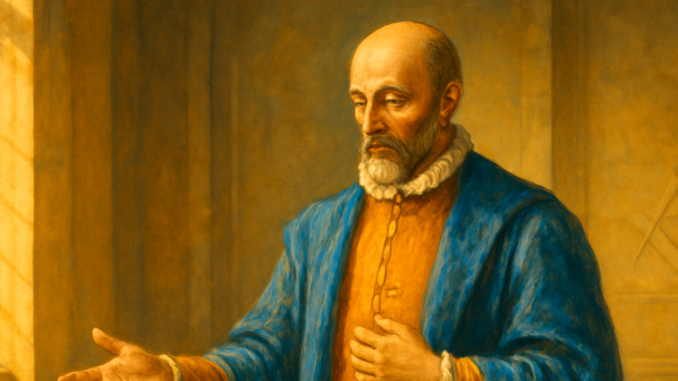
In the sixteenth century, Michel de Montaigne penned a brief but incisive essay on a question that still cuts to the bone: how do we handle honor? Why do we claim it, hoard it, or refuse to share it — and what does that say about our character? Centuries later, his reflections remain remarkably relevant for anyone who thinks seriously about virtue, humility, and personal growth. In this article, we trace the philosophical sources that nourished Montaigne when he wrote his forty-first essay, “On Not Sharing One’s Honor.” We follow the threads of Stoicism, Skepticism, and Renaissance humanism, and discover how these traditions continue to echo in the ethical practice of Freemasonry.
What Drove Montaigne to Write About Honor?
Michel de Montaigne lived in an era of religious wars, political intrigue, and a nobility that guarded its status with fierce determination. Honor was not an abstract concept — it was social capital that could make or break families. Yet in Essay 41 of his first book, Montaigne raised an uncomfortable question: does a prince or leader truly deserve all the honor attributed to him? Or does that honor rightly belong to the advisors, soldiers, and craftsmen who do the actual work?
The question itself was not new. Montaigne drew liberally from classical sources. But what makes his approach so distinctive is that he never adopted those sources uncritically. He chewed on them, doubted them, and made them his own. That makes the essay a brilliant example of philosophical digestion rather than slavish imitation — and it’s a quality that speaks directly to anyone who values independent thought.
The Influence of Plutarch on Montaigne’s Thinking About Honor
If there was one author Montaigne considered a kindred spirit, it was Plutarch. The first-century Greek writer offered, through his Lives and Moralia, a rich collection of portraits of statesmen and generals who wrestled with the problem of honor. Plutarch judged his heroes not merely by their deeds but above all by their character. He showed how Alexander the Great and Julius Caesar either shared their glory with those around them — or refused to.
From Plutarch, Montaigne adopted the idea that true greatness reveals itself in the willingness to acknowledge others. A leader who draws all praise toward himself betrays a lack of inner security. This is a thought that resonates deeply with the Masonic conviction that real merit lies not in outward display but in the quiet labor of inner development.
How Stoicism Shapes This Essay
Alongside Plutarch, Seneca was one of Montaigne’s most cherished conversation partners on the page. The Stoic philosopher insisted that external recognition is transient and unreliable. What truly matters, Seneca argued, is the inner state — the peace that comes from knowing you have acted virtuously, regardless of whether the world notices or acknowledges it. In his Letters to Lucilius, Seneca repeatedly warned against the temptation of making your happiness dependent on the judgment of others.
Montaigne translated this Stoic lesson into the practice of his own time. He watched kings and noblemen artificially inflate their reputations by concealing the contributions of others. Stoic wisdom offered an antidote: true honor cannot be divided, because it does not reside in external praise but in virtue itself. Marcus Aurelius, the Roman emperor-philosopher, expressed the same principle in his Meditations: act as though no one is watching, because the only audience that matters is your own conscience.
True honor cannot be divided, because it does not dwell in applause but in the silence of a sincere conscience.
Did Montaigne Doubt Honor Itself? The Role of Skepticism
Montaigne is often associated with Pyrrhonian Skepticism, the philosophical tradition tracing back to Pyrrho of Elis that experienced a remarkable revival during the Renaissance thanks to the rediscovery of Sextus Empiricus. At its core, this tradition advocates the suspension of judgment: we know less than we think, and our certainties are often mirages.
Applied to the theme of honor, this leads to a fascinating conclusion. If we cannot even be certain of our own motives, how can we assert with confidence that any particular honor is rightfully ours? Montaigne turned the skeptic’s doubt inward: perhaps we overestimate our own contributions and underestimate those of others. This intellectual humility forms the heart of his essay — and it is also a foundational principle of the Masonic lodge, where every Brother or Sister is invited to temper the ego in service of the collective work.
Renaissance Humanism and the Call to Self-Knowledge
Renaissance humanism — the broad intellectual movement of which Montaigne is an inseparable part — placed unprecedented emphasis on the dignity of the individual. Thinkers like Erasmus and Petrarch had paved the way for a culture in which personal reflection and self-knowledge were regarded as the highest forms of wisdom. Montaigne built on this legacy by refining the essay as a genre into an instrument of honest self-examination.
Seen in this light, “On Not Sharing One’s Honor” is far more than a political observation. It is a call to self-reflection. Montaigne asks the reader not only to look critically at those in power who claim honor, but above all to turn the mirror inward. Do I know my own limitations? Do I acknowledge the contributions of others to my success? These are questions that also stand at the center of Masonic practice. After all, the rough stone that must be shaped is always one’s own.
What Can Freemasons Learn From These Philosophical Roots?
The ethical practice of Freemasonry is not a standalone system. It draws from the same wellsprings as Montaigne: Stoicism, which teaches us to value inner virtue above external recognition; Skepticism, which counsels humility in the face of our own certainty; and humanism, which calls on each person to pursue continuous self-improvement.
When a Mason enters the lodge, the titles and honors of the outside world are left at the door. This is not mere ritual — it is a philosophical act rooted in the same traditions that informed Montaigne’s essay. The apron replaces the business suit, the gavel reminds us that we are all works in progress, and the level affirms that no one stands above another in the pursuit of wisdom.
Montaigne’s insistence that honor should not be hoarded speaks directly to the Masonic ideal of brotherly love and mutual support. In a well-functioning lodge, success is shared, credit is given freely, and the temptation to inflate one’s own role is gently but firmly checked by the culture of the Craft. The rough ashlar does not polish itself — it is shaped by the community, by the tools, and by the willingness to submit to a process larger than any individual ego.
These philosophical roots also remind us that Masonic ethics did not emerge in a vacuum. They are part of a centuries-long conversation about what it means to live well, to lead justly, and to know oneself honestly. Montaigne was one of the most eloquent voices in that conversation, and his essay on honor remains a powerful mirror for anyone walking the path of self-improvement — whether in a lodge or in the quiet of their own study.
Montaigne’s forty-first essay may be short, but its philosophical roots run deep — through Plutarch’s moral portraits, Seneca’s Stoic discipline, the radical doubt of Pyrrhonian Skepticism, and the humanist commitment to self-knowledge. These are not dusty relics of the past. They are living traditions that continue to shape how Freemasons think about virtue, humility, and the honest sharing of honor. The next time you are tempted to claim more credit than you deserve — or to let someone else’s contribution go unacknowledged — remember Montaigne’s quiet challenge: true honor is not something you can divide, because it was never yours alone to begin with.
Copyright text & image: devrijmetselaar.nl
Texts are based on the ideas and content of the author of devrijmetselaar.nl, reviewed, corrected, and supplemented with the assistance of OpenAI. Images are created based on the ideas of the author of devrijmetselaar.nl using OpenAI/DALL-E.
Frequently Asked Questions
What is Montaigne's main argument in his essay 'On Not Sharing One's Honor'?
Montaigne questions whether leaders and princes truly deserve all the honor attributed to them, suggesting that much of that honor rightfully belongs to the advisors, soldiers, and craftsmen who do the actual work. He argues that true greatness is revealed in the willingness to acknowledge the contributions of others rather than hoarding all praise for oneself.
How did Plutarch influence Montaigne's thinking about honor?
Montaigne considered Plutarch a kindred spirit and drew extensively from his works. From Plutarch's Lives and Moralia, Montaigne adopted the idea that true greatness lies in acknowledging others and sharing glory. Plutarch's portraits of leaders like Alexander the Great and Julius Caesar showed Montaigne that a leader who draws all praise toward himself lacks inner security.
How does Montaigne's philosophy on honor relate to Freemasonry?
Montaigne's ideas about honor resonate deeply with Masonic convictions that real merit lies not in outward display but in quiet labor and inner development. Both traditions value humility, virtue, and the recognition that true greatness comes from character and contributions to others rather than from self-promotion or the hoarding of status.

Be the first to comment