
It is early evening. A man sits at a simple wooden table, the glow of an oil lamp flickering across a scroll of parchment. He writes to a friend — not about affairs of state or rhetorical exercises, but about a question that has occupied his mind for years: does possession truly make a person happy? The man is Lucius Annaeus Seneca, and the letter he writes that evening is now known as Letter XCVIII from his collection Letters to Lucilius. It is a text that has lost none of its power, precisely because the temptation of material wealth has never disappeared.
The Heart of the Letter: Possessions Are Only on Loan
In Letter XCVIII, Seneca addresses his student and friend Lucilius with a message that is both comforting and confronting. His central thesis is that material wealth is not inherently reprehensible, but the wise person must never forget that possessions are merely on loan. Fortune — or Fortuna, as the Romans called her — can reclaim everything she has given in the blink of an eye. The person who truly understands this possesses their goods without being possessed by them.
Seneca draws a clear distinction between two attitudes toward wealth. The first belongs to the greedy individual, who clings to money, land, and luxury as though these things are part of their very being. The second belongs to the wise person, who enjoys what life offers but remains inwardly prepared for its loss. It is this second attitude that Seneca holds up as the key to peace of mind.
The Fire and the Art of Philosophical Detachment
To strengthen his argument, Seneca draws on the example of men who lost everything in a fire or some other calamity. Some collapsed entirely — their whole identity had been woven into their possessions. Others remained calm and rebuilt their lives without bitterness. Seneca recalls the story of the philosopher Stilbo, whose city was destroyed and who nonetheless declared he had lost nothing, because all his true possessions — his virtue, his wisdom, and his character — were untouchable.
Seneca had cited this example before in earlier works, but in Letter XCVIII he places it within a broader framework. The point is not merely about enduring loss when it strikes. It is about the daily practice of detachment — a discipline cultivated in calm times so that it is available in times of crisis.
Importantly, Seneca makes clear that this detachment does not require gloom or self-denial. He is no ascetic who rejects wealth entirely. On the contrary, he acknowledges that prosperity makes life more pleasant. But he warns that comfort must never harden into dependency. The wise person uses wealth the way a traveler uses an inn: grateful for the shelter, but always ready to move on the next morning.
Fortuna and the Practice of Preparedness
A major theme running through the letter is the relationship with Fortuna, the capricious goddess of fate. Seneca paints her as a force that gives and takes with equal ease. Those who are not prepared for her fickleness live in constant anxiety. And that anxiety, Seneca argues, is a greater evil than actual loss. A person who fears day and night that their fortune will vanish never truly enjoys what they have.
The remedy Seneca prescribes is the Stoic practice of praemeditatio malorum — the premeditation of adversity. This is not pessimism. It is a form of mental resilience. By regularly imagining what it would be like to lose everything, you train your mind not to break at the moment of genuine trial. Seneca compares this to a soldier who prepares for battle during peacetime — not out of a desire for war, but out of wisdom.
True wealth is not the possession of much, but the inner freedom to lose everything without losing yourself.
Virtue as the One Indestructible Possession
The philosophical heart of Letter XCVIII rests in the conviction that only virtue truly belongs to a person. Money, status, health, and even relationships are subject to change. But the character a person builds through self-reflection, discipline, and moral action cannot be taken away by any outside force. In this, Seneca follows the broader Stoic tradition of Zeno of Citium and Chrysippus, who taught that the good life depends not on external circumstances but on the inner condition of the soul.
This idea has echoed through the centuries — from the Meditations of Marcus Aurelius to the essays of Michel de Montaigne, who reflected at length on what a person truly needs to live contentedly. Where Seneca emphasizes preparation for loss, Montaigne stresses the importance of self-knowledge as the foundation for inner peace. Both thinkers arrive at the same core insight: those who know themselves will not be swept away by the illusion of material possession.
The Letter as a Mirror for the Freemason
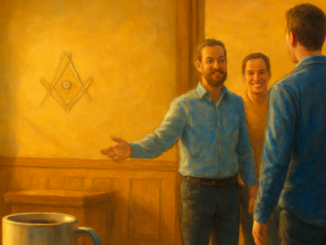
For those familiar with Freemasonry, Seneca’s message resonates in a particularly powerful way. The rough ashlar that the Freemason works upon represents the ongoing process of self-improvement — the shaping and refining of one’s own character. What Seneca describes as the building of inner virtue is, in essence, the same endeavor: not the accumulation of outward honor or riches, but the formation of a person who stands firm regardless of circumstances.
The idea that true wealth is invisible and resides within reflects the Masonic ideal that a person’s real worth cannot be read from their exterior. The lodge teaches its members to look beyond surface appearances and to value the qualities of the heart and mind above all else. Seneca’s Stoic philosophy and Masonic symbolism meet at this crossroads: both traditions insist that the most important work is the work done on oneself.
In a world saturated with consumerism and status signaling, this ancient Stoic wisdom offers a bracing reminder. The person who possesses the most is not the one with the greatest treasury, but the one who needs the least to feel whole.
Seneca’s Letter XCVIII is nearly two thousand years old, yet its message has lost none of its edge. It challenges us to examine our relationship with what we own, to practice detachment not as deprivation but as liberation, and to invest in the only wealth that cannot be taken from us: our character. For the Freemason walking the path of self-improvement, this letter serves as both a mirror and a compass — a timeless reminder that the rough stone is shaped not by what we accumulate, but by what we are willing to let go.
Copyright text & image: devrijmetselaar.nl
Texts are based on the ideas and content of the author of devrijmetselaar.nl, reviewed, corrected, and supplemented with the assistance of OpenAI. Images are created based on the ideas of the author of devrijmetselaar.nl using OpenAI/DALL-E.



Be the first to comment