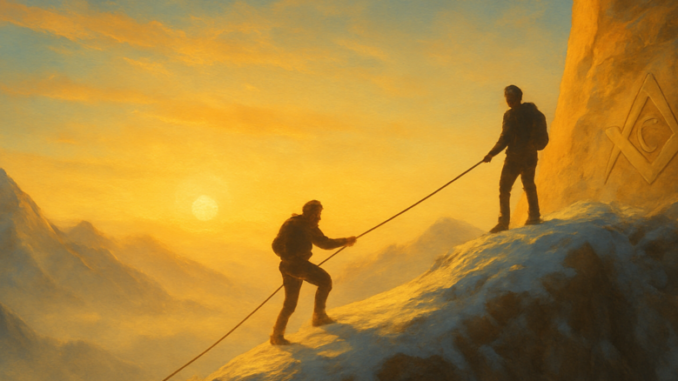
Somewhere high in the Karakoram, bodies lie beneath the snow. A renowned climber is missing, and the world waits in uncertainty. The mountain refuses to reveal who it has taken. In the tension between hope and grief, between knowing and not knowing, there lies a deeper lesson about what connects us as human beings — a lesson that reaches far beyond any summit, straight into the heart of every community built on trust.
The Rope That Binds
Mountaineers know a simple truth: you are only as strong as the weakest link on your rope. The line that connects climbers is more than a safety device. It is a promise — a promise not to let go when the abyss beckons, when the storm rises, when strength begins to fail. In that promise, Freemasons recognize something deeply familiar. We too are bound by an invisible cord, woven from ritual, trust, and mutual devotion.
The tragedy in Pakistan confronts us with the fragility of that bond. When one link in the rope falls, the entire group feels the shock. The bodies in the snow are not merely individuals — they are links in a chain of relationships: families, friends, climbing partners who now keep vigil and wait. In that collective uncertainty, the true nature of community reveals itself. It is not shared success that defines us, but how we face shared loss.
Uncertainty as a Teacher
Whether the missing climber has perished remains unanswered. That uncertainty is unbearable for those who wait, yet it also contains a kind of wisdom. The Greek philosopher Socrates taught us that true knowledge begins with acknowledging what we do not know. In Freemasonry, we speak of the rough ashlar — the raw material we work with before it takes shape. That roughness is not a flaw; it is a starting point. In the same way, uncertainty is not an enemy but a teacher that compels us toward humility.
Brotherhood is not forged in times of certainty, but in the darkness where we reach together for the light.
Our society craves quick answers. We want to know, confirm, and close the book. But the mountain teaches patience. It reveals its secrets in its own time — or keeps them hidden forever. In the tension between wanting to know and having to wait lies a meditation on our place within the greater whole. We are not masters of nature, nor of fate. We are travelers keeping one another company on a path full of unknowns.
The Vertical Journey as Symbol
A mountain climb is more than a physical endeavor. It is a vertical journey into the unknown — a movement from the earthly world toward rarefied heights where oxygen grows scarce and the mind sharpens. Johann Wolfgang von Goethe, himself a Freemason and a master of symbolism, wrote about the human impulse to ascend, to seek the higher. That drive is universal, expressed in towers, cathedrals, and yes, in the conquest of the world’s highest peaks.
But every ascent has its counterpart. The higher we climb, the thinner the air, the greater the risk. The climber who reaches the summit knows that the descent is often more dangerous than the climb itself. In that knowledge lies a paradox well known to Freemasonry: growth demands courage, but also the wisdom to recognize limits. The temple we build is not only directed toward heaven — it is rooted in the earth. Without a foundation, there can be no height.
Community in the Waiting Room
While rescue teams search and families wait, a temporary community of hope and fear takes shape. Strangers who have never met now share the same tension. Online and offline, people connect in a web of empathy. This is brotherhood in its rawest form — not chosen, but born from shared humanity.
In the lodge, we learn that brotherhood is not made solely of rituals and handshakes. It lives in the moments when we show up for each other, especially when words fall short. The philosopher Marcus Aurelius wrote that we are born to work together, like the upper and lower rows of teeth. That cooperation is not always harmonious, but it is necessary. Without it, we are loose elements at the mercy of wind and weather.
The Mountain Gives and Takes
For those who know the mountains, death is no stranger. Every season brings stories of triumph and tragedy. The mountain grants fulfillment to those who climb it, but claims the lives of those who go too far. In that harsh honesty, there is something pure. The mountain does not judge by fame or fortune, by lineage or belief. It treats all climbers equally — with the same indifference, the same potential grace.
As a society, we can learn from that equality. In the lodge, people meet as equals, stripped of the titles and distinctions of the outside world. The rough ashlar knows no rank. This equality is not naive. It acknowledges that we all struggle, all doubt, and all search for meaning. In that shared quest, we find one another — not as heroes or victims, but as fellow travelers on the way.
Looking Beyond the Summit
The tragedy in Pakistan reminds us that the journey matters more than the destination. The summit is a moment; the climb is a process. It is within that process that lasting bonds are formed — bonds that endure long after the glory has faded. The climbers who are now missing did not live solely for the peak. They lived for the mornings at base camp, the shared meals, the stories told by candlelight. That is the fabric of human existence.
As Freemasons, we recognize this truth. We do not build a finished temple; we dedicate ourselves to the act of building itself. Every stone we lay is an act of faith in the future, a gift to those who come after us. The mountain will stand regardless of who climbs it. But the stories of those who walked its slopes live on in those who remain — those who remember, who carry forward what was begun.
In the uncertainty surrounding the missing climbers, we find not despair but a mirror. The mountain reflects back to us what we already know but too often forget: that we are bound to one another by something stronger than rope or ritual. It is the simple, profound recognition that none of us climbs alone. Whether in the thin air of the Karakoram or within the walls of the lodge, true brotherhood is measured not by the heights we reach, but by how steadfastly we hold the line when the ground falls away beneath our feet.
Copyright text & image: devrijmetselaar.nl
Texts are based on the ideas and content of the author of devrijmetselaar.nl, reviewed, corrected, and supplemented with the assistance of OpenAI. Images are created based on the ideas of the author of devrijmetselaar.nl using OpenAI/DALL-E.
Frequently Asked Questions
What does Freemasonry teach about brotherhood and mutual support?
Freemasonry teaches that members are bound together by an invisible cord of ritual, trust, and mutual devotion—similar to how mountaineers are connected by a physical rope. Just as climbers promise not to let go when facing danger, Freemasons commit to supporting one another through both success and hardship, recognizing that true community is defined not by shared victories but by how we face shared challenges together.
How does Freemasonry view uncertainty and the unknown?
Freemasonry embraces uncertainty as a teacher that leads to humility and wisdom, much like the mountain's hidden secrets. Rather than demanding quick answers, Freemasonry encourages members to acknowledge what they do not know and to grow through that acknowledgment, understanding that brotherhood is truly forged in darkness when we reach together for the light.
What is the significance of the 'rough ashlar' in Freemasonry?
The rough ashlar represents raw, unfinished material that is shaped into a perfect stone through work and dedication. This symbol teaches that imperfection and uncertainty are not flaws but starting points for growth and self-improvement, reflecting Freemasonry's commitment to the continuous development of character and virtue in its members.
Why do Freemasons use symbolism like mountain climbing in their teachings?
Freemasonry uses universal symbols like mountain climbing because they speak to fundamental human experiences and truths that transcend culture and time. These symbols help members understand profound lessons about personal growth, interconnection, and our place within the greater whole—lessons that resonate deeply because they mirror the challenges and triumphs we all face in life.


Be the first to comment