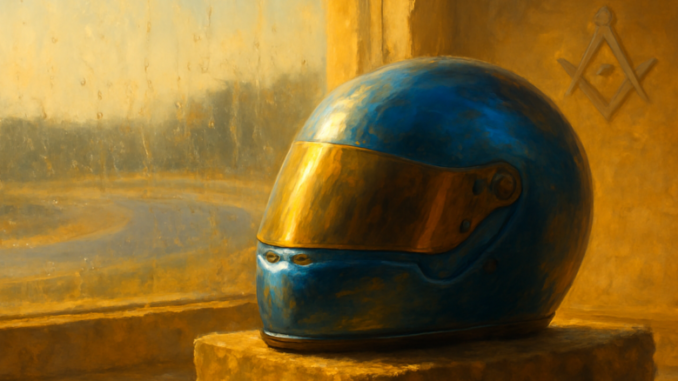
A young racing driver falls ill at the worst possible moment — media day, just before a potentially title-deciding race weekend. The cameras are ready, the world is watching, but the protagonist is confined to bed. It’s a scenario anyone can recognize: just when everything is on the line, fate intervenes. The outside world sees vulnerability. The initiated see a touchstone. Because what does adversity actually reveal about who you truly are? That question connects the race track to an ancient tradition that places character above performance.
The Outside World’s View: Vulnerability as Weakness
When a title contender misses a mandatory media appearance due to illness, the world’s reaction is predictable. Analysts speculate about the consequences for the championship. Rivals smell blood. Commentators wonder whether the pressure has finally become too much. In modern sports culture, vulnerability is almost automatically equated with weakness. We live in an age where visibility equals strength and absence equals failure.
This perspective is understandable but ultimately superficial. It reduces a person to their results and judges character based on attendance rather than inner composure. The outsider measures the driver by lap times and press appearances, not by how he handles an unexpected setback when no one is watching. Yet it is precisely there — in the quiet of a hotel room far from the spotlight — that something essential about personality reveals itself.
The Freemason’s View: Adversity as a Whetstone
Within Freemasonry, there exists a fundamentally different framework for understanding adversity. Where the outside world measures results, the Freemason focuses on the inner process. The rough ashlar — one of the central symbols in Masonic thought — is not shaped by success, but by friction, by hammer blows, by the patient chiseling away of excess material. Illness, disappointment, and powerlessness are not enemies of character in this view, but its very sculptors.
The Stoic philosopher Marcus Aurelius, whose thinking is closely intertwined with the ethical tradition that helped nourish Freemasonry, wrote in his Meditations that the obstacle on the path becomes the path itself. Adversity is not a detour — it is the way. This idea resonates deeply in the lodge, where a candidate is never judged by his worldly success, but by his ability to stand with integrity when circumstances turn against him. Aristotle called this phronesis: practical wisdom that only reveals itself under pressure, never in comfort.
True personality does not show itself when the spotlight is blazing, but when it goes dark. Character is what remains when circumstances fall away.
Two Worlds, One Question
The comparison between the world of motorsport and Freemasonry reveals a fascinating tension. Both worlds demand the highest standards of their participants. Both have rituals, hierarchy, and dedication. But where the sports world judges its heroes on visible performance, Freemasonry chooses to look at the invisible: the inner disposition, the ethical resilience, the willingness to grow when growth is painful.
A racing driver who misses media day due to illness loses a platform in the eyes of the world. A Freemason who experiences the same adversity stands before a mirror. Both are tested, but the standard by which they are measured differs fundamentally. The sports world asks: what can you show us? The lodge asks: who are you when no one is watching?
What Both Worlds Share
Yet the parallels are as striking as the differences. Both the racing driver and the Freemason understand the importance of discipline, preparation, and the ability to think clearly under pressure. Johann Wolfgang von Goethe — himself a Freemason and one of the greatest minds of his era — wrote that talent is formed in stillness, but character in the stream of life. The race track and the lodge are both streams in which personality is forged, albeit with different tools.
Discipline: In both sport and Freemasonry, consistently working on yourself is a core value. There are no shortcuts to mastery in either arena.
Brotherhood: A driver relies on his team; a Freemason relies on his Brethren. Neither stands alone. The strength of the bond determines the strength of the individual.
Ritual: The starting procedure on a circuit and the opening of a lodge have more in common than one might initially think. Both mark the transition from the ordinary to the extraordinary.
Dealing with loss: Not every race is won; not every degree is conferred without struggle. It is precisely in loss that the deepest lessons are found.
The Ethics of Vulnerability
There is a profound ethical lesson in allowing ourselves to be vulnerable. Modern society encourages us to be strong, invulnerable, and perpetually available. But Freemasonry reminds us that vulnerability is not a shortcoming — it is a prerequisite for genuine growth. The legend of Hiram Abiff, the Master Builder of Masonic tradition, is not a story about invincibility. It is about faithfulness to one’s principles, even when the price is the highest imaginable.
A young driver who publicly admits he is ill and needs rest displays a form of courage that is too often overlooked. It takes more character to acknowledge that you cannot continue than to push on at your own expense. In the language of the lodge: he chooses the level over the sword. He chooses honesty over appearance.
What We Can Learn from This
The lesson these two worlds offer together is clear. Personality is not defined by the number of victories or the height of a podium. It is shaped in those moments when the script no longer holds, when planning fails and the body refuses to cooperate. Epictetus, the Stoic philosopher who was born a slave yet became one of the most influential thinkers of antiquity, put it succinctly: it is not about what happens to you, but about how you respond to what happens to you.
Freemasonry has carried this wisdom through the centuries — not as abstract theory, but as a lived practice. Every Brother who has faced illness, loss, or failure knows that these moments are not interruptions on the path of self-improvement. They are the path itself. The rough ashlar does not become smooth through ease, but through the deliberate, sometimes painful work of the chisel.
Whether on the race track or in the lodge, life’s most revealing moments are not those of triumph, but those of trial. Adversity strips away pretense and leaves only what is real. The outside world may judge us by our visibility, our results, our composure in the spotlight. But the deeper question — the Masonic question — will always be this: who are you when no one is watching? That question deserves not just our attention, but our honest answer. For it is in that answer that true character lives.
Copyright text & image: devrijmetselaar.nl
Texts are based on the ideas and content of the author of devrijmetselaar.nl, reviewed, corrected, and supplemented with the assistance of OpenAI. Images are created based on the ideas of the author of devrijmetselaar.nl using OpenAI/DALL-E.
Frequently Asked Questions
What is the Masonic view of adversity and how does it differ from modern perspectives?
Freemasonry views adversity as a sculptor of character rather than a sign of weakness. Using the symbol of the rough ashlar, Masons understand that character is shaped through friction and challenge, not through success alone. This contrasts with modern culture, which often equates visibility and performance with strength. In Masonic philosophy, a person's true character is revealed not by their worldly achievements or public appearances, but by how they maintain integrity when circumstances turn against them.
How does the concept of the 'rough ashlar' relate to personal development in Freemasonry?
The rough ashlar is a central Masonic symbol representing the unfinished stone that must be shaped and refined. It symbolizes how adversity — through hammer blows and patient chiseling — removes excess material and imperfections from a person's character. Rather than viewing hardship as damage, Freemasonry teaches that illness, disappointment, and powerlessness are essential tools for sculpting inner strength and wisdom.
Why does Freemasonry focus on inner composure rather than external results?
Freemasonry emphasizes that true character cannot be measured by attendance, lap times, or public performance. Instead, it judges individuals based on their ability to maintain integrity and composure during difficult moments when no one is watching. This philosophy, influenced by Stoic thinkers like Marcus Aurelius, teaches that practical wisdom (phronesis) is developed through how one handles unexpected setbacks and adversity, not through visible success or media presence.

Be the first to comment