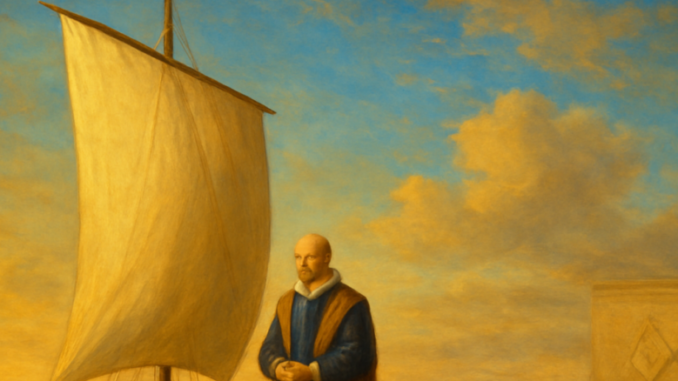
Have you ever wondered whether your success automatically means someone else loses out? It’s a deeply ingrained assumption in our culture — the idea that the world is a fixed pie, and every slice you take leaves less for everyone else. Michel de Montaigne, the sixteenth-century French philosopher and father of the personal essay, examined precisely this assumption in one of his shortest yet most provocative pieces of writing. Centuries later, his reflections still challenge the way we think about wealth, value, and what it truly means to build something together.
The Heart of the Essay
In Essay 21 of the first book of his Essais, Montaigne investigates the ancient belief that profit and loss are always perfectly balanced. The title says it all: “That the profit of one man is the damage of another.” He opens with a reference to Demades, an Athenian orator who condemned a trader on the grounds that his profession could only be profitable at the expense of others. This classical conviction serves as Montaigne’s launching point for deeper reflection.
The essay is remarkably brief — even by Montaigne’s own standards. Yet within its compact frame, it delivers a fundamental critique of the economic thinking of his era, and, as it turns out, of ours as well. At first, Montaigne appears to agree with the zero-sum principle, observing that nature itself seems to follow this pattern. The growth of one organism comes at the expense of another’s decay. Life feeds on death.
Classical Sources and Historical Examples
Montaigne draws on a range of classical thinkers to develop his argument. Beyond Demades, he references the Roman poet Lucretius, who described in De Rerum Natura how all matter exists in an eternal cycle of creation and dissolution. The Stoic idea that the cosmos is a closed system — where nothing is truly lost but merely changes form — echoes throughout Montaigne’s reasoning.
Particularly striking is how Montaigne turns to warfare for illustration. The spoils of the conqueror are the losses of the conquered. A general’s glory is built upon the bodies of fallen soldiers. In these examples, Montaigne proves himself a sharp observer of the human condition, unafraid to confront uncomfortable truths about how prosperity is often achieved.
The Underlying Philosophy
What makes this brief essay so enduringly relevant? Montaigne touches on a fundamental question about the nature of value and wealth. Is the world truly a zero-sum game, where every gain automatically causes loss elsewhere? Or are there forms of value creation that expand the total rather than merely redistribute it?
True wealth is not created by taking from others, but by building what did not yet exist.
Characteristically, Montaigne leaves the question open. He offers no definitive answers but instead invites the reader into a process of personal reflection. Yet the tone of the essay suggests that Montaigne himself was not fully convinced by the strict zero-sum principle. His later essays on friendship and on the education of children reveal a thinker who believed deeply in forms of exchange that enrich both parties.
A Masonic Perspective on Shared Growth
For those familiar with Freemasonry, Montaigne’s inquiry resonates powerfully with one of the Craft’s core principles. The Lodge is, above all, a space where shared growth is not only possible but expected — growth that does not come at the expense of the individual. The idea that sharing knowledge does not diminish your own but actually increases it stands in direct opposition to the zero-sum thinking Montaigne describes.
The building symbolism at the heart of Freemasonry offers a compelling counterpoint. When Masons work together on a structure, they create something that did not previously exist. The cathedral that rises from rough stone is not a redistribution of existing wealth — it is an addition to the world. This creative principle, this commitment to building something greater than oneself, transcends the logic of profit and loss entirely.
In the ritual work of the Lodge, Brethren experience this firsthand. The rough ashlar is shaped not by taking away from another stone but through patient, skilled labor applied to one’s own material. Every Brother who refines himself adds to the collective strength of the Lodge without diminishing anyone else. It is a living refutation of the zero-sum assumption.
Why This Matters Today
In an era when debates about economic inequality, sustainability, and fair distribution are more urgent than ever, Montaigne’s essay offers surprisingly timely food for thought. Zero-sum thinking still dominates much of our political and economic discourse. The assumption that immigrants “steal” jobs, that one person’s wealth automatically explains another’s poverty, or that nations are locked in a constant battle over finite resources — these are all variations of the principle Montaigne examined back in the sixteenth century.
At the same time, clear counterexamples abound. The spread of knowledge through education, the development of technology that opens up entirely new possibilities, the power of collaboration in scientific research — these are all processes in which value is created, not merely relocated. Montaigne would undoubtedly have studied these examples with great interest.
For Freemasons, these counterexamples are not abstract concepts. They are lived realities within the Lodge. Every piece of knowledge shared during a lecture, every insight gained through ritual, every bond strengthened through fellowship — these are tangible instances of value creation that leave no one poorer.
Key Takeaways from Montaigne’s Essay
Montaigne’s essay “That the profit of one man is the damage of another” is a concise yet deeply probing exploration of a fundamental assumption about how value and wealth operate. By invoking classical sources and making sharp observations about war, trade, and nature, Montaigne exposes a belief that continues to shape our thinking to this day.
The essay asks whether every gain automatically causes loss elsewhere. Montaigne references classical thinkers such as Demades and Lucretius. He uses vivid examples drawn from nature, commerce, and warfare. The question is deliberately left open, inviting personal reflection. And the essay remains strikingly relevant for contemporary discussions about distribution, prosperity, and the possibility of shared growth.
Montaigne’s essay invites you to examine your own assumptions. Do you see the world as a fixed pie that must be divided, or do you believe in the possibility of building something new together? This is not merely a philosophical question — it goes to the heart of how you relate to others and to the world around you. In the Masonic tradition, the answer is clear: we build. We shape rough stone into something purposeful and beautiful, and in doing so, we add to the world rather than subtract from it. The next time you encounter zero-sum thinking — in politics, in economics, or in your own mind — remember Montaigne’s open question, and consider whether the real opportunity lies not in dividing the pie, but in baking a larger one together.
Copyright text & image: devrijmetselaar.nl
Texts are based on the ideas and content of the author of devrijmetselaar.nl, reviewed, corrected, and supplemented with the assistance of OpenAI. Images are created based on the ideas of the author of devrijmetselaar.nl using OpenAI/DALL-E.
Frequently Asked Questions
What is the main thesis of Montaigne's Essay 21?
Montaigne examines the ancient belief that profit and loss are always perfectly balanced, exploring whether one person's success necessarily means another person's loss. He challenges the zero-sum thinking prevalent in his era by investigating whether the world truly operates as a fixed pie where every gain must come at someone else's expense.
What classical sources does Montaigne use to support his argument?
Montaigne draws on several classical thinkers, including Demades (an Athenian orator), the Roman poet Lucretius and his work De Rerum Natura, and Stoic philosophy. He also uses historical examples such as warfare to illustrate how profit and loss have traditionally been understood, noting how a conqueror's spoils represent the conquered's losses.
Why is this sixteenth-century essay still relevant today?
Montaigne's essay remains relevant because it addresses fundamental questions about the nature of value and wealth that continue to shape modern economic and cultural thinking. His critique of zero-sum thinking challenges deeply ingrained contemporary assumptions about whether success must come at someone else's expense, making it applicable to modern discussions about economics and competition.



Be the first to comment