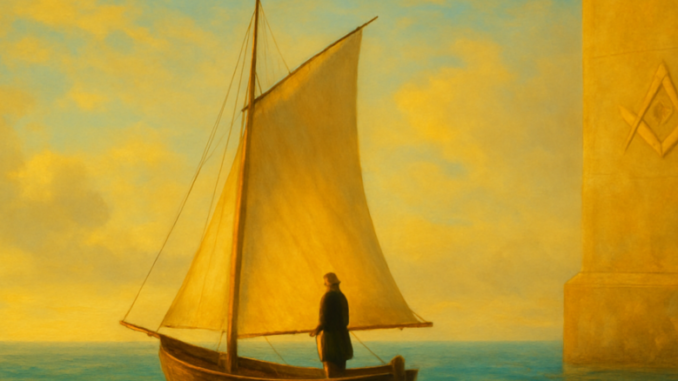
A candle flickers in the study as a young Freemason opens a yellowed copy of Candide. Voltaire’s razor-sharp wit, first published in 1759, still sparks after nearly three centuries. What drove this towering Enlightenment thinker to tear so relentlessly into the optimism of his era? And what can we — as modern seekers of wisdom — learn from this satirical journey through human suffering and the stubborn struggle for good?
The Central Idea: Optimism Under Fire
Voltaire wrote Candide as a devastating attack on the philosophical optimism of Gottfried Wilhelm Leibniz. The German philosopher argued that we live in “the best of all possible worlds” — a thesis that absolves God of evil by insisting that every instance of suffering is necessary for some greater good. Voltaire found this reasoning intolerable, particularly after the catastrophic Lisbon earthquake of 1755, which killed tens of thousands of people in a matter of minutes.
The title character, Candide, grows up in the castle of Baron Thunder-ten-Tronckh in Westphalia, where his tutor Pangloss instructs him in “metaphysico-theologo-cosmo-nigology.” This absurd academic discipline teaches only one lesson: everything is for the best. When Candide is thrown out of the castle for kissing the baron’s daughter, Cunégonde, an odyssey begins that will test this doctrine to its breaking point.
A Journey Through Human Suffering
Voltaire drags his hero through wars, earthquakes, shipwrecks, the Inquisition, and slavery. Each new chapter presents a catalogue of horrors that makes Pangloss’s optimism increasingly absurd. In Lisbon, Candide survives the infamous earthquake only to witness an auto-da-fé in which the Inquisition burns “heretics” to prevent future disasters. The irony is merciless: human cruelty joins forces with natural catastrophe as evidence against the best of all possible worlds.
True optimism does not consist in explaining away suffering — it lies in actively cultivating the good despite the chaos that surrounds us. This is the insight Voltaire builds toward, brick by brick, through every misfortune Candide endures.
One of the most harrowing episodes is the encounter with a mutilated slave in Suriname, who lost his hand in a sugar mill and his leg during an escape attempt. “This is the price at which you eat sugar in Europe,” he tells Candide. Here, Voltaire confronts the colonial exploitation that his contemporaries preferred to ignore — a searing piece of social criticism wrapped in satire.
Key Characters and Their Symbolism
Pangloss represents blind optimism that refuses to face reality. Despite smallpox, hangings, and galley slavery, he continues to insist that all is for the best. His name, derived from the Greek for “all tongue,” suggests he talks endlessly without truly thinking. Opposite him stands the pessimist Martin, who accompanies Candide on his later travels. Martin sees evil everywhere and expects nothing good — the other extreme that Voltaire equally rejects.
Cunégonde undergoes a transformation from desirable ideal to everyday reality. When Candide finally finds her, she has grown old and ugly. Yet he marries her — not out of passion, but out of faithfulness. This moment marks Candide’s transition from dreamer to realist who acts despite disillusionment.
Eldorado: Utopia as a Mirror
Midway through the story, Candide reaches the legendary Eldorado — a hidden land where gold is worthless, war is unknown, and everyone lives in harmony. Remarkably, Candide chooses to leave. He wants to return to the world to find Cunégonde and to flaunt his wealth. Voltaire suggests that utopias may indeed be possible, but human nature drives us back toward imperfect reality.
Eldorado has no priests who punish or reward — religion is pure gratitude. Science and reason are celebrated without dogma. Material wealth has no value because everyone has enough. The king treats visitors as equals, not as subjects. It is a vision of what could be, held up as a mirror to what is.
The Garden: A Philosophy of Practical Wisdom
The famous ending of Candide gathers all the survivors on a small farm near Constantinople. Pangloss continues to preach his optimism, Martin his pessimism, but it is Candide who speaks the words that form the book’s essence: “Il faut cultiver notre jardin” — we must cultivate our garden. This is not a retreat into private happiness but a call to concrete action. Philosophizing about evil changes nothing; working toward the good within your own reach does.
For Freemasons, this message resonates deeply. The lodge is just such a garden — a defined space where brethren work on their own rough ashlar, not to escape the world but to return to it better equipped. Voltaire, though not a Freemason himself, shared with the Enlightenment lodges a belief in practical virtue over abstract dogma. His friend and contemporary Benjamin Franklin was a member of the Craft, as were many other Enlightenment thinkers who cherished similar ideals.
Why Candide Still Matters
Candide remains relevant because the questions it raises never disappear. How do we reconcile suffering with a meaningful existence? How do we prevent philosophy from becoming an excuse for passivity? Voltaire offers no system, but an attitude: remain critical, do not despair, and contribute concretely to the good. In an age of climate crisis, wars, and polarization, his call to cultivate the garden sounds like a timeless compass for anyone seeking practical wisdom.
The struggle for good is won not through optimistic slogans or pessimistic resignation, but through daily labor in our own garden. For those familiar with the symbolism of the Masonic workshop, this message needs no explanation: the rough stone does not smooth itself.
Voltaire’s Candide is far more than a historical curiosity — it is an invitation to test abstract thinking against the stubborn realities of life. The struggle for good demands neither naive optimism nor cynical surrender, but the steady, daily work of cultivating our own garden. For anyone who knows the symbolism of the Masonic workshop, this truth is deeply familiar: the rough ashlar does not become smooth on its own. Candide reminds us that wisdom only gains its true value when it finds expression through our hands and our deeds.
Copyright text & image: devrijmetselaar.nl
Texts are based on the ideas and content of the author of devrijmetselaar.nl, reviewed, corrected, and supplemented with the assistance of OpenAI. Images are created based on the ideas of the author of devrijmetselaar.nl using OpenAI/DALL-E.
Frequently Asked Questions
What is the main argument Voltaire makes in Candide?
Voltaire wrote Candide as an attack on philosophical optimism, particularly Leibniz's theory that we live in 'the best of all possible worlds.' Through his protagonist's journey through wars, earthquakes, slavery, and cruelty, Voltaire argues that true optimism is not about explaining away suffering, but rather about actively cultivating good despite the chaos surrounding us.
What historical event inspired Voltaire to write Candide?
The catastrophic Lisbon earthquake of 1755, which killed tens of thousands of people in minutes, deeply influenced Voltaire. This disaster made him find Leibniz's reasoning that 'all suffering is necessary for some greater good' intolerable, and it became a driving force behind his satirical critique of naive optimism.
What does the episode with the mutilated slave in Suriname represent?
The encounter with the enslaved man who lost his hand in a sugar mill and his leg during escape represents Voltaire's critique of colonial exploitation and the human cost of European consumption. Through this harrowing scene, Voltaire exposes the suffering that his contemporaries preferred to ignore, demonstrating how natural disasters and human cruelty work together to contradict the theory of the best of all possible worlds.

Be the first to comment