
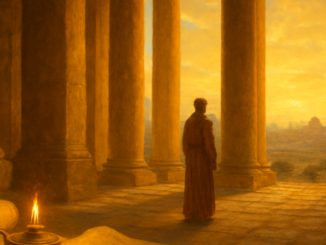
Evening settles over the lodge. An elder brother opens a yellowed book and reads aloud from a letter written nearly two millennia ago to a young leader on the island of Crete. The words ring surprisingly modern — about appointing trustworthy overseers, about purity of heart, about deeds that speak louder than words. The brethren listen intently, for what the Apostle Paul wrote to his companion Titus touches the very core of what Freemasons strive to achieve: the building of a community of people defined by integrity.
A Letter to a Young Leader
The Epistle to Titus is one of the shortest texts in the New Testament — just three chapters long. Paul likely wrote these words around the year 65 AD to his trusted associate Titus, whom he had left behind on Crete to organize fledgling Christian communities. In antiquity, the island was notorious for its rough population and moral laxity. Titus faced a daunting task: bringing structure where chaos reigned, appointing leaders where distrust prevailed, and building a community that would actually live by its professed values.
The heart of Paul’s counsel revolves around a single central theme: the gap between what people claim to believe and how they actually behave. He warns Titus about those who profess purity yet whose actions prove otherwise. True purity, Paul argues, is not revealed through words or rituals but through the conduct of daily life. This distinction between profession and practice, between outward show and inner truth, forms the thread running through the entire letter.
The Architect of Character
Paul provides detailed criteria for selecting leaders, whom he calls elders or overseers. These guidelines read like a manual for character formation: an overseer must be blameless, not quick-tempered, not addicted, not greedy — but hospitable, prudent, just, and self-controlled. What matters is not lineage or eloquence, but demonstrated integrity in everyday life. The community is literally built from individuals who have first built themselves.
A community is only as strong as the integrity of its leaders, and that integrity is not measured in words but in deeds.
For Freemasons, this resonates deeply. The lodge recognizes no hierarchy based on social status or wealth, but rather one grounded in moral growth and dedication to the brotherhood. The true Master is not the one who knows the most symbols, but the one who weaves the lessons of the ritual into his daily actions. Just as Titus was tasked with seeking out individuals of proven character, every lodge seeks brethren who are willing to work on themselves.
Purity as an Inner State
One of the most frequently quoted passages from the epistle appears in the first chapter: “To the pure, all things are pure.” Paul’s point is that true purity is not a matter of external cleansing or dietary restrictions, but of the condition of the heart. The person who is inwardly pure — who has cleansed his intentions of self-interest and deceit — sees the world through pure eyes. Conversely, the person who is inwardly corrupted by greed or malice sees corruption in everything he touches.
This concept of inner purity as a prerequisite for right action is woven throughout Masonic ritual. The rough ashlar that must be shaped refers to precisely this process: not polishing the exterior, but transforming the interior. The Freemason works on his character the way a stonemason works on his stone — with patience, precision, and honest acknowledgment of the imperfections that remain to be removed.
Good Works as Building Stones
Paul repeatedly emphasizes that faith without good works is lifeless. In the second chapter, he urges Titus to encourage the community to devote itself to good works — not to earn merit, but because good works are the natural fruit of a transformed heart. The letter closes with the same message: “Let our people learn to devote themselves to good works, so as to help cases of urgent need, and not be unfruitful.”
Consider the key principles Paul lays out: integrity as the foundation of leadership; purity of intention over outward display; good works as the fruit of inner growth; and building community through the power of example. Each of these pillars maps directly onto the Masonic experience.
This emphasis on deeds over words, on practice over theory, resonates powerfully within the Masonic tradition. The symbols of the gavel, the chisel, and the compasses are tools — not decorations. They remind every brother that the lodge is not a place for passive contemplation but for active building: building oneself, building the brotherhood, and building the world beyond the temple walls.
Grace and Human Dignity
What makes the Epistle to Titus especially compelling is the nuance with which Paul addresses human shortcomings. He reminds Titus that they themselves were once foolish, disobedient, and enslaved by all manner of desires. This candid admission of past imperfection prevents moral arrogance. The leader who corrects others never forgets that he himself has needed — and perhaps still needs — correction.
In the Masonic lodge, there is no perfect brother. Every Freemason, regardless of degree or experience, remains a student. The rituals remind him of this enduring imperfection — not to shame him, but to keep him humble. The brother who understands that he was and remains a rough stone judges the roughness of others with greater compassion.
A Blueprint for Community
Read through the eyes of a Freemason, the Epistle to Titus offers a blueprint for building community that has lost none of its relevance. The principles are timeless: select leaders based on character, not status. Judge people by their deeds, not their words. Work on your own purity before you presume to correct others. And never forget that the community you build is only as strong as the moral foundation upon which it stands.
Paul’s letter to a young leader on a Mediterranean island nearly two thousand years ago speaks directly to the work that takes place in every lodge today. The tools may differ, the language may have changed, but the task remains the same — shaping raw human material into something worthy of the temple we aspire to build together.
The Epistle to Titus endures because its message transcends its original context. For Freemasons, it serves as a powerful reminder that the real work of the Craft is not performed with physical tools but with the moral instruments of self-examination, integrity, and compassionate leadership. The rough stone does not shape itself. It requires the patient hand of a craftsman who knows his own imperfections and yet persists in the work. In building ourselves, we build the community. In building the community, we honor the ancient charge to leave the world a little better than we found it.
Copyright text & image: devrijmetselaar.nl
Texts are based on the ideas and content of the author of devrijmetselaar.nl, reviewed, corrected, and supplemented with the assistance of OpenAI. Images are created based on the ideas of the author of devrijmetselaar.nl using OpenAI/DALL-E.
Frequently Asked Questions
What is the Epistle to Titus and why is it relevant to Freemasonry?
The Epistle to Titus is a letter written by the Apostle Paul around 65 AD to his associate Titus on the island of Crete. It focuses on building a community of integrity through demonstrated character rather than words or rituals. Freemasons find it relevant because it emphasizes the same core principle they strive for: creating a community defined by integrity where actions speak louder than professions.
What was Titus's main challenge in organizing Christian communities on Crete?
Titus faced the task of bringing structure and order to fledgling Christian communities on an island notorious for its rough population and moral laxity. He needed to appoint trustworthy leaders where distrust prevailed and help build a community that would live by its professed values despite the surrounding chaos.
What qualities did Paul say an overseer or leader should possess?
According to Paul's guidelines in the epistle, an overseer must be blameless, not quick-tempered, not addicted, and not greedy. Instead, they should be hospitable, prudent, just, and self-controlled. Paul emphasized that true leadership is measured by demonstrated integrity in everyday life and deeds, not by lineage, eloquence, or social status.

Be the first to comment