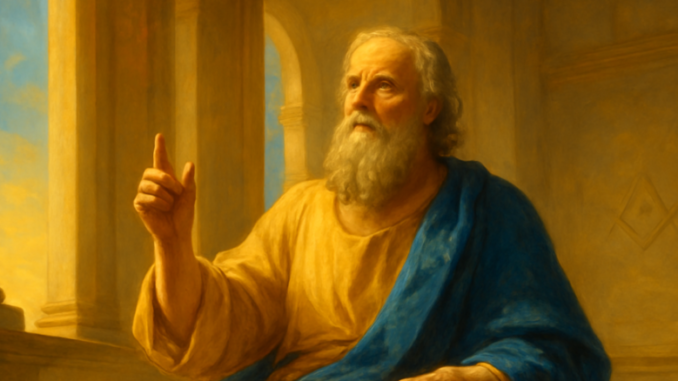
What actually happens when we perceive something truly beautiful? Does beauty merely please the eye, or does its influence reach far deeper — into the very core of who we are? In his dialogue Phaedrus, Plato has Socrates offer a striking answer: beauty is not a superficial phenomenon but a memory of a higher reality the soul once knew. For Freemasons, who are well-versed in using symbolism as a bridge between the visible and the invisible, this classical work opens a fascinating perspective on their own tradition.
What Did Plato Actually Mean by ‘Beauty’?
In the Phaedrus, Plato does not describe beauty as something subjective or as mere aesthetic pleasure. For him, beauty is a reflection of an eternal Idea — a Form that the soul recognizes from an existence before it entered a physical body. When we encounter something beautiful — a face, a landscape, a work of art — we experience, according to Plato, a glimpse of that original perfection. It is as though the soul awakens from a deep slumber.
This immediately raises a question: is beauty, then, a teacher? Plato would answer with an emphatic yes. In the famous passage about the winged soul, Socrates explains how the perception of beauty causes the “wings” of the soul to grow. Those wings were once the means by which the soul could ascend to the divine realms. Beauty reminds us of our origin and calls us toward inner growth.
How Does This Relate to the Masonic Tradition?
Freemasonry possesses a rich symbolic language that, much like Plato’s philosophy, points toward a deeper reality behind the visible world. Consider the light that is kindled in the lodge, the rough ashlar that must be shaped, or the search for the Lost Word. These symbols function in a manner remarkably similar to Plato’s concept of beauty: they remind the Brother of a truth he intuitively knows but that lies buried under layers of habit and everyday preoccupation.
Beauty, in the Phaedrus, is not an ornament of life — it is a summons to the soul to remember who it truly is.
The Freemason is invited to see in every symbol a mirror of his own inner life. When he contemplates the square and compasses, he does not see mere tools but an invitation to self-reflection and moral perfection. This is precisely what Plato meant: the visible as a gateway to the invisible, the material as a reminder of the spiritual.
Why Does Plato Describe the Soul as ‘Winged’?
In the Phaedrus, Socrates compares the soul to a chariot drawn by two horses and guided by a charioteer. One horse is noble and strives upward; the other is unruly and pulls downward. The charioteer — representing reason — must keep both horses under control in order to guide the soul toward the heavenly spheres. This image speaks directly to the Masonic tradition, in which the mastery of lower impulses and the cultivation of virtue are central themes.
The wings of the soul symbolize the capacity for transcendence — the ability to rise above the mundane. Beauty nourishes those wings. When the soul perceives beauty, it swells with longing for the higher. This longing is not a weakness but a force that drives a person toward the search for truth and wisdom.
Which Masonic Values Can We Recognize in the Phaedrus?
When we place several key themes from the Phaedrus alongside the Masonic tradition, the parallels are striking:
Self-reflection: Plato invites us to examine our own soul. Freemasons know this as the work on the rough ashlar — the lifelong effort to refine one’s character.
Virtue: The charioteer must keep the horses in balance. Virtue is not the suppression of passion but the proper directing of it.
Brotherhood: The dialogue itself is a form of connection. Socrates and Phaedrus seek insight together, just as Brothers do in the lodge.
Light and knowledge: Beauty illuminates the soul and reminds it of its origin in the light — a concept deeply embedded in Masonic ritual.
Inner growth: The wings of the soul grow through the experience of beauty and truth, mirroring the Masonic journey from darkness to light.
These parallels are not mere coincidence. Freemasonry has drawn upon classical philosophy throughout the centuries, and Plato remains one of its most influential sources. His ideas about the soul, the ladder of knowledge, and the function of symbols resonate profoundly within the Masonic tradition.
What Can We Learn from This for Our Own Path?
The Phaedrus invites us to regard beauty not as a luxury but as a necessity for the soul. In a world that is often hurried and purely functional, Plato reminds us that the soul requires nourishment. That nourishment is found in the contemplation of the beautiful, the true, and the good.
For the Freemason, this carries a practical message: take the symbols seriously. They are not decorations but windows onto a deeper reality. When you enter the lodge and experience the ritual, remain open to the beauty that unfolds before you. It is in that openness that the soul spreads its wings and remembers where it came from — and where it is headed.
Plato’s Phaedrus is far more than a philosophical treatise on beauty. It is an invitation to each of us to take the soul seriously, to recognize beauty as a teacher, and to see the symbols around us as signposts on the path toward inner growth. For Freemasons, accustomed to the language of symbols and the search for light, this classical dialogue offers a remarkably timely mirror. The question that remains is simple: what beauty will today remind your soul of who you truly are?
Copyright text & image: devrijmetselaar.nl
Texts are based on the ideas and content of the author of devrijmetselaar.nl, reviewed, corrected, and supplemented with the assistance of OpenAI. Images are created based on the ideas of the author of devrijmetselaar.nl using OpenAI/DALL-E.
Frequently Asked Questions
According to Plato's Phaedrus, what is the true nature of beauty?
Plato describes beauty not as mere aesthetic pleasure or subjective preference, but as a reflection of an eternal Idea or Form. Beauty is a glimpse of original perfection that the soul recognizes from a pre-physical existence. When we encounter something beautiful, we experience the soul awakening and remembering a higher reality it once knew, making beauty a teacher that calls us toward inner growth and spiritual development.
How do Masonic symbols relate to Plato's concept of beauty in the Phaedrus?
Freemasonry uses symbolic language—such as the light in the lodge, the rough ashlar, and the search for the Lost Word—in a manner remarkably similar to Plato's philosophy. These symbols point toward deeper truths beyond the visible world and function as reminders of spiritual realities. When a Freemason contemplates symbols like the square and compasses, they serve as invitations to self-reflection and moral perfection, embodying Plato's principle that the visible world is a gateway to the invisible.
What does Plato mean when he describes the soul as 'winged' in the Phaedrus?
Plato compares the soul to a chariot drawn by two horses and guided by a charioteer. The wings of the soul are described as the means by which the soul once ascended to divine realms. According to Plato, the perception of beauty causes these 'wings' to grow, allowing the soul to rise and reconnect with its spiritual origin, symbolizing the soul's capacity for transcendence and return to higher consciousness.


Be the first to comment