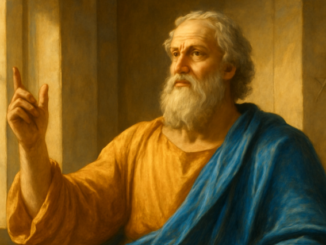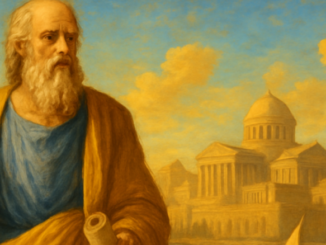
Ancient Greek temple columns symbolizing Plato's philosophy and Masonic ideals
Plato – Freemasonry & Connection

Plato’s Phaedrus: Beauty as a Gateway to the Soul

What actually happens when we perceive something truly beautiful? Does beauty merely please the eye, or does its influence reach far deeper — into the very core of who we are? In his dialogue Phaedrus, Plato has Socrates offer a striking answer: beauty is not a superficial phenomenon but a memory of a higher reality the soul once knew. For Freemasons, who are well-versed in using symbolism as a bridge between the visible and the invisible, this classical work opens a fascinating perspective on their own tradition. What Did Plato Actually Mean by ‘Beauty’? In the Phaedrus, Plato does not describe beauty as something subjective or as mere aesthetic pleasure. For him, beauty is a reflection of an eternal Idea — a Form that the soul recognizes from an existence before it entered a physical body. When we encounter something beautiful — a face, a landscape, a work of art — we experience, according to Plato, a glimpse of that original perfection. It is as though the soul awakens from a deep slumber. This immediately raises a question: is beauty, then, a teacher? Plato would answer with an emphatic yes. In the famous passage about the winged soul, Socrates explains […]

Candle-lit Masonic lodge symbolizing Plato's dialogue on courage and virtue
Plato – Freemasonry & Connection

Plato’s Laches and Freemasonry: Courage as a Binding Virtue

It is late in the evening. The candles in the lodge burn low as a Brother, still in his work attire, rises to speak. He does not talk about great deeds or heroic battles. Instead, he recounts a moment earlier that day when he stayed silent while a colleague was treated unjustly. The question lingers in the room: was that cowardice, or was it wisdom? It is precisely this struggle that Plato captured more than two thousand years ago in his dialogue Laches — a conversation about the true nature of courage that remains strikingly relevant for anyone who has ever wondered what it truly means to be brave. The Search for a Definition of Courage In the Laches, Plato stages a conversation between Socrates and two Athenian generals: Laches and Nicias. Both men have proven their courage on the battlefield, yet when Socrates asks them to define what courage actually is, their answers fall short. Laches initially proposes that courage simply means holding your ground in battle and refusing to flee from the enemy. Socrates dismantles this definition effortlessly by pointing to situations where retreat is actually the braver choice. This search for a definitive answer is far from […]

Ancient Greek philosophical dialogue symbolizing Masonic search for virtue
Plato – Freemasonry & Connection

Plato’s Protagoras: Can Virtue Be Taught? A Masonic View

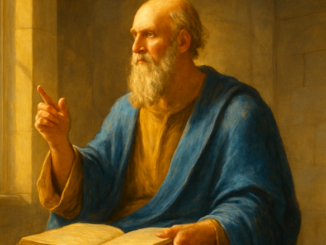
Picture yourself sitting across from a wise teacher. You ask him whether becoming a good person is something you can learn, or whether it’s something you must be born with. He looks at you and says: that depends on what you mean by learning. This is precisely the question Plato posed over two thousand years ago in his dialogue Protagoras. And it is the same question Freemasons ask themselves every time they enter the lodge. What Did Plato Actually Mean by Teachability? In the Protagoras, Plato stages a conversation between his teacher Socrates and the renowned Sophist Protagoras. The central question seems straightforward enough: can virtue be taught? Protagoras insists it can. After all, he makes his living selling wisdom, teaching young Athenians how to become better citizens. Socrates isn’t so sure. If virtue can truly be taught, why do so many excellent fathers fail to pass their virtue on to their sons? But here’s the crucial nuance: Socrates does not deny that people can grow in virtue. What he challenges is the method. Can you transmit virtue the way you teach someone arithmetic? Or does moral growth demand something different — something deeper? This distinction matters enormously for anyone […]

Ancient Greek philosophical dialogue symbolizing Masonic search for virtue
Plato – Freemasonry & Connection

Plato’s Meno and Freemasonry: Discovering Virtue by Asking

Picture yourself in lodge after an initiation ceremony. A brother turns to you and asks: what is virtue, really? You open your mouth to answer — and then realize you don’t quite know. This moment of not-knowing is exactly where Plato’s dialogue Meno begins, and where the Freemason’s most important work can take place. A Question That Changes Everything In the Meno, the Thessalian nobleman Meno poses a seemingly simple question to Socrates: can virtue be taught? Socrates responds with a counter-question that drives the entire dialogue: how can we teach something if we don’t even know what it is? This question isn’t meant to frustrate. It opens the door to deeper understanding. For the Freemason, this dynamic is deeply familiar. With every degree advancement, you encounter symbols and rituals whose meaning is never directly explained. You must search for yourself, ask questions, and discover that the question is often more important than the answer. Plato called this the method of elenchus — the systematic examination of what you think you know, until you discover what you truly know. Knowledge Already Within You One of the most celebrated passages in the Meno is the exchange between Socrates and a young […]