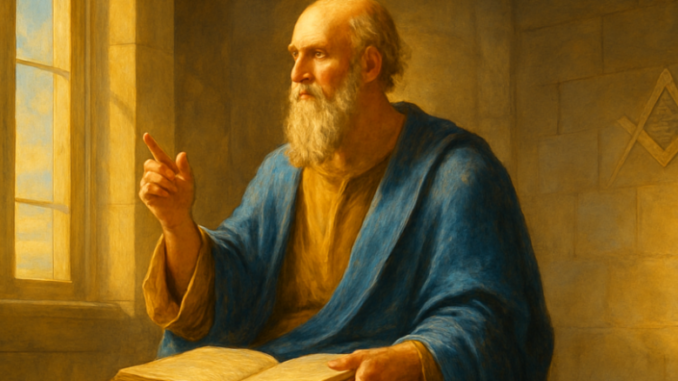
What truly makes a person good? And who decides what ‘good’ even means? Plato posed these questions more than two thousand years ago in his celebrated dialogue The Republic, and they still echo through the lodge today. When we study the third book of this masterwork, we discover striking parallels with Freemasonry — not in dogmas or prescriptions, but in a shared conviction that human beings can be shaped through intentional education, through community, and through the pursuit of inner light.
Why Did Plato Place Such Value on Education?
For Plato, education was never a secondary concern — it was the key to a just society. In the third book of The Republic, he describes how young people should be formed through music, gymnastics, and stories that cultivate virtue. His interest was not in the transmission of facts, but in the shaping of character. The soul, he argued, must be trained just as the body is: through discipline, beauty, and truth.
Plato believed that stories and art have the power to mold the soul. For this reason, he advocated telling only those myths that inspire courage, temperance, and justice. Bad examples, he reasoned, corrupt the young mind. This may sound rigid, but the underlying principle is timeless: the ideas and images we consume shape who we become.
Do Freemasons Recognize This Approach?
Without question. Freemasonry is, at its core, a fellowship of continuous formation. When a candidate enters the lodge, he begins a journey that never truly ends. The goal is not to collect titles or degrees, but to undergo inner transformation. Like Plato, Freemasons view the individual as a rough stone that can be shaped — through labor, reflection, and brotherhood — into a more perfect form.
The rituals performed in the lodge function much like the stories Plato discussed: they are rich with symbolism and carry profound moral lessons. They teach about mortality, loyalty, the value of silence, and the power of the spoken word. Through repetition and shared experience, these lessons embed themselves deeply in the consciousness of every participant.
Education in Freemasonry is not a transfer of knowledge — it is an invitation to self-transformation within a community of like-minded seekers.
What Role Does Community Play in This Formation?
Plato emphasized that no one can fully educate themselves in isolation. The polis, the city-state, provides the framework within which the citizen flourishes. Without community there is no virtue; without shared values there is no justice. The philosopher understood that human beings are social creatures, shaped through interaction with others.
This resonates deeply with the Masonic principle of brotherhood. The lodge is not a collection of disconnected individuals — it is a living organism in which every member bears responsibility for the others. Character formation does not happen in solitude, but in the encounter with brethren who mirror, challenge, and support one another. Connection is not a byproduct of lodge life; it is the very condition for growth.
Which Virtues Are Central to Both Plato and Freemasonry?
Plato identified four cardinal virtues: wisdom, courage, temperance, and justice. Together, these form the foundation of both the just soul and the just state. Every part of society — and every part of the human psyche — must cultivate its own virtue to achieve harmony.
Wisdom: the pursuit of truth and insight.
Courage: steadfastness in the face of adversity.
Temperance: self-control and inner balance.
Justice: giving each their due, in harmony with the whole.
Freemasons will recognize these virtues immediately. The search for light, so central to Masonic philosophy, is nothing other than the Platonic quest for wisdom. The courage to confront one’s own shadow, the temperance required to master ego and ambition, the justice that demands honest dealings with brethren and the world — each of these is a pillar of life in the lodge.
How Does This Translate to Modern Practice?
In an era when education is often reduced to chasing diplomas and planning careers, both Plato and Freemasonry offer a powerful counterbalance. They remind us that true formation goes far beyond the transfer of knowledge. It is about cultivating an inner compass — a moral awareness that guides all of our actions.
Today’s Freemason can read Plato as an ally. Not as an authoritarian voice from antiquity, but as a thinker who grappled with the same questions: How do I become a better person? How do I contribute to a better world? And above all — how do I pursue this alongside others, within a community that both challenges and sustains me?
A Shared Spirit Across the Ages
The connection between Plato’s educational ideal and Freemasonry does not lie in literal correspondences, but in a shared spirit. Both traditions believe in the capacity of human beings to be shaped — not through coercion, but through inspiration. Both see community as the indispensable context for personal growth. And both hold fast to the conviction that light, knowledge, and virtue are not final destinations, but stations along a lifelong journey.
When we read the third book of Plato’s Republic through Masonic eyes, we do not encounter a foreign philosophy — we hear a familiar voice. The Athenian thinker spoke of education as character formation, of virtue as an art of living, and of community as the necessary soil from which goodness grows. These are not abstract ideals. They are the daily realities of lodge life, where brethren meet, challenge one another, and grow together. Plato reminds us that the quest for the good is never a solitary endeavor — it is always a shared journey toward the light.
Copyright text & image: devrijmetselaar.nl
Texts are based on the ideas and content of the author of devrijmetselaar.nl, reviewed, corrected, and supplemented with the assistance of OpenAI. Images are created based on the ideas of the author of devrijmetselaar.nl using OpenAI/DALL-E.

Be the first to comment