You probably recognize it: that quiet, almost unconscious thought that when someone else wins, you automatically lose. The assumption that success, recognition, and happiness exist in limited supply — and that you need to fight for your share. This is zero-sum thinking, and it creeps into your personality without you even noticing. But what if that assumption is fundamentally wrong? What if real growth happens when you build together rather than compete alone?
What Exactly Is Zero-Sum Thinking?
The term originates from game theory, where it describes situations in which one person’s gain is automatically another person’s loss. Think of a poker game: the money you win is money your opponent loses. In those situations, zero-sum thinking is perfectly logical and accurate.
The problem arises when you apply this mindset to areas where it doesn’t belong. Relationships, personal development, knowledge sharing, creativity — these are not poker games. Yet many people treat their entire lives as though they are. They see a colleague’s promotion as a personal defeat. They experience a friend’s happiness as a painful reminder of their own shortcomings. This doesn’t just limit your possibilities — it distorts your personality over time.
How Zero-Sum Thinking Shapes Your Character
Your character is formed by the patterns you repeat. When you consistently think in terms of scarcity, you develop traits that go with it: distrust, envy, defensiveness. You become someone who struggles to celebrate what others achieve, because every victory of theirs feels like evidence of your own inadequacy.
Aristotle wrote that virtues are formed through repetition: you become just by performing just acts, courageous by making courageous choices. Unfortunately, the same principle applies to vices. By constantly acting from the assumption that there isn’t enough for everyone, you train yourself in small-mindedness.
Zero-sum thinking is not a realistic view of the world. It is a self-imposed prison that narrows your character down to fear and competition.
Freemasonry as an Antidote to Zero-Sum Thinking
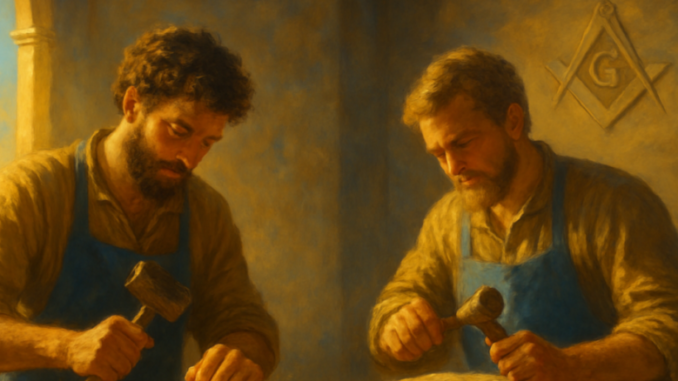
In the lodge, you learn a fundamentally different attitude from the very beginning. The first lesson you receive as an Entered Apprentice is that you do not build alone. The rough stone you work on — your own unrefined self — is destined for a shared structure. Your progress strengthens the whole, and the growth of your brothers contributes to your own development.
This is not some abstract ideal. In the practice of lodge meetings, you experience it concretely. When a brother shares an insight that moves you, you become richer without him becoming poorer. When you show vulnerability and it helps others open up, you lose nothing — you gain connection. The economy of the lodge simply does not operate by zero-sum rules.
From Competition to Complementarity
Freemasonry teaches you to look at what you can contribute rather than what you can win. This requires a fundamental shift in personality. You learn to ask different questions: What does this situation need? What can I give? How can I help this person grow without diminishing myself?
Johann Wolfgang von Goethe, himself a Freemason, understood this deeply. His work repeatedly demonstrates that human development is not a solitary endeavor but a dialogical process. You shape yourself in relation to others — not in spite of them.
Practical Steps to Break Free from Zero-Sum Thinking
Awareness is always the first step. Pay attention to your own reactions when someone around you achieves something. Do you feel a sting of jealousy? An impulse to downplay their success? These are signals that zero-sum thinking is active. There’s no reason for shame — but there is reason for attention.
Here are some practical ways to start breaking the pattern:
Deliberately practice celebrating the success of others, even when it brings you no direct benefit. Share your knowledge and insights freely, without calculating what you’ll get in return. Seek out situations where collaboration takes center stage rather than competition. Regularly reflect on your own thought patterns and ask yourself whether they actually match reality.
Character Formation as a Lifelong Practice
Freemasonry does not present itself as a quick fix. It is a path — a continuous exercise. Your personality doesn’t change through a single insight but through years of dedicated practice. Every lodge meeting, every conversation with a brother, every moment you choose connection over envy shapes you a little bit more.
This may be the most valuable thing Freemasonry has to offer: an environment where you can actively shape your character toward openness, trust, and abundance. Not through preaching, but through practice. Not through competing, but through building together.
Zero-sum thinking is a creeping disease of character. It limits your possibilities, distorts your relationships, and makes you smaller than you were meant to be. Freemasonry offers a genuine alternative: a brotherhood where you learn that growth does not have to come at the expense of others. Where you discover that working on your own rough stone simultaneously contributes to a greater edifice. Perhaps that is the deepest lesson of all — that your character only truly flourishes when you stop keeping score of who wins.
Copyright text & image: devrijmetselaar.nl
Texts are based on the ideas and content of the author of devrijmetselaar.nl, reviewed, corrected, and supplemented with the assistance of OpenAI. Images are created based on the ideas of the author of devrijmetselaar.nl using OpenAI/DALL-E.
Frequently Asked Questions
What is zero-sum thinking and why is it harmful?
Zero-sum thinking is the belief that one person's gain automatically means another person's loss, originating from game theory concepts like poker. While this mindset is logical in competitive situations, it becomes harmful when applied to areas like relationships, personal development, and creativity where success is not limited. This distorted thinking pattern shapes your character over time, developing traits like distrust, envy, and defensiveness, and ultimately narrows your personality down to fear and competition.
How does zero-sum thinking affect personal character development?
Your character is formed through repeated patterns. When you consistently think in terms of scarcity, you develop corresponding vices such as distrust, envy, and defensiveness. Following Aristotle's principle that virtues are formed through repetition, the same applies to vices—by constantly acting from the assumption of limited resources, you train yourself in small-mindedness and struggle to celebrate others' achievements, seeing them as evidence of your own inadequacy.
How does Freemasonry help overcome zero-sum thinking?
Freemasonry teaches a fundamentally different attitude from the beginning. As an Entered Apprentice, you learn that personal progress does not happen in isolation but rather contributes to a shared structure. The core teaching is that your own development strengthens the whole, and the growth of your brothers directly contributes to your own advancement, replacing scarcity-based competition with collaborative mutual development.




Be the first to comment