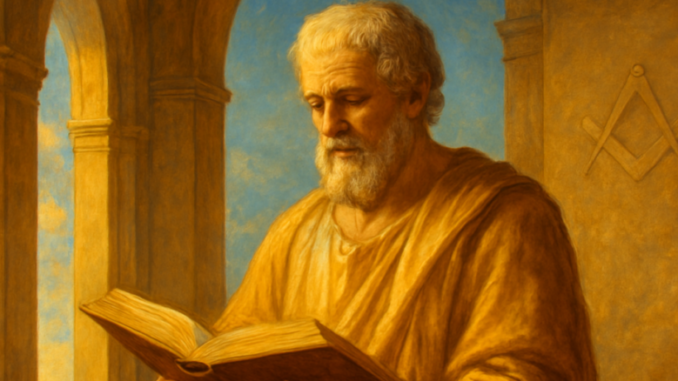
A hammer rests on the workbench. It was made to build, not to be admired. Yet some people collect hammers without ever driving a single nail. Lucius Annaeus Seneca would have recognized this modern tendency immediately. In his eighty-eighth letter to Lucilius, he poses an uncomfortable question that still resonates across the centuries: what is the point of knowledge that does not make us better human beings?
The Central Question of Letter LXXXVIII
Seneca opens his letter with a sharp critique of what was known in his day as the artes liberales — the liberal arts. These were subjects like grammar, music, geometry, astronomy, and rhetoric, considered essential for the education of a free man. But Seneca is unimpressed. He acknowledges that these disciplines may prepare the mind, yet he refuses to regard them as virtuous in themselves. His argument is clear: only knowledge that truly shapes the soul and leads toward wisdom deserves our highest respect.
The Stoic philosopher draws a distinction between knowledge that serves as preparation and knowledge that becomes an end in itself. The liberal arts belong to the first category. They are like the foundations of a building — necessary, but not the building itself. Anyone who keeps digging at the foundation without ever beginning to build has lost sight of the purpose entirely.
Knowledge Without Wisdom: A Beautiful but Empty Vessel
Throughout this letter, Seneca offers a wealth of examples to drive his point home. He wonders what use it is to know how many oarsmen Odysseus had, or whether Homer was older than Hesiod. Such questions keep scholars busy, but they make no one wiser or more virtuous. The grammarian can debate word origins endlessly, the musician can argue about scales until dawn, but neither comes any closer to a good life through these pursuits alone.
Knowledge that does not contribute to virtue is like a sword without a hilt — impressive to look at, but useless in the real battles of life.
This distinction is not intended as an attack on learning. Seneca himself was one of the most widely read men of his era. His criticism is aimed at those who confuse the means with the end. The geometer who studies triangles endlessly but never reflects on justice, the astronomer who counts the stars but neglects his own soul — these individuals, Seneca argues, have missed the essence of true formation.
The Tools of the Master Builder
There is a deeper layer in Seneca’s argument that resonates powerfully with a symbolic understanding of knowledge and craft. Consider the tools that a Master Builder employs. The compasses, the square, the plumb line — they are indispensable for constructing a temple. But the tools themselves are not the temple. A man who spends his entire life polishing his compasses without ever laying a foundation builds nothing of lasting value.
The same applies to the liberal arts. Grammar sharpens thinking, rhetoric teaches persuasion, geometry develops spatial insight. These are valuable working tools. But they only gain their true meaning when they are put to use in service of a higher purpose: the construction of a virtuous character, the building of a life that stands firm under pressure.
For those who work symbolically with the tools of the craft, Seneca’s message carries a particular weight. Every instrument on the workbench exists to be used — not merely displayed or discussed. The square reminds us to square our actions, the plumb line to align our conduct with moral truth. These are not ornaments; they are instruments of inner transformation.
The Temptation of Endless Study
Seneca also warns against what we might today call information addiction. In his time, there were scholars who devoted their entire lives to solving puzzles that moved no one forward. They enjoyed the search without ever wanting to find. The quest itself became an excuse to avoid the confrontation with the self.
This pattern is remarkably familiar. How many people throw themselves into endless study — certificates, courses, lectures, and reading lists — without ever pausing to ask what all that knowledge is actually for? Seneca would gently but firmly point them back to the core truth: it is not about what you know, but about who you become through what you know.
In the context of self-improvement and moral architecture, this warning is particularly relevant. A Brother who has memorized every ritual but never applies its lessons to his daily conduct has collected tools without building. The purpose of Masonic education, like the purpose of Seneca’s philosophy, is transformation — not mere accumulation.
The Building That Endures
Seneca’s letter does not end in pessimism. He acknowledges the value of preparation and education. But he insists that every course of study must ultimately lead toward philosophy — toward the love of wisdom that permeates all of life. Only when knowledge is converted into character, when insight leads to action, when the tools are actually used to build, does learning find its true meaning.
The image of the Master Builder returns here with full force. It is not the number of tools that determines the worth of the craftsman, but the quality of what he builds. A simple hut, sturdy and fit for purpose, is worth more than a drawing table covered in plans that were never executed. In the same way, a simple but virtuous life is worth far more than a mind stuffed with undigested learning.
The Symbolic Lesson for Today
Letter LXXXVIII is an invitation to honest self-reflection. What knowledge do we accumulate without ever putting it into practice? Which tools do we polish endlessly without ever beginning to build? The hammer on the workbench does not ask for admiration — it asks to be used. And so all true knowledge asks to be converted into life, into action, into character that can withstand the storms of existence.
For anyone walking a path of moral and spiritual development, Seneca’s challenge is direct: Are your studies making you a better person, or merely a more informed one? Are you building something with the tools you have been given, or simply arranging them in ever-more-elaborate displays? The answer to these questions reveals whether our learning serves its highest purpose — or whether it has quietly become an end in itself.
Seneca’s message in Letter LXXXVIII is timeless in its simplicity. The liberal arts are valuable as preparation, but they must never become the destination. Knowledge that does not contribute to wisdom and virtue remains sterile — like tools that are never taken up. The real question is not how much you know, but whether your knowledge helps you build a life worth living. Seneca asked that question two thousand years ago. It is still waiting for an answer.
Copyright text & image: devrijmetselaar.nl
Texts are based on the ideas and content of the author of devrijmetselaar.nl, reviewed, corrected, and supplemented with the assistance of OpenAI. Images are created based on the ideas of the author of devrijmetselaar.nl using OpenAI/DALL-E.



Be the first to comment