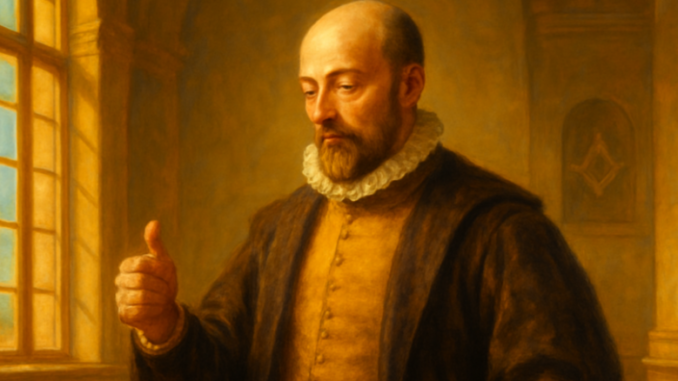
Why would a sixteenth-century French philosopher devote an entire essay to something as ordinary as the thumb? And what could this small body part possibly have to do with the way Freemasons recognize and connect with one another? Michel de Montaigne’s curious meditation on thumbs turns out to resonate deeply with the ritual gestures and fraternal values at the heart of Freemasonry — in ways that are both surprising and profoundly illuminating.
Why Would Anyone Write About Thumbs?
It sounds almost like a joke: an essay about thumbs. But anyone familiar with Michel de Montaigne knows that he had a gift for finding the profound within the mundane. In his short text Of Thumbs, he explores how this single body part has been charged with meaning throughout history. Roman emperors decided the fate of gladiators with a turn of the thumb. Soldiers cut off their thumbs to escape military service. Rings were worn on thumbs as markers of status and authority.
What fascinated Montaigne was the way cultures invest the body with meaning. The thumb is not a neutral piece of anatomy — it is a vehicle for communication, power, and connection. And it is precisely here that his observation touches a deeper truth that also lies at the center of Freemasonry: the human gesture as a carrier of meaning that reaches far beyond words.
How Can a Small Gesture Say So Much?
In Freemasonry, the importance of gesture is understood intimately. The handshake with which Brethren greet one another, the specific postures assumed during ritual, the precise placement of hands — these are all forms of non-verbal communication that carry deep significance. Those who know these gestures recognize a Brother. Those who do not simply see an ordinary handshake.
Montaigne would undoubtedly have grasped this principle. He writes about how the Romans, with a simple movement of the thumb, determined life and death. This was neither coincidence nor caprice — it was an acknowledgment that the human body speaks a language older than the written word. Freemasonry has preserved this ancient truth and formalized it within its rituals.
The gesture is humanity’s oldest language, and Freemasonry keeps this language alive as a living tradition of connection and recognition.
Connecting the Small to the Great
Montaigne’s method is one of attentive observation. He takes something seemingly insignificant and reveals how it is woven into the fabric of history, culture, and human nature. This is precisely the attitude that Freemasonry encourages: a kind of self-reflection that begins with the concrete and opens out into the universal.
Consider the rough ashlar that the Entered Apprentice is symbolically called upon to shape. It is just a stone, one might say. But within that stone lies the entire journey from ignorance to wisdom. The same principle applies to the thumb in Montaigne’s essay: a small part of the body that opens a window onto great questions about power, communication, and human fellowship.
Why Embodied Knowledge Still Matters
In our modern age, we tend to reduce knowledge to information that can be looked up or spoken aloud. But Montaigne reminds us that for centuries, essential knowledge was transmitted through the body. The craftsman who shows his apprentice how to hold a chisel, the mother who teaches her child how to offer a comforting embrace, the Brother who initiates a candidate into the ritual gestures of the Lodge — all of them transmit knowledge that cannot be found in books.
Freemasonry is, at its core, a craft tradition. It is no accident that we trace our symbolic lineage to the stonemasons who built the great cathedrals of Europe. Their knowledge was not purely intellectual — it lived in their hands, their posture, their way of moving through the world. Montaigne, who recognized the value of bodily experience in his own philosophy, would have appreciated this deeply.
How Ritual Strengthens the Brotherhood
One of the most fascinating aspects of Montaigne’s essay is his attention to the way gestures create community. The Roman thumb was not merely an individual act — it was a public ritual that united spectators in a shared experience. Everyone understood what the thumb meant, and that shared understanding forged a bond.
Something remarkably similar happens in the Masonic Lodge. When Brethren perform a ritual together, when they make the same gestures and speak the same words, a bond forms that is difficult to capture in language. It is no coincidence that this type of connection often runs deeper than friendships built solely on conversation. The body remembers what the mind forgets.
Gestures create recognition among the initiated. Ritual actions anchor values within the body. Shared physical experiences strengthen the bonds of Brotherhood. And non-verbal communication transcends the barriers of language and culture.
What Can This Ancient Wisdom Teach Us Today?
Montaigne’s essay on thumbs is far more than a sixteenth-century curiosity. It is an invitation to pay attention to the small things that bind us together. In an era when so much communication has become digital and purely verbal, both Montaigne and Freemasonry remind us of the irreplaceable value of physical presence and shared gesture.
The next time you shake someone’s hand, or perform a ritual gesture in the Lodge, think of Montaigne’s thumbs. Recognize that you are participating in a tradition of human connection stretching back to the earliest civilizations. Within the small gesture lies a great truth: we are social beings who need one another, and the body speaks a language older and deeper than any word.
Michel de Montaigne found in the thumb a mirror of the human condition. Freemasonry has refined that mirror into a system of rituals and gestures that connect Brethren across the globe. Both traditions teach us the same lesson: those who look attentively at the small will discover the infinite within it. And those who learn to understand the language of the body will find a connection that needs no words at all.
Copyright text & image: devrijmetselaar.nl
Texts are based on the ideas and content of the author of devrijmetselaar.nl, reviewed, corrected, and supplemented with the assistance of OpenAI. Images are created based on the ideas of the author of devrijmetselaar.nl using OpenAI/DALL-E.

Be the first to comment