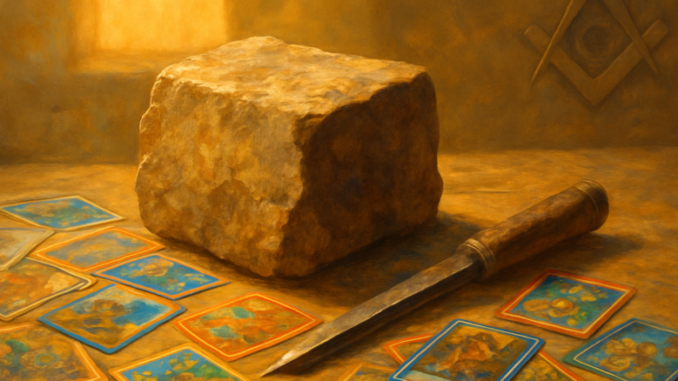
A delivery truck in the United States is robbed. The haul: collectible trading cards worth nearly $900,000. The story raises eyebrows. Trading cards? Essentially children’s toys? And yet this crime exposes something fundamental about our relationship with possession, desire, and ultimately character. What does it say about a person when they’re willing to steal for glossy pieces of cardboard? And perhaps more importantly — what does our own attachment to material things reveal about who we truly are?
Why Do People Steal What Others Collect?
At first glance, the theft seems absurd. Trading cards — originally designed for a game children played in the 1990s — now change hands for sums that could buy houses. But within that absurdity lies a deeper truth. The value of these cards exists solely in the meaning people project onto them. They serve no intrinsic function, no practical purpose. They are symbols of nostalgia, status, or speculative wealth.
The thieves didn’t see cardboard. They saw the accumulated desire that millions of people have layered onto that cardboard. And here we touch on something Freemasons have been exploring for centuries: the question of what is truly valuable, and how our desires shape our character.
What Does Greed Reveal About Human Character?
Aristotle wrote in his Nicomachean Ethics that virtue is a matter of finding the right balance. Greed — or pleonexia, as he called it — is the desire for more than one’s fair share. It is not simply wanting to have; it is wanting to have at the expense of others. The philosopher saw this as a fundamental character flaw that deforms the soul.
Freemasonry takes this wisdom seriously. In the rituals and symbols of the lodge, one question stands at the center: who am I, and who do I wish to become? The rough ashlar that the Entered Apprentice works upon represents his unpolished character. Every strike of the gavel is an attempt to chip away greed, vanity, and self-deception. The goal is not wealth or status, but inner refinement.
The true measure of character is not what a person possesses, but how he relates to what he does not have.
Possession as a Mirror: What Are We Really Collecting?
This is where things get interesting. The question isn’t only why someone steals, but why someone collects in the first place. Marcus Aurelius, the Stoic emperor-philosopher, cautioned in his Meditations against becoming attached to external things — not because possession is inherently wrong, but because attachment makes us vulnerable and erodes our character.
A collector who treasures his cards as an investment sees the world differently from someone who keeps them as reminders of childhood. Both possess the same object, but the meaning they assign to it reveals something about their inner life. Freemasonry invites precisely this kind of self-reflection: why do I value what I have? What does my desire say about my character?
How Does Ritual Shape Character?
In Freemasonry, the central aim is not the accumulation of knowledge or possessions, but the transformation of the self through ritual and reflection. The ceremonies are not theatrical performances — they are exercises in self-examination. When a candidate enters the lodge blindfolded, he symbolically experiences his own ignorance. The light he receives is not an external illumination, but an invitation to look within.
This stands in sharp contrast to the theft in the news. The thieves took something that did not belong to them, driven by the illusion that possession would make them richer. But true wealth, as the Masonic tradition teaches, is not created by taking — it is created by becoming. Character is shaped by what you give, not by what you seize.
What Can We Learn from This Theft?
Seneca, the Stoic philosopher and advisor to emperors, wrote that a wise man carries his wealth within himself. External goods can be stolen, burned, or lost. But character, once forged, endures. The question this news story raises is therefore not merely ethical — it is existential: where are we investing our life’s energy?
Are we investing in accumulating things that can be stolen? Or are we investing in qualities that no one can take from us? Are we willing to examine our desires, as Freemasons do in their rituals?
Freemasonry offers no ready-made answers, but it does offer a method. Through ritual, symbol, and brotherly dialogue, members are invited to examine their own character. Not to achieve perfection, but to live more consciously. To slowly transform the rough stone into something that fits within a greater edifice.
Is Character Ultimately Our Only True Possession?
Perhaps that is the deepest lesson hidden within this seemingly trivial news story. Trading cards can be stolen, bank accounts can be emptied, houses can burn down. But the character a person builds over a lifetime — the virtues cultivated, the wisdom gained through honest self-examination — that is inalienable property.
Goethe, himself a Freemason, wrote that a person is not defined by what he has, but by what he does with what he has. The thieves in this story chose to take. The collectors chose to cling. Freemasonry invites us toward a third path: consciously choosing who you want to be, regardless of what you possess or lose.
A theft of collectible trading cards might seem far removed from philosophical questions about character and identity. Yet this story touches on something universal: our relationship with possession, desire, and self-worth. Freemasonry reminds us that the most important work does not take place in the outside world, but in the workshop of our own hearts. It is there that we forge a character no thief can ever steal.
Copyright text & image: devrijmetselaar.nl
Texts are based on the ideas and content of the author of devrijmetselaar.nl, reviewed, corrected, and supplemented with the assistance of OpenAI. Images are created based on the ideas of the author of devrijmetselaar.nl using OpenAI/DALL-E.

Be the first to comment