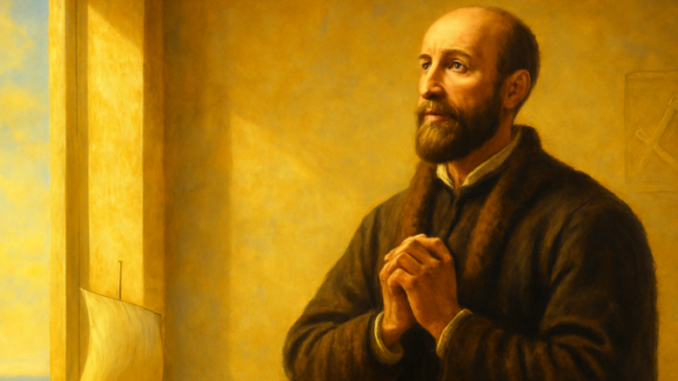
Imagine helping a friend move house, only for something valuable to break halfway through. Does that make your help worthless? Or does it matter that you showed up with the best of intentions? Michel de Montaigne wrestled with exactly these kinds of questions back in the sixteenth century. In his seventh essay from the first book, he explores how our inner motivation shapes the way our actions should be judged. Short but powerful, this essay offers surprisingly practical insights for anyone who reflects on the true value of what they do — and it resonates deeply with the symbolic traditions of Freemasonry.
The Core Idea: Intention Over Outcome
Montaigne argues that it is not the result of an action that determines its worth, but the intention behind it. An endeavor can fail due to circumstances entirely beyond our control, yet that does not make the underlying motive any less pure or praiseworthy. Conversely, someone might stumble into a good outcome without any noble intention whatsoever. In such cases, Montaigne insists, we must look at what the person truly intended to accomplish.
This may sound obvious at first glance, but Montaigne demonstrates how often we do the opposite in practice. We judge people by their successes or failures while the inner driving force remains hidden from view. The essay invites us to look beyond appearances and ask a more searching question: what truly motivated this person?
Lessons from Classical Antiquity
As was his custom, Montaigne draws from the rich well of classical history to illustrate his point. He cites examples of generals and statesmen whose plans failed despite their sharp intellect and good will. The outcome of a battle or political campaign, after all, depends on countless factors beyond human control — weather, chance, the whims of fortune.
He also points to situations where someone achieved success through luck or favorable circumstances, while their original motivation was questionable at best. A general might win a battle thanks to his opponent’s blunders rather than his own strategic brilliance. Should we then praise him? Montaigne suggests not — at least not for his skill. What matters is the intention behind the effort.
Applying This Wisdom to Everyday Life
How does this translate to your own life? Think of moments when you gave your best effort, yet the result was disappointing. Perhaps you had a difficult conversation approached with genuine care, but were misunderstood. Or you poured hours into a project that ultimately did not succeed. Montaigne offers real consolation here: your worth as a person does not depend on the success of your efforts, but on the sincerity with which you undertook them.
This insight cuts both ways. When judging others, ask yourself: what was their intention? Someone who unintentionally hurts you with a well-meaning remark deserves a very different response than someone who deliberately sets out to cause pain. By focusing on intentions rather than outcomes alone, you practice a gentler and more just form of judgment.
Intention and Symbolic Tradition in Freemasonry
In traditions that work with symbols and rituals — Freemasonry foremost among them — intention plays a central role. An action derives its meaning from the inner attitude with which it is performed. Lighting a candle is a simple act in itself, but when you do it with mindful attention and dedication, it becomes a symbol of inner light. The outer form is merely the vessel for a deeper truth that resides in the intention behind it.
Montaigne’s essay reminds us that every symbolic act draws its power from the sincerity of the person performing it. A ritual carried out mechanically loses its meaning. But the very same act, performed with full presence and pure intention, can be genuinely transformative. It is not the form that is sacred, but the spirit with which you fill it. Every Freemason who has stood in Lodge and felt the difference between going through the motions and truly being present will recognize this truth immediately.
Practical Steps to Put Intention First
If you want to apply this insight in your own life, start with awareness. Before you undertake any important action, pause for a moment and ask yourself: why am I doing this? What do I truly want to achieve? This simple pause helps you act from a clear intention rather than reacting on autopilot.
At the end of each day, take five minutes to reflect on your most significant choices. Ask yourself whether you acted from the intention you truly wanted to embody. When something fails, examine whether your intention was genuine. If it was, acknowledge that and be kind to yourself. Practice evaluating others based on their likely intentions, not solely on visible results.
It is not the outcome that determines the value of an action, but the will with which it was undertaken.
Why Montaigne’s Insight Still Matters Today
In a world increasingly focused on measurable results and visible achievements, Montaigne offers a vital counterbalance. He reminds us that the inner dimension of our actions matters just as much as the outer. In fact, it is precisely this inner dimension that makes us moral beings. Machines can produce results, but only humans can act with intention.
This sixteenth-century essay proves remarkably relevant today. Whether you are working on personal growth, nurturing relationships, or engaging in meaningful ritual practice, the question of intention remains at the heart of it all. Montaigne does not give us a definitive answer, but he provides a clear compass: look to the intention, and you will better understand the work.
Montaigne’s seventh essay is brief but profound. It challenges us to look beyond the surface and seek the value of actions in the intention that preceded them. For anyone striving to live more consciously — and especially for those who walk a path of symbolic self-improvement — this insight offers a practical guide. Start examining your own intentions today. Not because outcomes do not matter, but because the direction of your will determines who you truly are.
Copyright text & image: devrijmetselaar.nl
Texts are based on the ideas and content of the author of devrijmetselaar.nl, reviewed, corrected, and supplemented with the assistance of OpenAI. Images are created based on the ideas of the author of devrijmetselaar.nl using OpenAI/DALL-E.
Frequently Asked Questions
How does Montaigne's philosophy on intention relate to Freemasonry?
Montaigne's emphasis on inner motivation and moral character aligns deeply with Freemasonry's core teachings about self-improvement and virtue. Both traditions recognize that true worth comes from sincere intention and the purity of one's heart, not merely external outcomes or material success. This shared focus on inner development makes Montaigne's essay particularly resonant for Masons seeking to refine their character and understand the deeper meaning of their work.
If my good intentions don't produce good results, does that mean I've failed?
According to Montaigne's philosophy—and Masonic principles—no, you have not failed. What matters is that you acted with genuine sincerity and gave your best effort, regardless of circumstances beyond your control. In Freemasonry, this understanding encourages members to focus on doing the right thing for the right reasons, trusting that the integrity of their intention is itself a form of success.
How should I judge others' actions according to this essay?
Montaigne urges us to look beyond surface outcomes and consider the underlying motivation behind someone's actions. Before criticizing or praising, ask yourself: what was their true intention? This approach cultivates compassion and wisdom, values that Freemasonry actively promotes among its members as essential to building a better society.
Does Freemasonry teach that outcomes don't matter?
No—Freemasonry values both sincere effort and responsible action. However, the tradition emphasizes that your moral character and intentions are within your control, while many outcomes depend on forces beyond you. By mastering your intentions and motivations, you fulfill your duty as a Mason, regardless of whether external results always align with your hopes.
Can someone get a good result with bad intentions?
Yes, and Montaigne acknowledges this reality frankly. Someone might achieve success through luck or others' mistakes while harboring questionable motives. Freemasonry teaches that such hollow victories deserve no true praise, as they lack the moral foundation that gives an action genuine worth and meaning.



Be the first to comment